Impact of (magneto-)thermoelectric effect on diffusion of conserved charges in hot and dense hadronic matter
Published 5 Mar 2024 in nucl-th, hep-ph, and hep-th | (2403.02705v2)
Abstract: We investigate the thermoelectric effect, which describes the generation of an electric field induced by temperature and conserved charge chemical potential gradients, in the hot and dense hadronic matter created in heavy-ion collisions. Utilizing the Boltzmann kinetic theory within the repulsive mean-field hadron resonance gas model, we evaluate both the diffusion thermopower matrix and diffusion coefficient matrix for the baryon number ($B$), electric charge ($Q$), and strangeness ($S$). The Landau-Lifshitz choice for the rest frame of the fluid is enforced in the derivation. We find that the thermoelectric effect hinders the diffusion processes of multiple conserved charges, particularly reducing the coupling between electric charge and baryon number (strangeness) in baryon (strangeness) diffusion. Given that the repulsive mean-field interactions between hadrons have a significant effect on the diffusion thermopower matrix and diffusion coefficient matrix in the baryon-rich region, we extend the investigation to include the impact of magnetic fields, analyzing the magneto-thermoelectric effect on both the diffusion coefficient matrix and the Hall-like diffusion coefficient matrix. The sensitivities of the magnetic field-dependent diffusion thermopower matrix and magneto-thermoelectric modified diffusion coefficient matrix to the choices of various transverse conditions are also studied.
The paper evaluates how magneto-thermoelectric modifications alter the diffusion coefficient matrix using the RMFHRG model.
The study reveals that thermoelectric gradients weaken inter-charge coupling and magnetic fields induce Hall-like transverse diffusion effects.
The findings help refine heavy-ion collision models and deepen understanding of QCD phase behavior near critical endpoints.
Impact of (magneto-)thermoelectric effect on diffusion of conserved charges in hot and dense hadronic matter
Introduction
Relativistic heavy-ion collisions, as conducted in experiments at facilities such as RHIC at BNL and the LHC at CERN, have provided a unique opportunity to probe the properties of strongly interacting matter under extreme conditions of temperature and density. A wealth of experimental data suggests the existence of a quark-gluon plasma (QGP), which represents a deconfined state of matter. Theoretical investigations have primarily used Quantum Chromodynamics (QCD), with lattice QCD calculations predicting a smooth crossover for QCD matter from a hadronic phase to a QGP phase at small or zero baryon chemical potential. At large baryon chemical potential, effective low-energy QCD models indicate the presence of a first-order phase transition ending at a second-order critical endpoint. Despite extensive efforts, conclusive experimental evidence for these predictions remains elusive.
Alongside equilibrium QCD thermodynamics, transport coefficients are pivotal in characterizing the medium's response to perturbations around equilibrium, playing a central role in modeling heavy-ion collision dynamics. Extensive studies have explored shear and bulk viscosities; however, the diffusion processes, particularly concerning conserved charges, have garnered increasing interest. Multiple conserved charges such as baryon number, electric charge, and strangeness contribute significantly to the dynamical description of the evolution observed in low-energy heavy-ion collisions. The diffusion coefficient matrix quantifies the coupling among the diffusion currents of these charges.
Utilizing kinetic theory and employing the repulsive mean-field hadron resonance gas (RMFHRG) model, the paper comprehensively evaluates the diffusion thermopower matrix and diffusion coefficient matrix. The Landau-Lifshitz frame is adopted, and the interplay between repulsive mean-field interactions and magnetic fields is critically analyzed regarding their effects on diffusion in the baryon-rich region. The derived magneto-thermoelectric modified diffusion coefficients are contrasted under varying transverse conditions, highlighting their sensitivities to magnetic fields and the underlying thermoelectric modifications.
Results and Analysis
Diffusion Coefficient Matrix
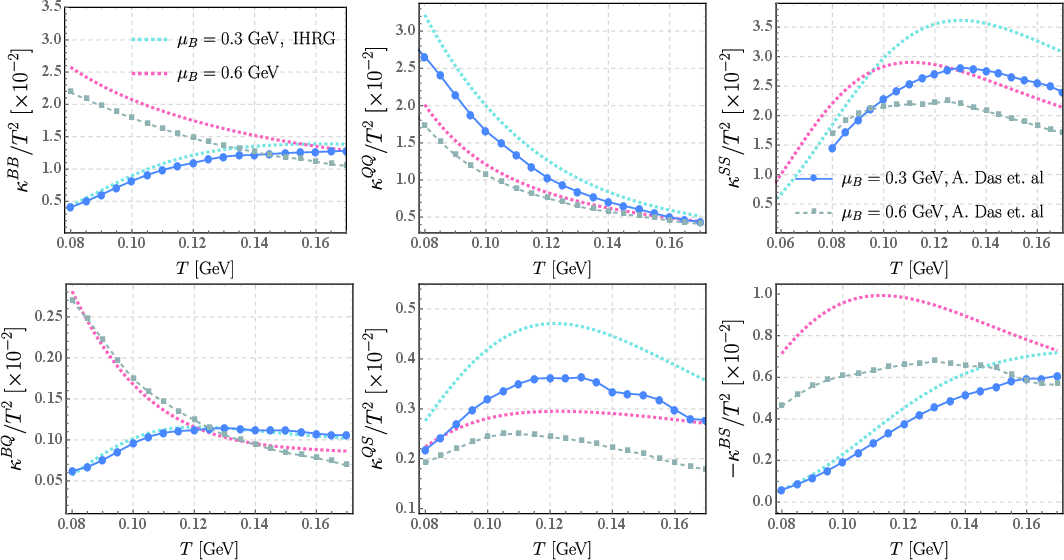
The investigation first focuses on the scaled diffusion coefficient matrix and its dependency on temperature and baryon chemical potential. The components of the matrix exhibit symmetry, and the RMFHRG model introduces notable corrections. The diagonal elements dominate, while the off-diagonal terms can reach comparable magnitudes, underscoring the significance of inter-charge couplings. Comparisons with results from other models confirm both quantitative and qualitative consistency, although discrepancies linked to quantum statistical effects and degrees of freedom persist [(2403.02705), Das et al].
Figure 1: The diffusion coefficient matrix results obtained by A. Das et al.
Thermoelectric and Magneto-Thermoelectric Effects
The study of the thermoelectric effect reveals the attenuating impact on baryon and strangeness diffusion when gradients in chemical potential result in electric field generation that in turn influences these diffusion processes. The reduction in inter-charge coupling brought about by the thermoelectric effect signals a weakened correlation between electric and baryon charge, while strangeness diffusion also becomes less pronounced under similar conditions.
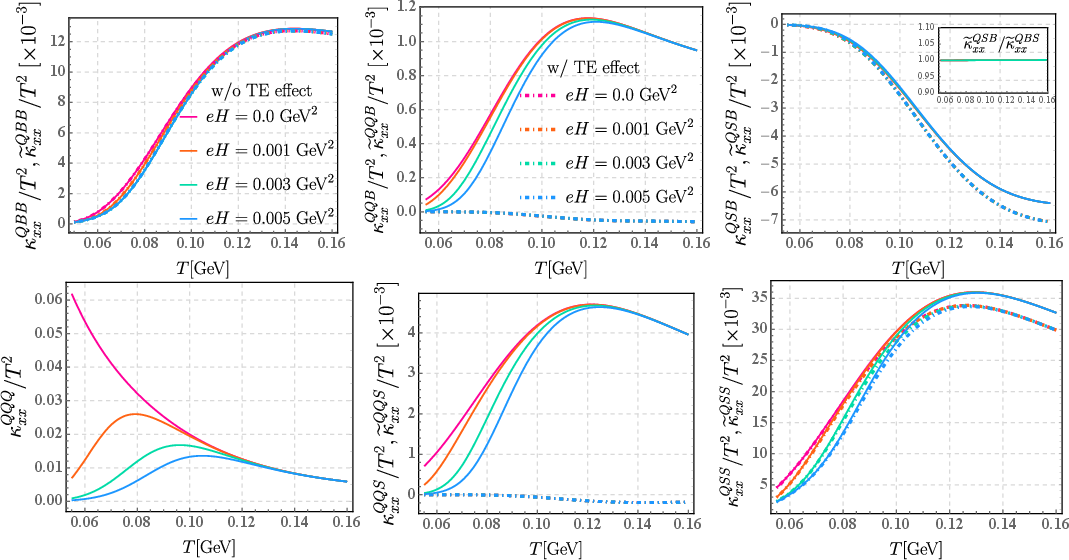
In the presence of magnetic fields, the matrix acquires new dimensions with Hall-like (transverse) diffusion coefficients emerging. The magneto-thermoelectric effect dramatically alters the landscape, particularly in the high baryon potential regime. Magnetic fields are noted to suppress strangeness diffusion notably.
Figure 2: Both complete scaled magnetic field-dependent diffusion coefficient matrix κxxQqq′ and magneto-thermoelectric modified diffusion coefficient matrix κxxQqq′′.
These effects are further complicated by transverse conditions—whether gradients manifest longitudinal or introduce transverse components. The paper meticulously quantifies variations under these conditions, establishing the relative steadiness of qualitative behaviors across the factors studied.
Implications and Future Directions
The implications of the research extend both theoretically and practically. The thermoelectric and magneto-thermoelectric impacts on conserved charge diffusion offer insights into modeling dissipative hydrodynamics in heavy-ion collisions. With increasing understanding of the interactions in baryon-rich environments, frameworks can be developed to incorporate these effects into broader collisional models.
Given the absence of conclusive experimental pinpointing for QCD phase transitions as described, such theoretical models and their extensions into magneto-hydrodynamic simulations may advance the understanding of the QCD phase diagram near critical endpoints. Future work could further explore the dynamic magnetic field profiles in collisions and integrate complex quantum statistical effects, refining model predictions in pursuit of experimental clarification.
Conclusion
The paper offers critical insights into the interplay between thermoelectric and diffusion processes in hadronic matter. By meticulously evaluating transport coefficients and their sensitivity to various factors, it establishes a coherent understanding of the responses of hot, dense matter in relativistic collision environments. Integrating these findings may prove foundational for enhanced phenomenological models of QCD matter and the continued exploration of fundamental interactions at high energy scales.