Using LLMs for the Extraction and Normalization of Product Attribute Values
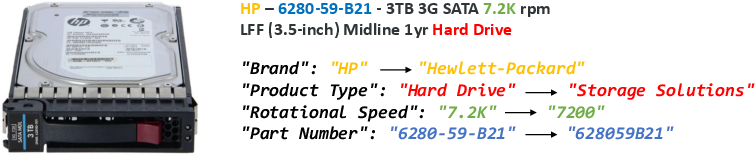
Abstract: Product offers on e-commerce websites often consist of a product title and a textual product description. In order to enable features such as faceted product search or to generate product comparison tables, it is necessary to extract structured attribute-value pairs from the unstructured product titles and descriptions and to normalize the extracted values to a single, unified scale for each attribute. This paper explores the potential of using LLMs, such as GPT-3.5 and GPT-4, to extract and normalize attribute values from product titles and descriptions. We experiment with different zero-shot and few-shot prompt templates for instructing LLMs to extract and normalize attribute-value pairs. We introduce the Web Data Commons - Product Attribute Value Extraction (WDC-PAVE) benchmark dataset for our experiments. WDC-PAVE consists of product offers from 59 different websites which provide schema.org annotations. The offers belong to five different product categories, each with a specific set of attributes. The dataset provides manually verified attribute-value pairs in two forms: (i) directly extracted values and (ii) normalized attribute values. The normalization of the attribute values requires systems to perform the following types of operations: name expansion, generalization, unit of measurement conversion, and string wrangling. Our experiments demonstrate that GPT-4 outperforms the PLM-based extraction methods SU-OpenTag, AVEQA, and MAVEQA by 10%, achieving an F1-score of 91%. For the extraction and normalization of product attribute values, GPT-4 achieves a similar performance to the extraction scenario, while being particularly strong at string wrangling and name expansion.

Paper Prompts
Sign up for free to create and run prompts on this paper using GPT-5.
Top Community Prompts
Collections
Sign up for free to add this paper to one or more collections.