Published 5 Jan 2024 in cs.LG and cs.AI | (2401.02602v2)
Abstract: The abilities of humans to understand the world in terms of cause and effect relationships, as well as to compress information into abstract concepts, are two hallmark features of human intelligence. These two topics have been studied in tandem in the literature under the rubric of causal abstractions theory. In practice, it remains an open problem how to best leverage abstraction theory in real-world causal inference tasks, where the true mechanisms are unknown and only limited data is available. In this paper, we develop a new family of causal abstractions by clustering variables and their domains. This approach refines and generalizes previous notions of abstractions to better accommodate individual causal distributions that are spawned by Pearl's causal hierarchy. We show that such abstractions are learnable in practical settings through Neural Causal Models (Xia et al., 2021), enabling the use of the deep learning toolkit to solve various challenging causal inference tasks -- identification, estimation, sampling -- at different levels of granularity. Finally, we integrate these results with representation learning to create more flexible abstractions, moving these results closer to practical applications. Our experiments support the theory and illustrate how to scale causal inferences to high-dimensional settings involving image data.
The paper proposes a novel neural framework that integrates causal abstraction by clustering variables and domains, enabling scalable inference across multiple causal layers.
It employs Neural Causal Models (NCMs) to reconstruct higher-level structural causal models from limited low-level data, ensuring abstraction consistency across Pearl’s causal hierarchy.
The approach demonstrates promising results in high-dimensional tasks such as image analysis, paving the way for advanced applications in AI explainability and generative modeling.
Summary of "Neural Causal Abstractions" (2401.02602)
Introduction to Neural Causal Abstractions
The paper "Neural Causal Abstractions" (2401.02602) explores the linking of human abilities of understanding the world in causal terms and abstracting information through causal abstraction theories. It addresses practical challenges in real-world causal inference tasks, such as those depicted in Pearl's causal hierarchy, by introducing a new family of causal abstractions. This is centered on clustering both variables and their domains, thus refining and expanding upon existing abstraction notions to accommodate individual causal distributions. Through the utilization of Neural Causal Models (NCMs), the approach integrates the causal hierarchy into neural networks, offering a structured technique to tackle complex causal inference tasks at varying granularities.
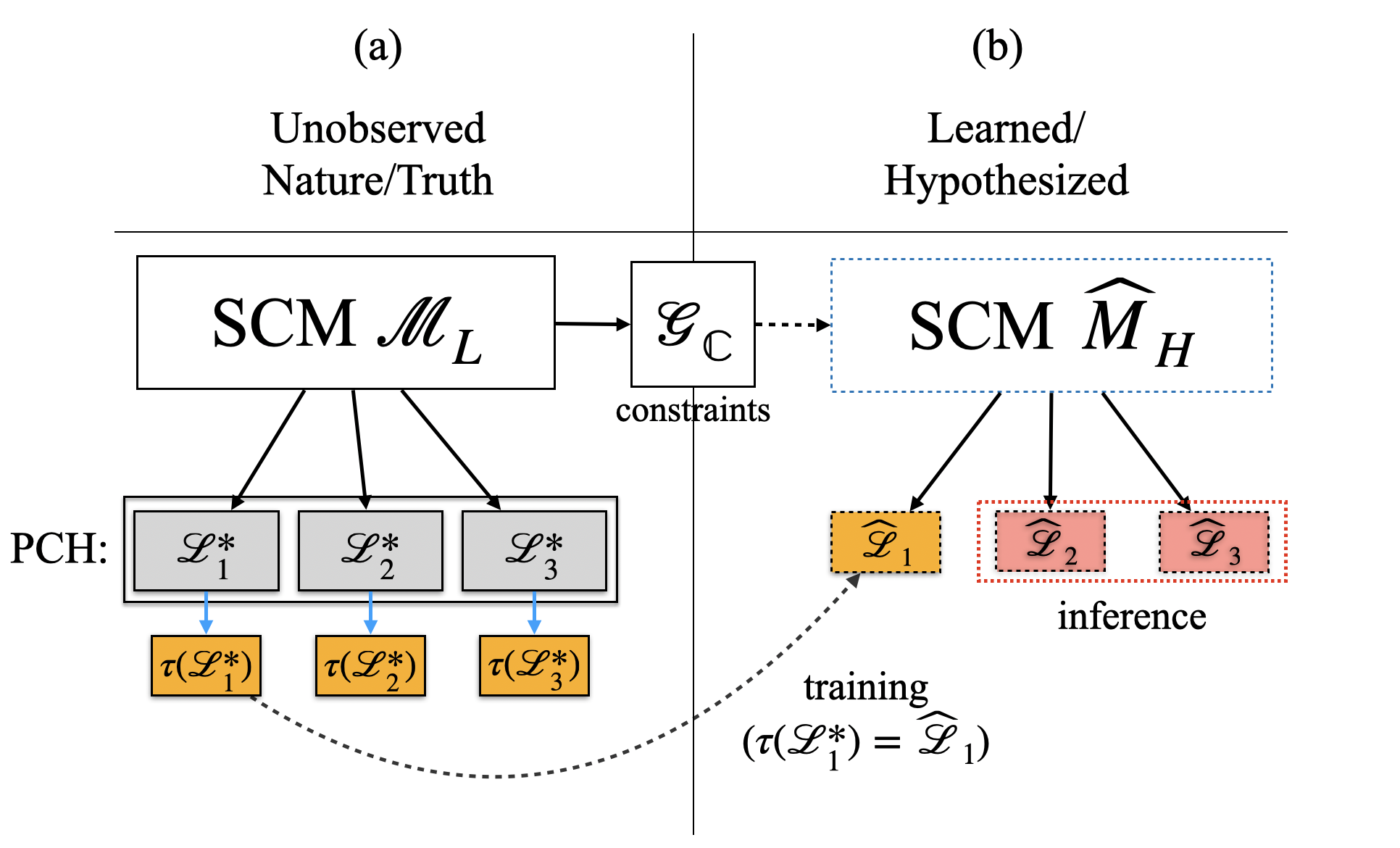
Figure 1: Overview of this paper. High-level SCMMH (right) is trained on available data to serve as an abstract proxy of the true, unobserved, low-level SCM $\cM_L$ (left).
The Concept of Constructive Abstractions
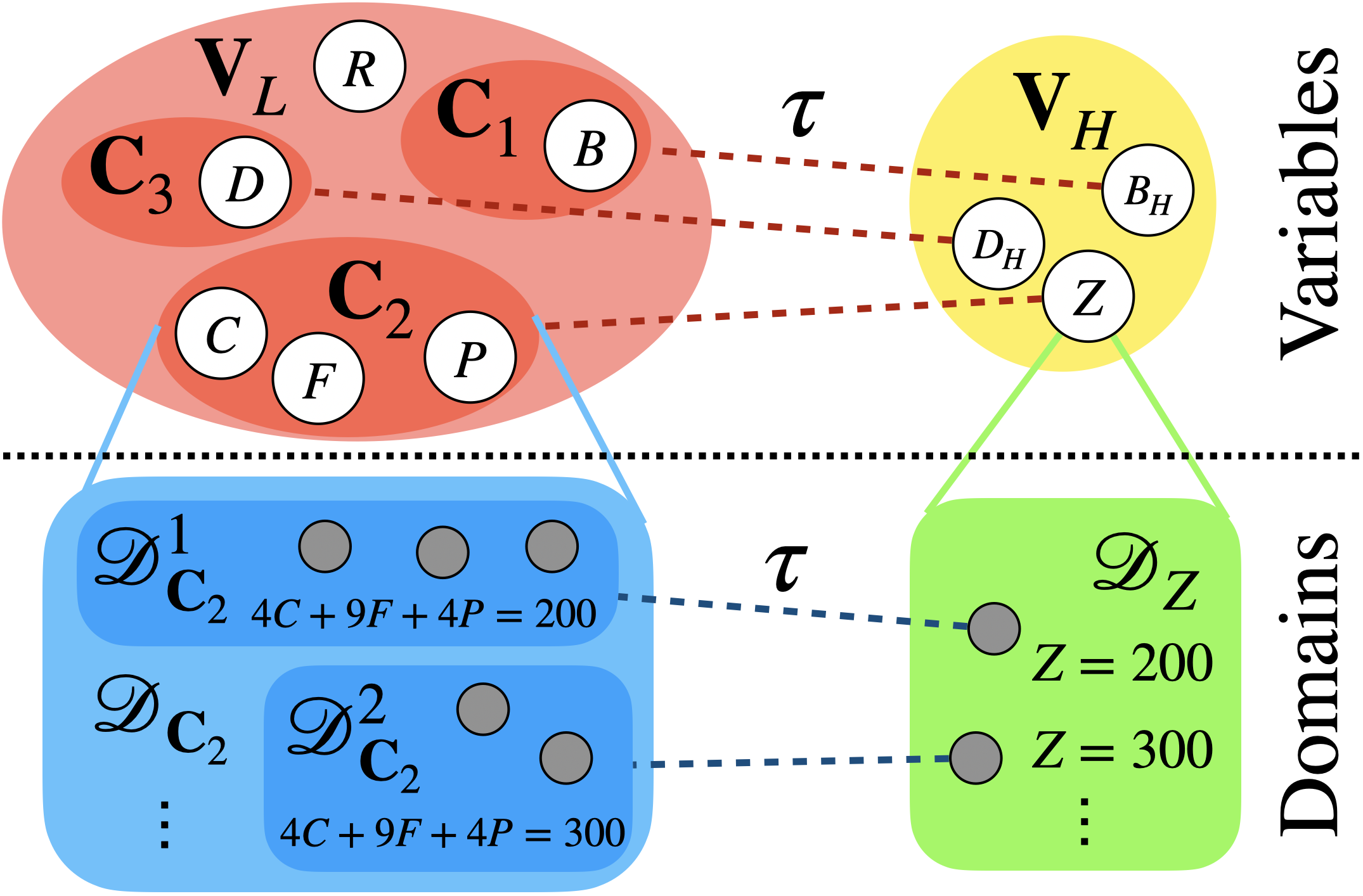
A pivotal aspect of the approach is the consideration of constructive abstraction functions defined concerning intervariable and intravariable clusters. Intervariable clusters permit grouping variables, minimizing unnecessary details—an example being clustering macronutrient variables into a single caloric variable. Intravariable clusters model inherent invariances within these groups, such as equivalences in caloric impact from different macronutrient combinations (Figure 2).
Figure 2: Example of a constructive abstraction function tau w.r.t.\ corresponding inter/intravariable clusters.
Layer-Specific Abstraction Consistency
On a more granular level, abstraction consistency over Pearl's layered causal hierarchy is achieved through consistency conditions across layers. The approach secures a model over high-level variables (VH) that is consistent with a model over low-level variables (VL) despite interventions or observations by maintaining consistency across translations mediated by the abstraction τ. This consistency is critical as it allows the translated outcomes of various layers to remain coherent and meaningful across abstraction levels, ensuring that higher-level models faithfully represent lower-level causal mechanisms while accommodating inherent variances.
Algorithmic Reconstruction of Abstractions
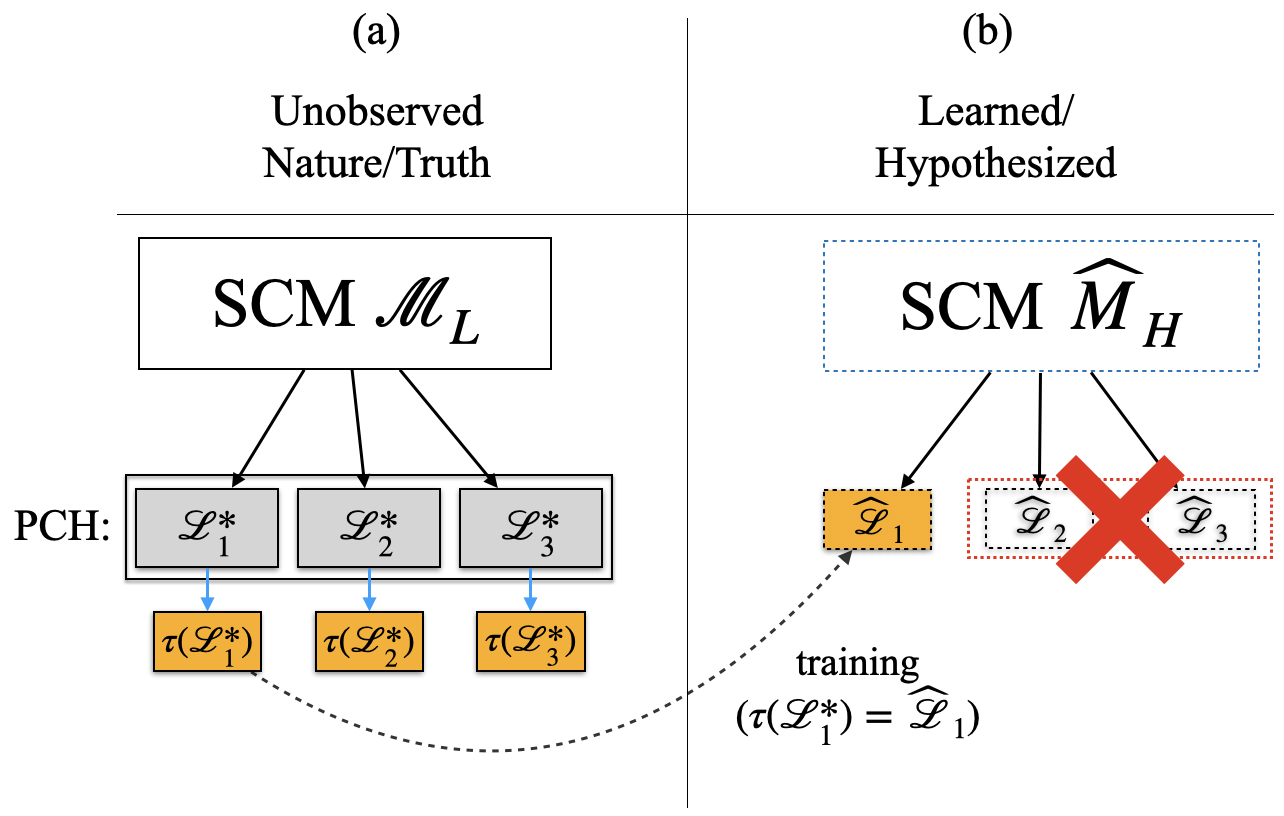
The work also devises techniques for effectively reconstructing meaningful higher-level SCMs from lower-level data, even when complete specifications of the low-level model are unavailable. A key proposition is employing NCMs for causal inference across abstractions, providing a neural framework that utilizes more manageable higher-level causal models gleaned from restricted data resolution. Through identifying and utilizing causal diagrams—abstractions of the lower level graph—it becomes feasible to ascertain queries across different settings, enhancing our pathway of reaching higher causal layers from lower observational data (Figure 3).
Figure 3: Illustration of the Abstract CHT. Without additional information, a high-level model hM_H trained to be $\cL_1$-tau consistent with cM_L is not guaranteed to be $\cL_2$ or $\cL_3$-tau consistent.
Learning Abstractions and Applications in Neural Frameworks
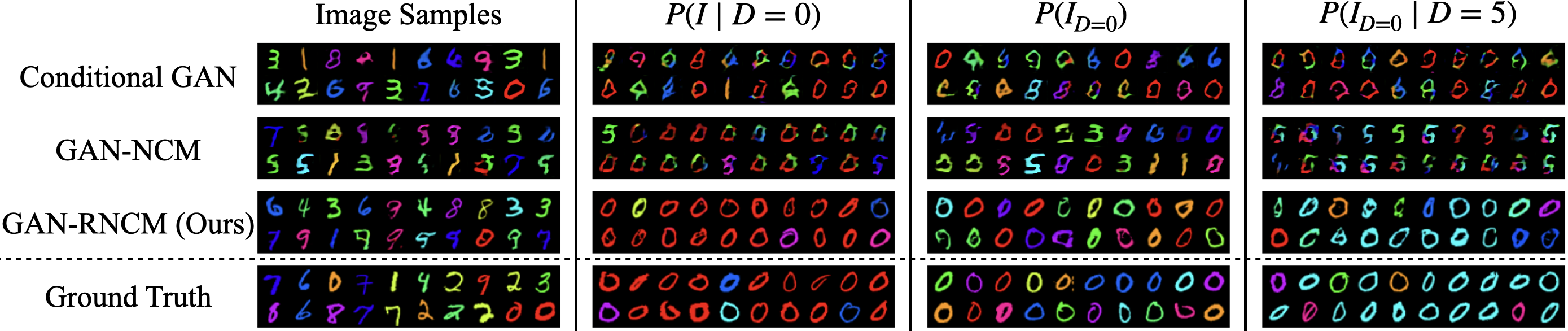
By integrating neural networks into the framework, concepts from representation learning become applicable. The paper introduces a representational NCM variant, which fosters learning variables and causal assumptions at a more abstract representation level. This is illustrated in application experiments involving high-dimensional data, such as image datasets (Figures 12 and 14), where representational learning provides flexible representations while ensuring high-level causal consistency.
Figure 4: Colored MNIST results. Samples from various causal queries (top) are collected from competing approaches (left), with the ground truth samples from the data generating model shown in the bottom row.
Conclusion and Implications
This novel integration of causal abstraction into neural systems posits a pathway for scalable, high-dimensional causal reasoning, broadening feasible applications within AI. Future development may leverage these structured abstraction techniques to streamline complex domains like generative models or AI explainability within intricate real-world systems.
Future Directions
The paper indicates potential expansions of these concepts to other domains, emphasizing improving structure in abstractions and enhancing efficiency in neural causal inference. Further research could explore refining these abstraction methods to capture more nuanced interactions, potentially advancing current understanding and application of causality in AI.
This summary highlights key concepts and contributions from the paper, illustrating the bridging of causal abstraction theories with neural computation techniques, facilitating more structured and transparent causal inference in artificial intelligence.