Papers
Topics
Authors
Recent
Search
2000 character limit reached

Noise robustness and metabolic load determine the principles of central dogma regulation

Published 20 Oct 2023 in q-bio.MN and physics.bio-ph | (2310.13803v4)

Abstract: The processes of gene expression are inherently stochastic, even for essential genes required for growth. How does the cell maximize fitness in light of noise? To answer this question, we build a mathematical model to explore the trade-off between metabolic load and growth robustness. The model predicts novel principles of central dogma regulation: Optimal protein expression levels for many genes are in vast overabundance. Essential genes are transcribed above a lower limit of one message per cell cycle. Gene expression is achieved by load balancing between transcription and translation. We present evidence that each of these novel regulatory principles is observed. These results reveal that robustness and metabolic load determine the global regulatory principles that govern gene expression processes, and these principles have broad implications for cellular function.

Definition Search Book Streamline Icon: https://streamlinehq.com
References (64)
  1. Nature 436, 588-92 (2005).
  2. Cell 166, 1282-1294.e18 (2016).
  3. Cell 165, 1493-1506 (2016).
  4. Proc Natl Acad Sci U S A 117, 18010-18017 (2020).
  5. Cell Syst 12, 924-944.e2 (2021).
  6. Science 309, 2010-3 (2005).
  7. Nature 441, 840-6 (2006).
  8. Science 329, 533-8 (2010).
  9. Nat Commun 10, 68 (2019).
  10. F. Crick, Central dogma of molecular biology. Nature 227, 561-3 (1970).
  11. Phys Rev Lett 84, 5447-50 (2000).
  12. Phys Rev Lett 97, 168302 (2006).
  13. Science 330, 1099-102 (2010).
  14. Phys. Rev. Lett. 107, 218101 (2011).
  15. mBio 12, e0256121 (2021).
  16. Cell Syst 12, 56-67.e6 (2021).
  17. Mol Syst Biol 16, e9828 (2020).
  18. Science 350, 1096-101 (2015).
  19. Nature 425, 737-41 (2003).
  20. Science 378, eabk2066 (2022).
  21. Nature 473, 337-42 (2011).
  22. PLoS Biol. 19, e3001416 (2021).
  23. Nat Commun 8, 1225 (2017).
  24. PLoS Genet 10, e1004556 (2014).
  25. Biochim Biophys Acta 9, 648-60 (1952).
  26. Cell 184, 4579-4592.e24 (2021).
  27. Phys Rev E 105, 014420 (2022).
  28. FASEB J 3, 2360-70 (1989).
  29. J Biol Chem 217, 947-57 (1955).
  30. Cell Syst 5, 283-294.e5 (2017).
  31. D. Gillespie, A rigorous derivation of the chemical master equation. Physica A 188, 404–425 (1992).
  32. D. T. Gillespie, Exact stochastic simulation of coupled chemical reactions. The Journal of Physical Chemistry 81, 2340–2361 (1977).
  33. Proc Natl Acad Sci U S A 99, 9697-702 (2002).
  34. Mol Syst Biol 11, 808 (2015).
  35. (2023).
  36. FEMS Yeast Res 16 (2016).
  37. Nat Commun 14, 1762 (2023).
  38. Cell Rep 14, 22-31 (2016).
  39. G3 (Bethesda) 10, 3229-3242 (2020).
  40. Philos Trans A Math Phys Eng Sci 374 (2016).
  41. R. Milo, What is the total number of protein molecules per cell volume? A call to rethink some published values. Bioessays 35, 1050-5 (2013).
  42. Mol Gen Genet 170, 137-44 (1979).
  43. PLoS One 5, e15442 (2010).
  44. Mol Cell Biol 19, 7357-68 (1999).
  45. Genome Res 13, 1863-72 (2003).
  46. Nucleic Acids Res 38, D750-3 (2010).
  47. Methods Mol Biol 416, 183-94 (2008).
  48. Sci Rep 9, 11005 (2019).
  49. Cell 10, 453-62 (1977).
  50. T. von der Haar, A quantitative estimation of the global translational activity in logarithmically growing yeast cells. BMC Syst Biol 2, 87 (2008).
  51. Nat Struct Mol Biol 15, 1263-71 (2008).
  52. BMC Genomics 9, 574 (2008).
  53. Nature 455, 1251-4 (2008).
  54. Science 347, 1260419 (2015).
  55. Nat Genet 23, 387-8 (1999).
  56. J Bacteriol 185, 5673-84 (2003).
  57. mBio 9 (2018).
  58. BMC Microbiol 4, 4 (2004).
  59. Nat Genet 38, 636-43 (2006).
  60. Science 297, 1183-6 (2002).
  61. Proc Natl Acad Sci U S A 99, 12795-800 (2002).
  62. C. R. Rao, Information and the accuracy attainable in the estimation of statistical parameters. Bulletin of Calcutta Mathematical Society 37, 81-91. (1945).
  63. Cell Syst 4, 495-504.e5 (2017).
  64. Scandinavian Journal of Statistics 41, 1051–1063 (2014).
Citations (2)

Summary

  • The paper presents the RLTO model that quantifies the balance between noise robustness and metabolic load to optimize protein expression levels.
  • The paper demonstrates that optimal protein expression often leads to overabundance, with essential low-expression genes expressed at high levels to counter stochastic noise.
  • The paper introduces the one-message rule and coordinated load balancing between transcription and translation, validated by experiments in yeast, E. coli, and human cells.

Noise Robustness and Metabolic Load: Principles of Central Dogma Regulation

Introduction

The study explores how noise robustness and metabolic load dictate the regulatory principles of the central dogma of molecular biology, focusing on the optimization of transcription and translation levels to maximize cellular fitness. The authors introduce the Robustness-Load Trade-Off (RLTO) model, which predicts that optimal protein expression often results in a vast overabundance, proposes a "one-message rule" for transcription, and examines the intricate balance between transcription and translation processes.

RLTO Model Formulation

The RLTO model is designed to evaluate how cells manage protein expression given the stochastic nature of gene expression processes and the associated metabolic costs. The model includes several salient features:

  1. Stochastic Protein Levels: The model assumes that protein levels are subject to stochastic variations, influencing single-cell growth rates.
  2. Metabolic Load Considerations: Gene transcription and translation impose a metabolic load on the cell, with transcription incurring a significant biosynthetic cost.
  3. High-Dimensional Fitness Landscape: The fitness landscape is characterized by its asymmetry, with a small metabolic cost for overabundance and a high cost for growth arrest due to underabundance.

The model describes an optimization problem where cells balance metabolic load and growth robustness by carefully regulating transcriptional and translational activities.

Optimal Protein Overabundance

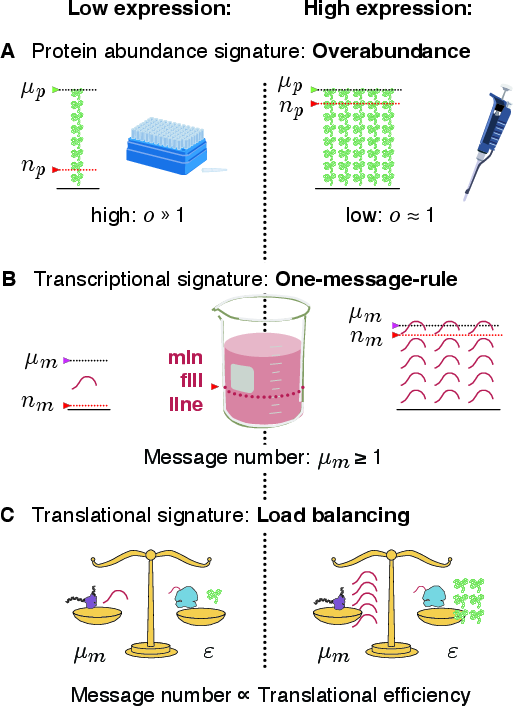
The model predicts that optimal expression levels for many genes result in a protein overabundance, a phenomenon attributed to the asymmetric fitness landscape. Low-expression essential genes exhibit high overabundance, while high-expression genes do so to a lesser extent. This prediction aligns with experimental observations where essential proteins exhibit significant robustness to depletion. Figure 1

Figure 1: Central dogma regulatory principles. Panel A: Overabundance. Low-expression essential genes are expressed with high overabundance; whereas, high-expression essential genes are expressed with low overabundance.

One-Message Rule and Load Balancing

One-Message Rule

The RLTO model predicts a "one-message rule," positing that essential genes must be transcribed at least once per cell cycle to ensure growth robustness. This transcriptional floor is necessary to mitigate the noise associated with low-expression genes, ensuring adequate protein production amid stochastic gene expression. Figure 2

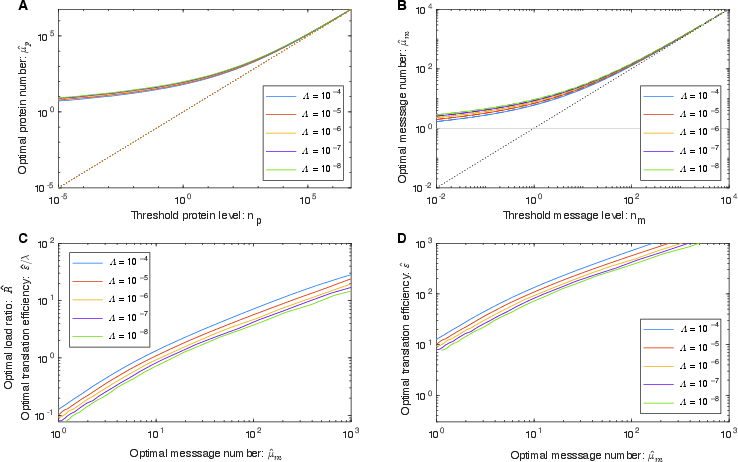
Figure 2: Four perspectives on load balancing. Panel B: Message number versus message threshold.

Load Balancing

Load balancing is a principle where transcription and translation are adjusted to maintain an optimal expression level. The RLTO model suggests that the optimal translation efficiency scales linearly with the message number, resulting in a coordinated modulation of transcription and translation, especially in eukaryotic systems. This strategy reduces noise, particularly for low-expression genes, and is supported by observations in yeast and mammalian cells but not in E. coli, where translation efficiency remains roughly constant due to hypothesized ribosome-per-message limits. Figure 3

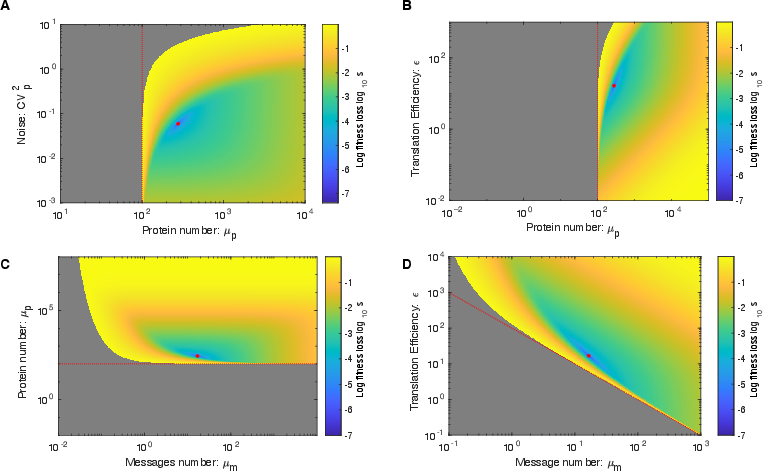
Figure 3: Four perspectives on the fitness landscape. Panel D: Message number versus translation efficiency.

Experimental Verification and Implications

The predictions of the RLTO model have been corroborated by experimental data across different organisms, including yeast, E. coli, and human cells. The model's ability to anticipate overabundance and transcriptional rules reflects its robustness. Additionally, the implications extend beyond understanding basic biological processes, offering insights into targeting low-expression proteins for therapeutic interventions. However, the high robustness of low-expression proteins makes them challenging drug targets, highlighting the necessity for strategies targeting more highly expressed proteins.

Conclusion

The study proficiently combines theoretical modeling with empirical observations, offering a comprehensive view of how noise and metabolic constraints shape gene regulatory mechanisms. The RLTO model successfully elucidates essential principles of central dogma regulation, emphasizing the role of protein overabundance, transcriptional floors, and load balancing in optimizing cellular fitness. The insights gained pave the way for future explorations into metabolic regulation and genetic engineering applications. Figure 4

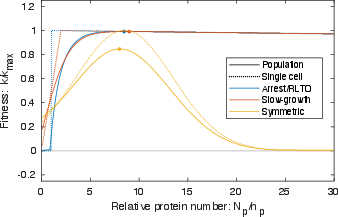
Figure 4: Exploring the mathematical mechanism of overabundance. Both the arrest and slow-growth models are optimized far beyond the threshold expression levels due to the asymmetric fitness landscape.

Paper to Video (Beta)

No one has generated a video about this paper yet.

Whiteboard

No one has generated a whiteboard explanation for this paper yet.

Open Problems

We haven't generated a list of open problems mentioned in this paper yet.

Collections

Sign up for free to add this paper to one or more collections.

Tweets

Sign up for free to view the 1 tweet with 0 likes about this paper.