- The paper demonstrates that using GANs, particularly WGAN and ProgGAN, significantly improves map realism compared to traditional PCG methods.
- The study evaluates various GAN architectures, revealing ProgGAN's efficiency and high-resolution detail generation with complex landscapes.
- The work emphasizes effective dataset handling from DEM files by augmenting heightmaps to optimize the GAN training process.
GAN-Based Content Generation of Maps for Strategy Games
Introduction
The paper "GAN-Based Content Generation of Maps for Strategy Games" (2301.02874) addresses the challenge of generating realistic and visually appealing maps for strategy games using Generative Adversarial Networks (GANs). Traditional Procedural Content Generation (PCG) methods, like Perlin noise, often produce maps that lack natural and complex features. To counter this, the authors propose a GAN-based model capable of generating maps with intricate landscape details, enhancing the strategic depth of gameplay.
GAN Architectures Explored
The study evaluates several GAN architectures, including DCGAN, WGAN, ProgGAN, and VAE + WGAN, to identify the most effective approach for map generation.
DCGAN
DCGAN serves as the baseline model, employing architectural modifications such as strided convolutions instead of pooling layers and batch normalization to stabilize learning. Despite these enhancements, DCGAN is limited by issues like mode collapse and vanishing gradients, resulting in lower fidelity map outputs.
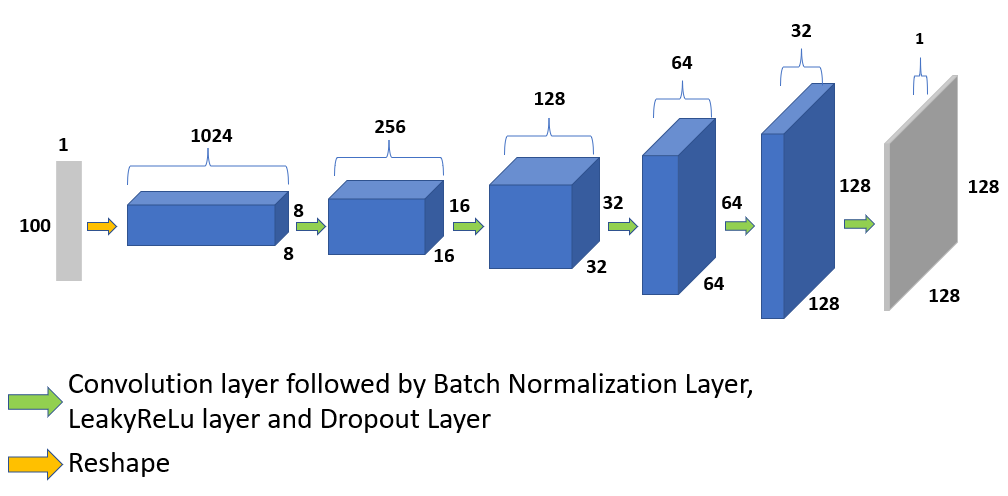
Figure 1: DCGAN's Generator Model
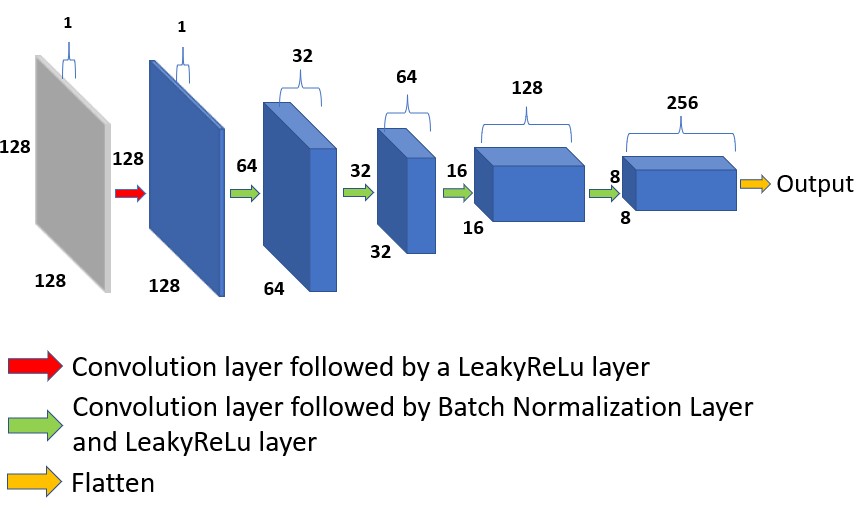
Figure 2: DCGAN's Discriminator Model
WGAN
WGAN introduces a Wasserstein loss function that provides a stable training process by facilitating a continuous improvement of the generator even when the discriminator reaches optimality. This model significantly outperforms DCGAN by generating maps with recognizable geographic features, such as peninsulas and mountain ranges.
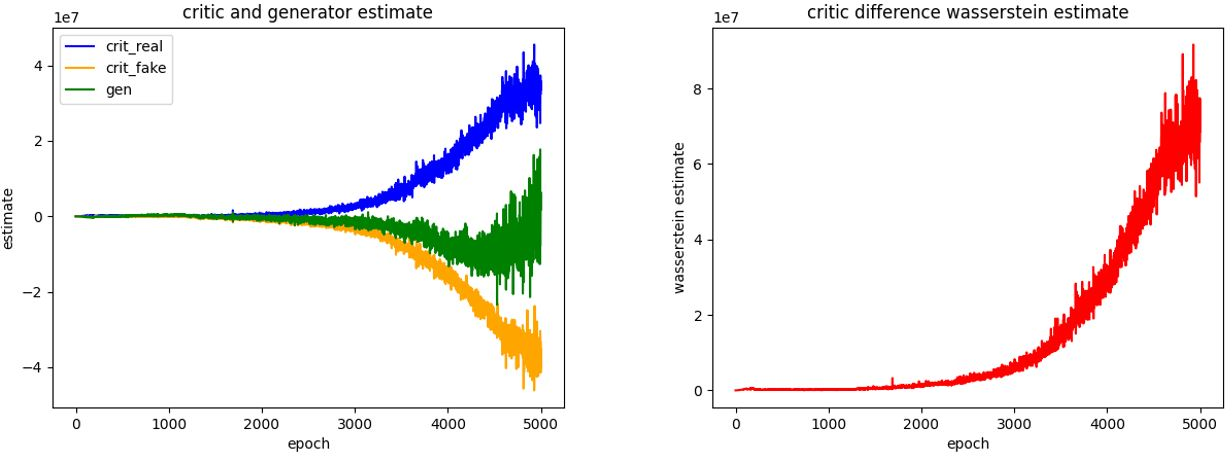
Figure 3: Left: Wasserstein estimate for C real and fake images and G generated images during the training phase; Right: Difference between the C Wasserstein estimate of the real images and the fake images
ProgGAN
ProgGAN employs a technique of progressively increasing the image resolution during training, allowing the generator and discriminator to learn fine-grained details incrementally. This approach yields high-quality maps in reduced training times, maintaining the structural complexity found in real-world landscapes.
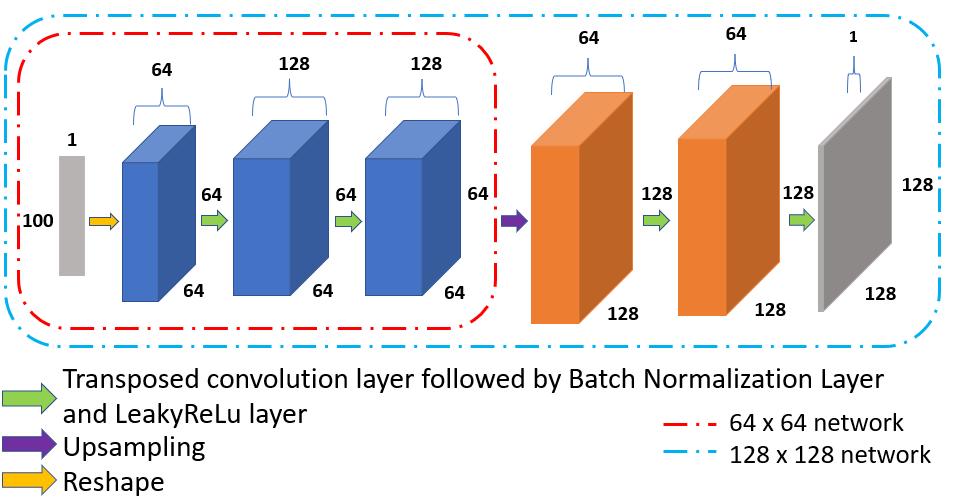
Figure 4: ProgGAN's Generator Model
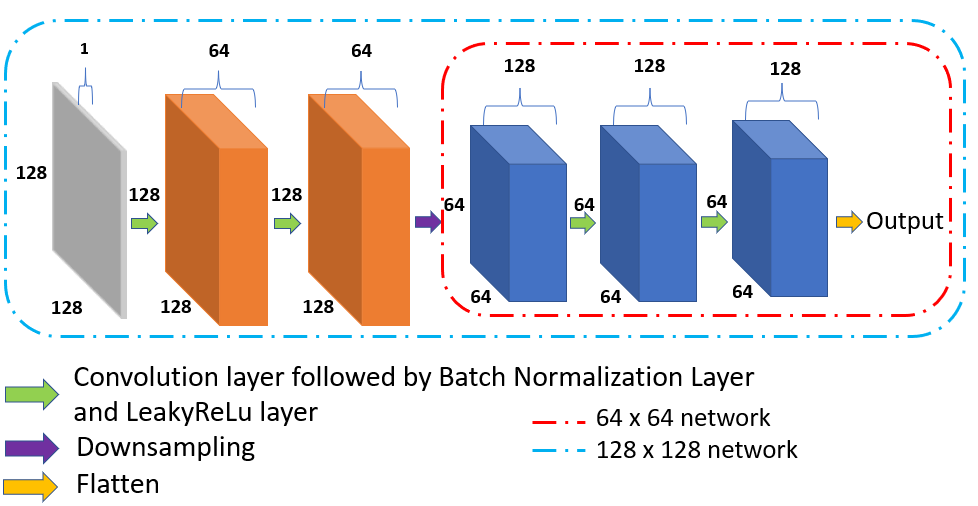
Figure 5: ProgGAN's Critic Model
VAE + WGAN
The combination of Variational Autoencoders (VAE) and WGAN aims to leverage the encoder's ability to capture latent representations of the dataset to improve WGAN's performance. Although conceptually promising, this method did not meet expectations due to the sub-optimal quality of generated maps.
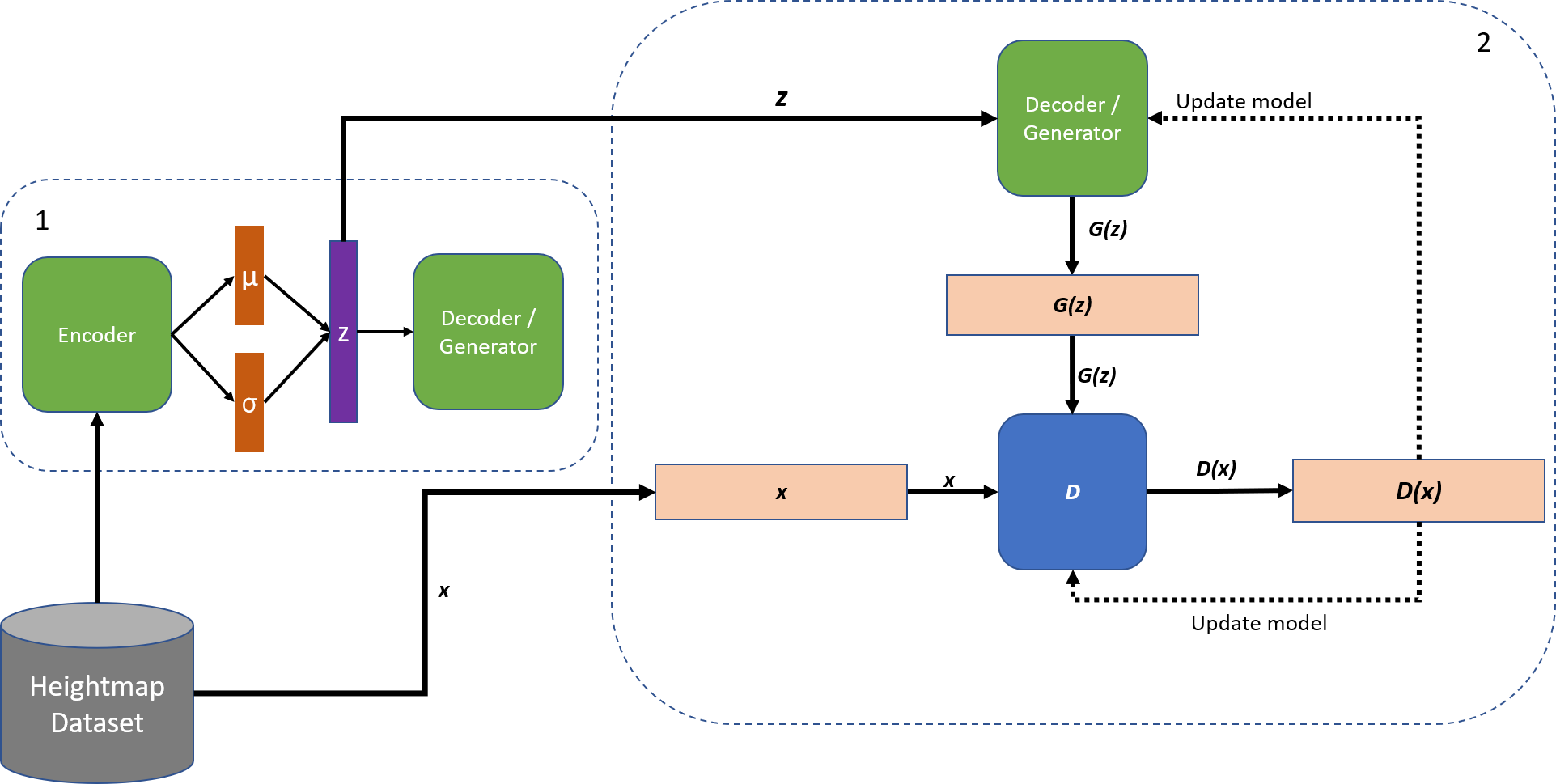
Figure 6: VAE + WGAN architecture. Train the VAE (1) to learn the representation of the Heightmap dataset. Then use the sample vector z created from the distribution's mean and standard deviation to train the WGAN (2). The VAE's decoder will be the generator of the WGAN.
Dataset and Preprocessing
A key component of the research involves the creation of a dataset of heightmaps derived from Digital Elevation Model (DEM) files with global coverage. The preprocessing steps include adjusting image brightness and applying augmentation techniques to increase dataset size without introducing artifacts that might mislead the GAN training process.
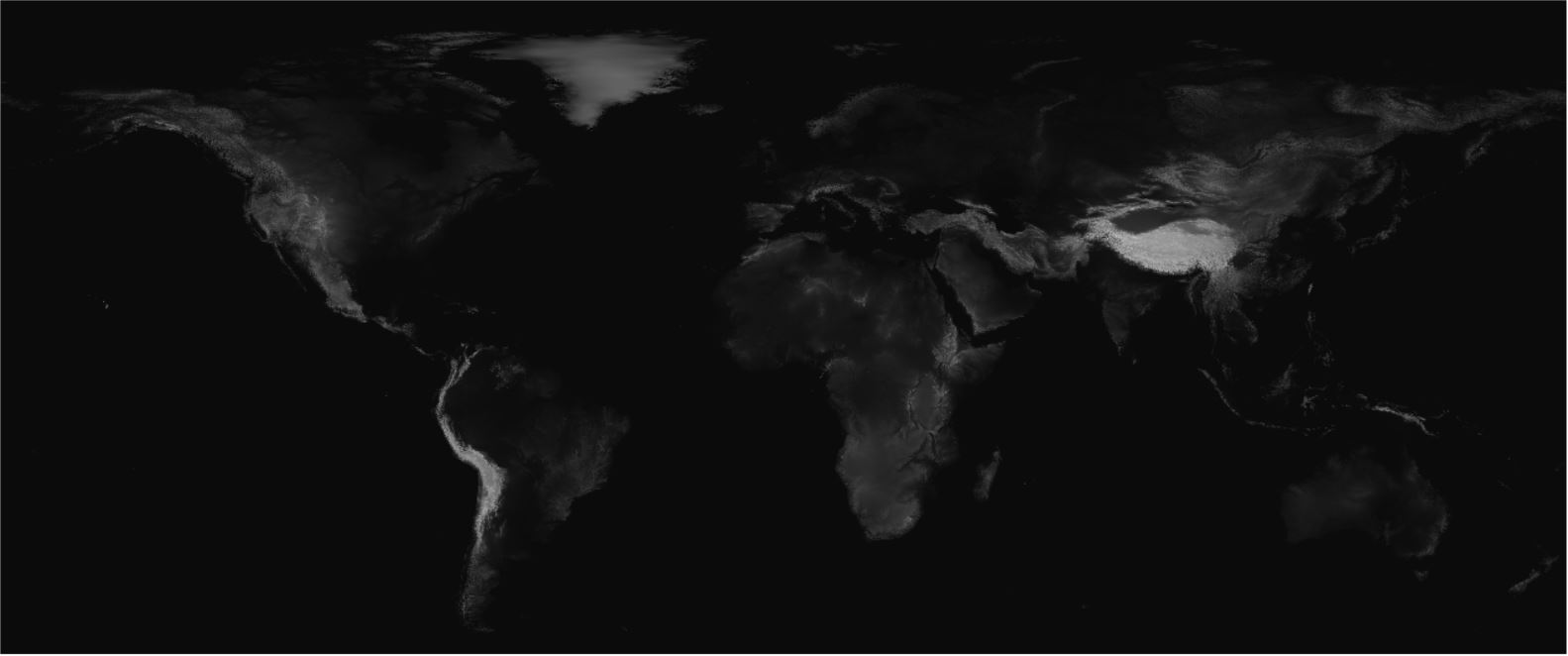
Figure 7: Heightmap of the planet Earth after joining the DEM files together
Results and Discussion
Through exhaustive experimentation, the authors conclude that while DCGAN and VAE + WGAN provide lesser quality outputs, WGAN and ProgGAN are highly effective for this task. ProgGAN, in particular, demonstrates superior training efficiency and the ability to produce maps with high resolution and diverse features.
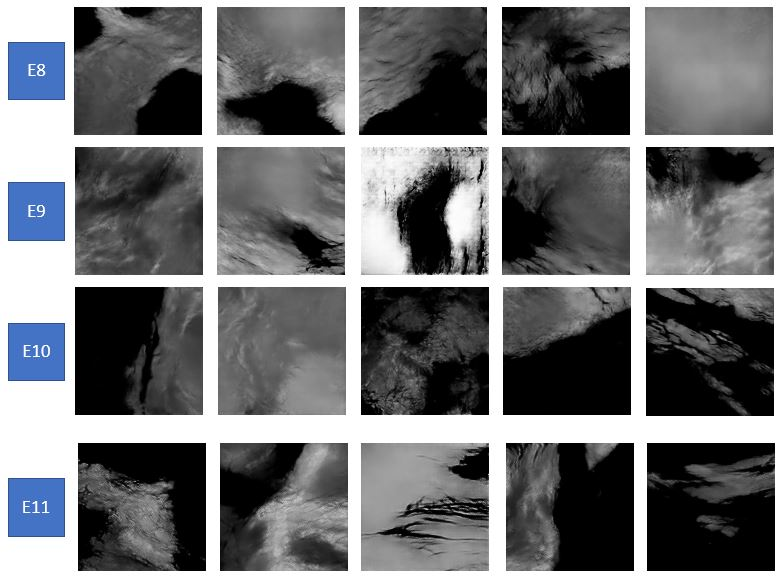
Figure 8: Images generated by WGAN after training, in the several experiments
Conclusion
The research successfully demonstrates that GANs, particularly WGAN and ProgGAN, are viable tools for generating complex and realistic maps for strategy games. These models not only enhance the visual appeal but also contribute to a richer strategic gameplay experience. Future work could explore further optimizing these models and scaling to higher resolutions, potentially utilizing more powerful hardware resources.