- The paper establishes a framework combining DFT and Eliashberg theory to predict superconductivity in hydrogen-rich compounds, validated by experimental breakthroughs in SH3, LaH10, and YH9.
- It shows that high-pressure experiments confirm superconductivity near room temperature, with critical temperatures reaching up to 260K under megabar pressures.
- The study outlines future challenges in stabilizing these superconductors at lower pressures, suggesting further computational and experimental efforts may unlock ambient superconductivity.
Room Temperature Superconductivity: The Roles of Theory and Materials Design
This document presents a detailed analysis of the theoretical and experimental advancements in achieving room-temperature superconductivity (RTS). The study focuses on recent developments within the sphere of superconductivity, particularly concerning hydrogen-rich compounds under high pressure. It encompasses a thorough overview of the milestones that have been achieved through a theoretical design and subsequent experimental validation.
Theoretical Foundations and Computational Advances
The primary theoretical framework for understanding superconductivity was established by the BCS theory in 1957, which proposed electron pairing mediated by phonons. Subsequent decades brought the Migdal-Eliashberg theory, extending superconductivity understanding to account for strong coupling effects up to the modern Density Functional Theory (DFT) implementations. DFT, particularly when combined with Eliashberg theory, allows for the prediction of electron-phonon coupling parameters and critical temperatures (Tc) for specific materials. The formulation of the superconducting density functional theory (SCDFT) extended these capabilities, providing a rigorous first-principles method to predict superconducting properties without empirical input.
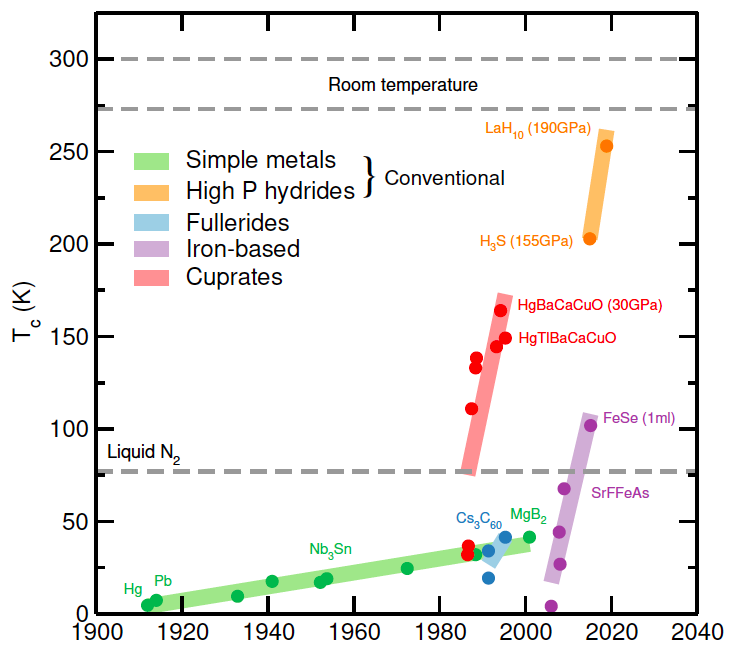
Figure 1: A plot from the discovery of superconductivity in Hg in 1911 covering major advances in maximum Tc over the years, illustrating the progression toward current hydride superconductors.
Experimental Milestones and Material Discovery
The exploration of hydrogen-rich compounds under megabar pressures has led to the discovery of superconductors with Tc approaching room temperature. The three compelling discoveries highlighted are hydrogen sulfide (SH3), lanthanum hydride (LaH10), and yttrium hydride (YH9). These hydrides, achieved through computational predictions validated by experimentation, exhibit superconductivity at remarkably high temperatures:
Implications and Future Directions
The implications of these developments are profound for both theoretical research and practical applications. The progress demonstrated here signifies a promising pathway toward achieving superconductivity at ambient conditions, presenting new opportunities for revolutionary applications in technology and energy.
The fundamental challenges remain multifaceted, requiring advances in understanding the coupling mechanisms in hydrogen-rich compounds and the development of techniques for synthesizing stable phases at lower pressures. Continued exploration through computational techniques and high-pressure experiments is expected to yield further insights and discoveries in the field.
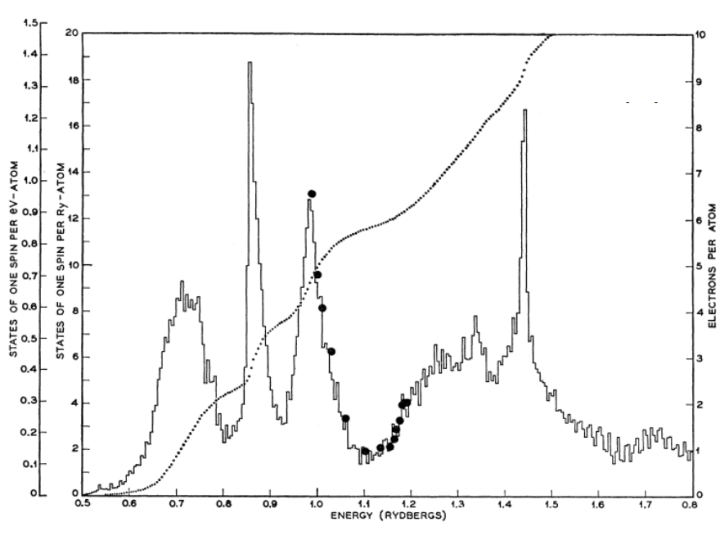
Figure 3: McMillan's plot illustrating the remarkable agreement between experimental values and calculations, providing a foundation for understanding superconductivity in metal alloys.
Conclusion
The advancement toward room-temperature superconductivity is exemplified by the synthesis and characterization of compressed metal hydrides, substantiated by theoretical predictions and experimental validations. Researchers continue to face challenges related to stability, material selection, and pressure requirements. However, with ongoing innovations in computational materials design and experimental techniques, the realization of practical superconductors that operate at ambient conditions remains an attainable goal.
The collective efforts within this domain highlight the transformative potential of integrating theoretical frameworks with experimental breakthroughs, ushering in a new era of superconducting materials with unprecedented properties and applications.