Motion Artifacts Correction from Single-Channel EEG and fNIRS Signals using Novel Wavelet Packet Decomposition in Combination with Canonical Correlation Analysis
Abstract: The electroencephalogram (EEG) and functional near-infrared spectroscopy (fNIRS) signals, highly non-stationary in nature, greatly suffers from motion artifacts while recorded using wearable sensors. This paper proposes two robust methods: i) Wavelet packet decomposition (WPD), and ii) WPD in combination with canonical correlation analysis (WPD-CCA), for motion artifact correction from single-channel EEG and fNIRS signals. The efficacy of these proposed techniques is tested using a benchmark dataset and the performance of the proposed methods is measured using two well-established performance matrices: i) Difference in the signal to noise ratio (ΔSNR) and ii) Percentage reduction in motion artifacts (η). The proposed WPD-based single-stage motion artifacts correction technique produces the highest average ΔSNR (29.44 dB) when db2 wavelet packet is incorporated whereas the greatest average η (53.48%) is obtained using db1 wavelet packet for all the available 23 EEG recordings. Our proposed two-stage motion artifacts correction technique i.e. the WPD-CCA method utilizing db1 wavelet packet has shown the best denoising performance producing an average ΔSNR and η values of 30.76 dB and 59.51%, respectively for all the EEG recordings. On the other hand, the two-stage motion artifacts removal technique i.e. WPD-CCA has produced the best average ΔSNR (16.55 dB, utilizing db1 wavelet packet) and largest average η (41.40%, using fk8 wavelet packet). The highest average ΔSNR and η using single-stage artifacts removal techniques (WPD) are found as 16.11 dB and 26.40%, respectively for all the fNIRS signals using fk4 wavelet packet. In both EEG and fNIRS modalities, the percentage reduction in motion artifacts increases by 11.28% and 56.82%, respectively when two-stage WPD-CCA techniques are employed.
Paper Prompts
Sign up for free to create and run prompts on this paper using GPT-5.
Top Community Prompts
Explain it Like I'm 14
Overview
This paper is about cleaning up brain signals recorded by wearable devices so doctors and computers can understand them better. When people move, the signals get messy—these unwanted wiggles are called “motion artifacts.” The authors propose two new ways to remove these artifacts from two kinds of brain signals:
- EEG: electrical activity from the scalp
- fNIRS: changes in blood oxygen in the brain using harmless infrared light
Their goal is to make single-channel recordings (from just one sensor) much cleaner without needing lots of sensors.
What questions did the researchers ask?
They focused on simple versions of two big questions:
- How can we remove movement-related mess from single-channel EEG and fNIRS recordings?
- Do our new methods make the signals clearer and closer to the true brain activity compared to other techniques?
How did they do it? (In everyday language)
First, two key ideas:
- Motion artifacts: Imagine you’re trying to listen to a quiet song, but someone keeps bumping the microphone. The recorded sound will have sudden spikes or weird patterns that aren’t part of the actual music. That’s what motion artifacts are in brain signals.
- Single channel: Many “smart” cleaning tools need multiple microphones (or sensors) to separate noise from the real sound. The challenge here is cleaning signals from only one sensor.
They proposed two methods:
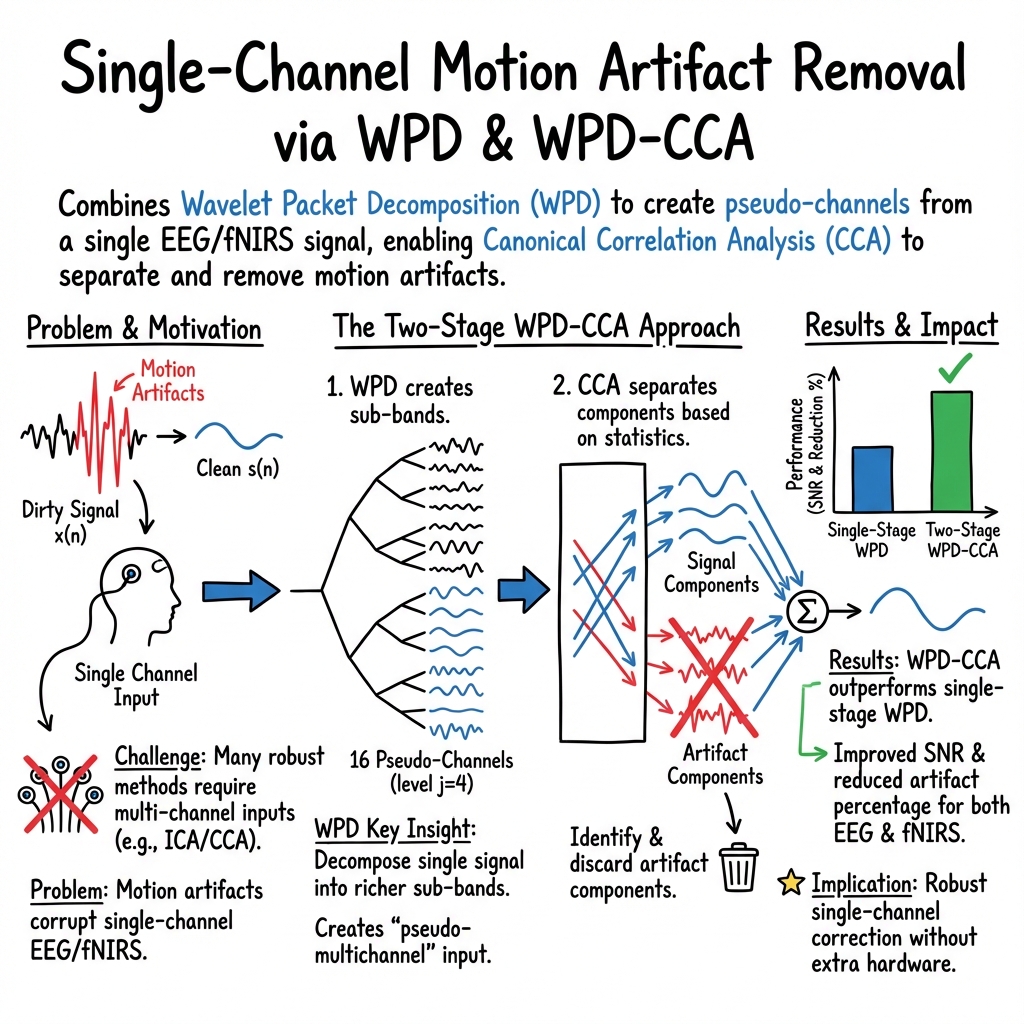
- Wavelet Packet Decomposition (WPD)
- Think of a song split into bass, mid, and treble. WPD breaks a signal into many “sound bands” (sub-bands), each holding different frequency parts.
- The authors split each signal into 16 sub-bands (like 16 equalizers).
- Different “wavelet families” (like different types of equalizers) were tested: Daubechies (db), Symlets (sym), Coiflets (coif), and Fejer-Korovkin (fk). Each has versions like db1, db2, db3, etc., which are just slightly different settings.
- WPD combined with Canonical Correlation Analysis (WPD-CCA)
- CCA is like a super tool that compares multiple versions of a signal to find the parts that most consistently belong together. It can separate “true signal” from “noise” if given multiple inputs.
- But we only have one channel! So the trick is: use WPD to create 16 sub-bands (pretend these are 16 channels), then feed them to CCA. CCA picks out the components that look like motion artifacts, and we remove those before reconstructing the clean signal.
Extra steps they used:
- Preprocessing: They reduced power-line hum (like electrical buzz at 50 Hz) and fixed slow drifts in the signal using standard filtering and baseline correction.
- Ground truth: The dataset included two close-by sensors: one was moved on purpose (noisy), and one was kept still (clean “ground truth”). They used the clean signal to check if removing a component actually made the noisy signal more similar to the clean one.
How they measured success:
- ASNR (a difference in signal-to-noise ratio): Higher numbers mean the signal became clearer after cleaning.
- n (percentage reduction in motion artifacts): This tells how much the noisy signal became more like the clean one (higher is better).
What did they find, and why is it important?
The main results across real recordings:
- EEG (23 recordings):
- WPD alone: Best clarity (ASNR) with db2; best artifact reduction (n) with db1.
- WPD-CCA (two-stage): Best overall with db1. ASNR ≈ 30.76 dB; n ≈ 59.51%.
- Improvement using WPD-CCA over WPD: About 11% more artifact reduction and higher clarity.
- fNIRS (16 recordings):
- WPD alone: Best clarity and artifact reduction with fk4. ASNR ≈ 16.11 dB; n ≈ 26.40%.
- WPD-CCA (two-stage): Best clarity with db1 (ASNR ≈ 16.55 dB); best artifact reduction with fk8 (n ≈ 41.40%).
- Improvement using WPD-CCA over WPD: About 57% more artifact reduction and higher clarity.
What this means:
- The two-stage method (WPD-CCA) consistently cleans signals better than WPD alone.
- It works well even with only one sensor, which is great for simple, wearable devices.
Why does this matter?
Cleaner brain signals help:
- Doctors make better diagnoses (for example, epilepsy detection in EEG)
- Researchers study thinking and emotions more accurately
- Brain-computer interfaces make more reliable decisions
- Everyday wearable devices provide better health monitoring without forcing people to sit completely still
These methods can also be used when there’s no “clean reference” signal available. The authors showed a simple approach (discarding the lowest-frequency sub-band) still improves EEG signals in many cases.
Final takeaways and impact
- The paper introduces new, practical ways to remove motion artifacts from single-channel brain signals using smart signal-splitting (WPD) and clever comparison (CCA).
- The two-stage WPD-CCA method is especially powerful—it turns one signal into many sub-bands, applies CCA to find and remove noise, and then reconstructs a cleaner signal.
- It outperforms many existing techniques and is well-suited for wearable, real-world use where people naturally move.
- This can lead to better medical tools, more comfortable monitoring, and more reliable brain-based technologies.
Knowledge Gaps
Knowledge gaps, limitations, and open questions
The following list highlights what remains missing, uncertain, or unexplored in the study, framed to guide future research:
- Reliance on “reference ground truth” signals to select motion-corrupted components: develop a fully unsupervised, ground-truth-free criterion for identifying and discarding artifact sub-bands/CCA components in single-channel EEG and fNIRS.
- Incomplete strategy for ground-truth-free cleaning in fNIRS: the paper defers an analogous approach to EEG’s S15-removal for fNIRS to future work without specifying rules; design and validate fNIRS-specific component selection criteria that avoid removing genuine hemodynamic signals.
- Risk of removing true physiological signal: the ad hoc removal of low-frequency approximation sub-bands (e.g., S15) may excise legitimate EEG slow oscillations or fNIRS hemodynamic content; quantify signal preservation using task-evoked responses and domain-specific biomarkers (ERPs, HbO/HbR).
- Lack of real-world evaluation without ground truth: ASNR and n depend on reference signals; establish alternative validation metrics (e.g., task performance, test–retest reliability, spectral fidelity, physiological plausibility) for datasets lacking ground truth.
- No statistical inference: provide inferential statistics (confidence intervals, hypothesis tests, effect sizes) to assess whether observed ASNR/n improvements are statistically significant across recordings and modalities.
- Parameter selection is heuristic: systematically optimize and report sensitivity to WPD level (j), wavelet family, vanishing moments, decomposition depth, and CCA lag structure; derive data-driven or adaptive selection rules.
- CCA lag choice is fixed (y(t)=x(t−1)+x(t+1)): explore and tune lag structures (single/multiple lags, adaptive lag lengths per modality/sampling rate), and assess sensitivity in low-rate fNIRS data.
- Preprocessing pipeline may be inappropriate for fNIRS: justify or correct the use of a 50 Hz notch filter for signals sampled at 25 Hz (above Nyquist); quantify the impact of baseline correction (polynomial order) on physiological content.
- Generalizability to naturalistic movement: evaluate performance on continuous, spontaneous motion scenarios (not periodic, scripted movement) and across diverse activities typical in wearable use.
- Limited dataset scope: extend testing beyond one benchmark dataset (23 EEG, 16 fNIRS recordings) to multiple cohorts, sensors, montages, and acquisition conditions; report cross-dataset generalization.
- Handling of non-motion artifacts is unaddressed in evaluation: explicitly assess the methods’ effectiveness against heartbeat, respiration, Mayer waves (fNIRS), and GA/PA (EEG) and their interactions with motion.
- Wavelet selection remains ad hoc: propose principled criteria or automated selection (e.g., Bayesian optimization, cross-validation, signal morphology metrics) rather than manual scanning of families/moments.
- Component rejection decision-making relies on correlation improvements with ground truth and visual inspection: formalize objective metrics (e.g., kurtosis, skewness, local variance, temporal sparsity) and thresholds for component rejection.
- Limited multimodal exploitation: explore joint EEG–fNIRS denoising strategies that leverage cross-modal redundancy/constraints (e.g., co-CCA, joint decomposition) instead of treating modalities separately.
- CCA assumptions may not hold on WPD-generated “channels”: rigorously test the impact of violating linear/square/stationary mixing assumptions when sub-bands serve as pseudo-channels; compare to alternate BSS methods suited for single-channel signals (e.g., CEEMDAN, SSA variants, nonlinear ICA).
- No head-to-head comparison with contemporary baselines: benchmark against recent state-of-the-art denoisers (including deep learning-based approaches) on the same dataset with identical metrics and protocols.
- Real-time feasibility untested: measure computational latency, memory footprint, and energy constraints to determine suitability for on-device, real-time wearable applications; investigate streaming/online implementations.
- Lack of segment-wise artifact detection: implement artifact onset/offset detection to restrict processing to corrupted epochs, minimizing distortion of clean segments.
- Subject-level variability not analyzed: characterize inter-subject/session variability and derive personalized or adaptive parameter selection strategies to maintain performance across individuals.
- fNIRS-specific processing gaps: evaluate performance separately for 690 nm and 830 nm channels, convert to HbO/HbR using the modified Beer–Lambert law, and assess whether denoising preserves canonical hemodynamic response shapes and timing.
- Potential border/edge effects in WPD: quantify boundary artifacts and their impact on reconstruction, especially around motion epochs; consider overlap–save/overlap–add strategies.
- Quality control for problematic trials: rather than excluding poor-quality recordings (e.g., trials 12 and 15), develop automated quality metrics and robust methods that salvage usable signal or flag unusable segments.
- Metric assumptions may bias n: the choice Pclean=1 is idealized; assess sensitivity of n to more realistic Pclean values and propose a corrected measure for imperfect channel agreement.
- Aggregation of sub-bands after CCA inversion: evaluate phase coherence, timing fidelity, and spectral consistency post-reconstruction to ensure physiologically plausible signals are preserved.
Collections
Sign up for free to add this paper to one or more collections.