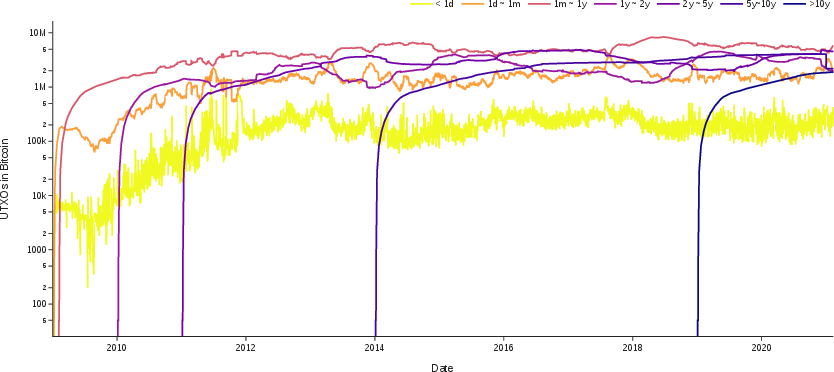
- The paper introduces an innovative cohort analysis method to partition Bitcoin blockchain transactions based on temporal characteristics, improving data management.
- The paper demonstrates that a significant proportion of UTXOs serve as a long-term store of value while newer UTXOs act as a medium of exchange.
- The analysis validates its approach by matching Bitcoin supply data with external sources and lays groundwork for similar methods in other UTXO-based cryptocurrencies.
Summary of "Deciphering Bitcoin Blockchain Data by Cohort Analysis"
The paper "Deciphering Bitcoin Blockchain Data by Cohort Analysis" presents an innovative methodology for analyzing Bitcoin blockchain transactions by applying cohort analysis, a technique traditionally used in social sciences for population data. This approach addresses the challenges posed by the vast and complex Bitcoin transaction history exceeding 1.6 billion transactions.
Methodology and Technique
The study leverages cohort analysis to categorize Bitcoin transactions into cohorts based on their temporal characteristics. Specifically, unspent transaction outputs (UTXOs) and spent transaction outputs (STXOs) are organized into daily birth cohorts and death cohorts, respectively. This method allows for an efficient and economically insightful examination of the blockchain by segmenting the data into manageable partitions based on time of creation and spending.
By employing Google Colaboratory and Google BigQuery, the authors extract relevant data, significantly reducing the computational burden. They construct partitioned tables that facilitate cohort-specific queries and visualizations, enabling analysis of temporal patterns in BTC usage across various time spans.
Key Findings
UTXO and STXO Analysis
The use of cohort analysis reveals distinct trends in Bitcoin as a currency:
Economic Indicators and Validation
The study further validates its methodology by comparing calculated Bitcoin supply data against external sources, showing an exact match with CoinMetrics data.
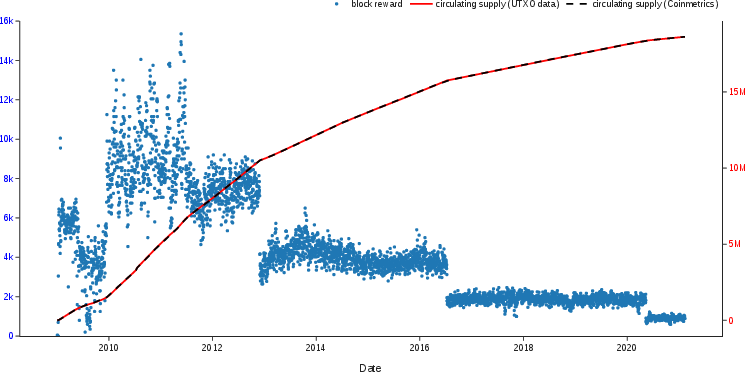
Figure 2: Block reward and circulating BTC supply comparison, verifying data accuracy.
- The cohort analysis method yields datasets capturing STXO and UTXO characteristics from 2009 to 2021, providing a valuable resource for economic modeling and future research expansions into other UTXO-based cryptocurrencies.
Implications and Future Directions
The application of cohort analysis to blockchain data grants new insights into Bitcoin's economic functionalities and offers significant computational efficiencies. This approach can extend to other cryptocurrencies (e.g., Litecoin, Dash) that utilize the UTXO model, as outlined in the study.
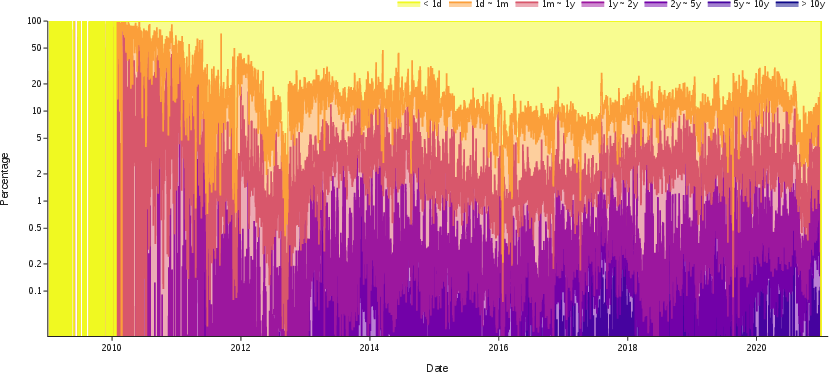
Figure 3: Lifespan distribution of Bitcoin STXOs, illustrating various lifespan categories.
The paper suggests potential for broad applications in finance, security evaluations, and macroeconomic studies. Nonetheless, the authors acknowledge challenges in differentiating UTXOs used as stores of value from those lost or held below transaction-cost thresholds ("dust"). Future work may adapt these techniques to account-based blockchains such as Ethereum, opening avenues for comparative analysis across differing blockchain architectures.
Conclusion
This research exemplifies the application of social science methodologies to technical blockchain data, achieving substantial insights into Bitcoin's transaction dynamics. The integration of cohort analysis with blockchain data facilitates efficient processing and meaningful economic analysis, advancing the understanding of cryptocurrencies in financial ecosystems and informing subsequent studies in related domains.