- The paper introduces a comprehensive set of semiclassical equations incorporating Berry connection for non-Hermitian systems, detailing its impact on wave-packet dynamics.
- It demonstrates how complex eigenvalues and distinct left/right eigenvectors induce transitions and anomalous weight change in crystalline materials.
- The study highlights symmetry constraints and proposes experimental verification via metamaterials to validate the observed non-Hermitian phenomena.
Berry Connection Induced Anomalous Wave-Packet Dynamics in Non-Hermitian Systems
The paper presents a detailed exploration into the effects of Berry connection on wave-packet dynamics in non-Hermitian systems, particularly focusing on crystalline materials. It introduces a comprehensive set of semiclassical equations of motion that incorporate contributions from Berry connection, thereby extending the conventional understanding applied to Hermitian systems.
Introduction to Non-Hermitian Dynamics
In Hermitian systems, the Berry phase and curvature significantly influence wave-packet dynamics through modifications in semiclassical equations of motion. This is well-established in the context of transport phenomena such as the intrinsic anomalous Hall effect. However, non-Hermitian systems, often characterized by dissipation or energy gain, offer a complex landscape that challenges existing paradigms. This paper addresses the gap by formulating the complete set of semiclassical equations for wave-packet dynamics governed by non-Hermitian Hamiltonians, emphasizing the anomalous effects induced by Berry connections.
The paper derives new formulations for wave-packet dynamics in non-Hermitian systems. It considers a generic non-Hermitian Hamiltonian H, where eigenvalues can be complex, leading to distinct dynamics compared to Hermitian systems. In such settings, left and right eigenvectors are distinct, necessitating new Berry connection definitions across these eigenvectors.
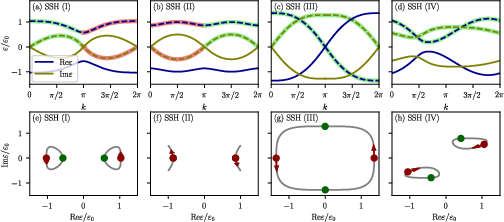
Figure 1: Energy dispersion of the non-Hermitian SSH model, illustrating the complex eigenvalues that drive non-Hermitian dynamics.
The Berry connection's role is highlighted in modifying dynamics, particularly through terms that influence weight rate and velocity in non-Hermitian systems, marking a departure from the standard Hermitian case.
Wave-Packet Construction
Constructing wave packets from non-Hermitian bands involves careful consideration of imaginary energy components, which dictate dominance in dynamics. The breakdown of adiabatic approximation is significant here, as transitions between bands occur at points where energy imaginary parts cross.
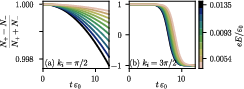
Figure 2: Time evolution of the normalized weight difference for the non-Hermitian SSH model, showing transitions between bands driven by complex energy crossings.
The authors detail how wave packets in these systems are subject to dynamic reordering due to these crossings, demonstrating new phenomena distinct from traditional Hermitian dynamics.
Symmetry Considerations and Experimental Implications
Symmetry analysis reveals conditions under which anomalous terms may vanish, especially emphasizing constraints imposed by combined time-reversal and inversion symmetry in non-Hermitian contexts. The paper advocates for experimental verification using metamaterials, highlighting the immediate applicability of these theoretical predictions.
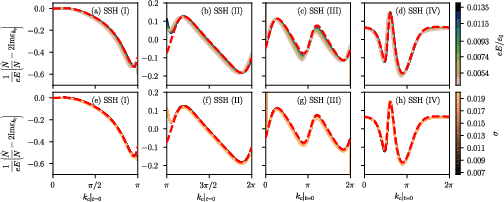
Figure 3: Evolution of anomalous weight rate and velocity, demonstrating dependency on applied electric fields across differing parameter regimes.
The results suggest new avenues for experimental characterization of non-Hermitian systems, potentially employing existing metamaterial platforms for real-world validation.
Conclusion
The research illustrates a transformative step in understanding non-Hermitian systems through Berry connection-induced modifications in semiclassical dynamics. The implications extend beyond theoretical exploration, suggesting novel observable effects potentially paving the way for advances in material science. The methods proposed not only fill gaps in existing literature but also trigger future studies aimed at further dissecting complex systems through innovative lenses.

