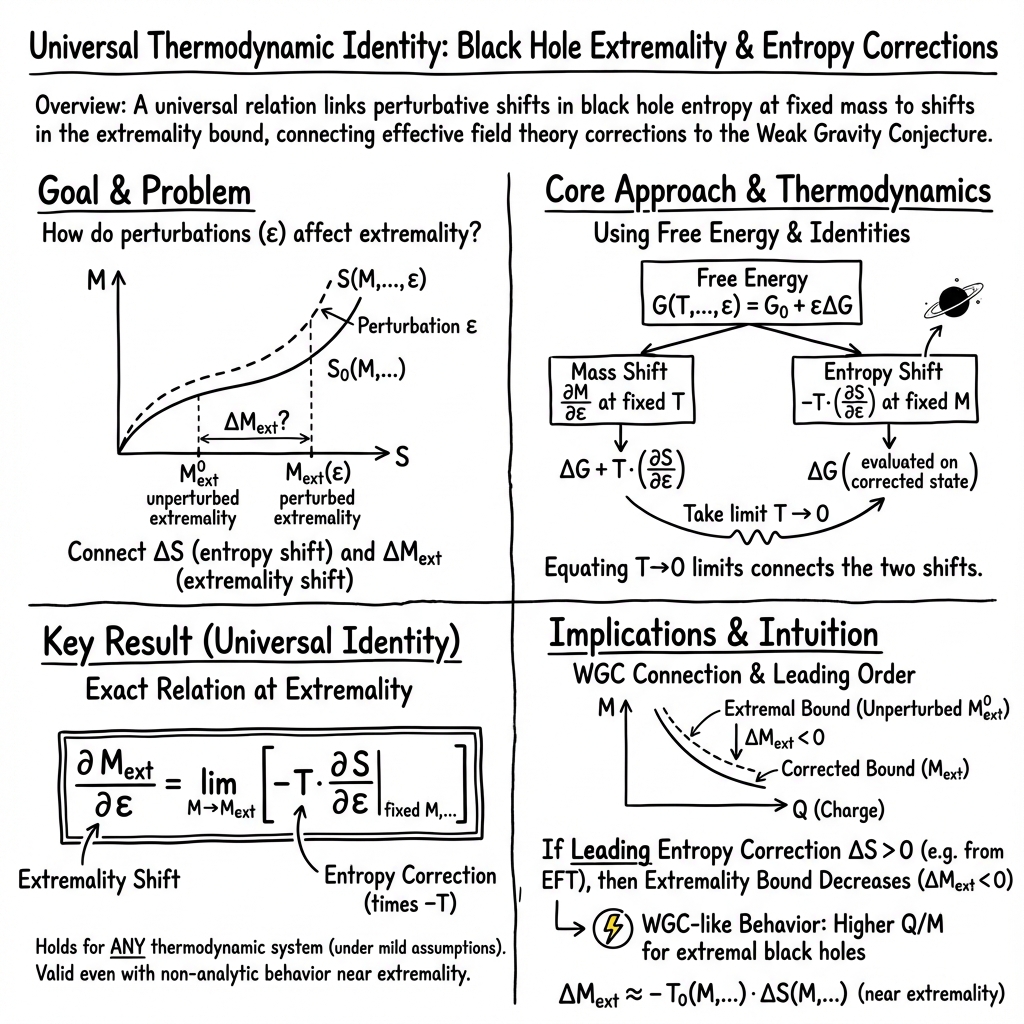
- The paper demonstrates that perturbative corrections in gravitational theories alter both the entropy and the extremality bounds of black holes through a precise thermodynamic identity.
- The methodology employs effective field theory and higher-derivative operators to quantify how small corrections lead to measurable shifts in extremal mass thresholds.
- The findings align with the Weak Gravity Conjecture, implying that positive entropy corrections result in a reduced mass for extremal black holes, with implications for UV-complete theories.
A Universal Relation Between Corrections to Entropy and Extremality
Introduction
The paper "A Universal Relation Between Corrections to Entropy and Extremality" (1909.05254) explores the impact of perturbative corrections in gravitational theories, specifically focusing on black holes. These corrections, which originate from the framework of effective field theories (EFT), introduce additional degrees of freedom at high energies, leading to modifications in key black hole properties, such as entropy and extremality bounds. The authors, Garrett Goon and Riccardo Penco, provide a thermodynamic derivation establishing a universal relation between the leading corrections to both entropy and extremality bounds across a wide range of gravitational systems, suggesting a significant link to the Weak Gravity Conjecture (WGC).
Universal Relation and Thermodynamic Derivation
The authors demonstrate that perturbative corrections in gravitational theories, parameterized by ϵ, affect the expressions for black hole entropy and their extremality bounds. The central result is the exact thermodynamic identity that relates these corrections:
∂ϵ∂Mext(,ϵ)=M→Mext(,ϵ)lim−T(∂ϵ∂S(M,,ϵ))M,
where Mext and S(M,,ϵ) represent the extremality bound and entropy, respectively, in the perturbed theory. This equation indicates that a positive correction to entropy implies a decrease in the mass of extremal black holes at fixed quantum numbers, a behavior consistent with predictions from the WGC, positing that black holes at extremality should satisfy Q/M≥1. The derivation relies on key assumptions, including the third law of thermodynamics and is applicable to both gravitational and broader thermodynamic systems, independent of dimensionality or specific matter content.
Implications and Connection to the WGC
The results have important implications for the WGC, a conjecture suggesting that gravity is the weakest force in any consistent UV-complete theory. The correction relations suggest that as one includes positive higher-derivative corrections to entropy, a corresponding decrease in the mass of extremal black holes is observed, thereby aligning with WGC-predicted inequalities regarding charge-to-mass ratios in gravitational EFTs.
Given the robustness and generality of the thermodynamic derivation, these results could extend beyond the immediate field of black hole physics, offering potential applications across other fields involving thermodynamic systems subject to perturbative dynamics.
Example: Charged Black Holes in AdS4
The paper further examines the validity of its theoretical claims through explicit calculations involving charged, asymptotically anti-de Sitter (AdS) black holes in four dimensions. By considering both the influence of cosmological constant perturbations and the inclusion of higher-derivative operators, the authors confirm the applicability of their derived relations to concrete physical scenarios.
The corrections for large, extremally charged black holes were examined using the following action with additional higher-derivative terms. This confirmed both the universal and approximate relations, accounting for factors like cosmological constant as a perturbing parameter, demonstrating consistency with existing literature.
Conclusion
In conclusion, this paper provides an important contribution to the field of theoretical physics by illustrating a broad, thermodynamically derived relation between entropy corrections and black hole extremality, supporting hypotheses from the WGC. The applicability of these findings across varying black hole configurations suggests potential pathways for future research in gravitational theories and effective field frameworks, potentially inspiring further exploration into the connections between UV-complete theories and observable macroscopic phenomena.