- The paper investigates transdermal transport mechanisms using coarse-grained MD simulations to model the stratum corneum under static electric fields.
- It employs the Martini force-field to replicate lipid components, revealing reversible vesicle formation at 7-8 mV/nm that aids iontophoresis.
- Results indicate that precise electric field adjustments can optimize membrane dynamics, offering insights for improved non-invasive drug delivery techniques.
Tuning the Transdermal Transport by Application of External Continuous Electric Field
Introduction
The study "Tuning the Transdermal Transport by Application of External Continuous Electric Field: A Molecular Dynamics Coarse-Grained Study" explores the mechanisms behind iontophoresis by applying continuous electric fields on the stratum corneum (SC) of the skin. Through coarse-grained molecular dynamics (MD) simulations, this research investigates the complex interactions of low-intensity static electric fields with the stratum corneum, which significantly impact transdermal transport efficacy.
Methodology
The authors employed MD simulations with a coarse-grained approach to analyze the effects of static electric fields on a modeled stratum corneum membrane. Using the Martini force-field, the simulations incorporated components such as ceramide, cholesterol, and fatty acids to mimic the lipid matrix within the SC. The model also included explicit representation of polarizable water and ions in a simulation box of defined dimensions. Simulations were conducted using GROMACS, where electric fields were applied along the z-axis.
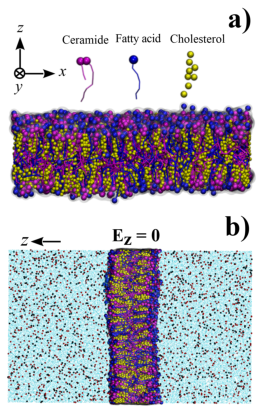
Figure 1: a) Coarse-grained representation for the human stratum corneum lamellar lipidic membrane containing ceramide (24\%), fatty acid (39\%), and cholesterol (36\%). The membrane thickness is 5.4 nm. b) Initial state of the simulation box in the zero-field condition.
Results and Discussion
The study demonstrated that an electric field strength below 6 mV/nm did not cause significant structural changes to the SC but did result in charge separation within the system. The introduction of electric fields between 7 and 8 mV/nm led to dynamic vesicle formation and reincorporation, encapsulating water in the vesicle core, suggesting a reversible iontophoresis under these conditions.
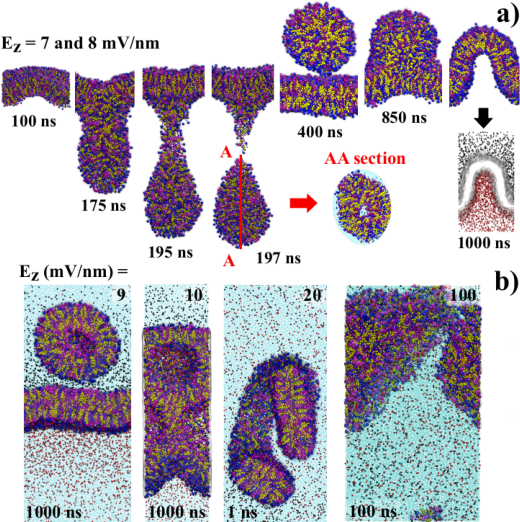
Figure 2: Temporal evolution up to 1000 ns for z-axis applied electric fields demonstrating vesicle dynamics under 7 and 8 mV/nm.
Increasing the field strength to 9 mV/nm and above resulted in irreversible changes such as membrane disruption and phase transitions. The authors attributed these phenomena to electroporation thresholds influenced by the local field environment and internal charge separation, which follow an Arrhenius-like dependence.
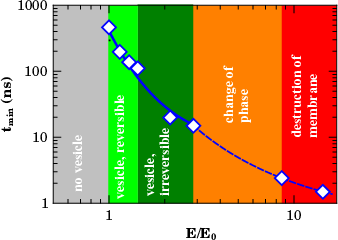
Figure 3: Diagram showing the minimal time for events for stratum corneum membrane model as a function of normalized electric field strength.
Moreover, the study revealed that changes in shear and bulk viscosity of the membrane were significant under applied fields, yet their correlation to membrane dynamics requires further investigation.
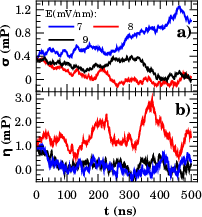
Figure 4: Shear and bulk viscosity of the system under different electric field applications.
Conclusions
This research provides insights into the molecular dynamics of iontophoresis, highlighting the role of vesicle formation in enhancing transdermal delivery. The phase diagram produced—showing the conditions for vesicle formation, membrane destabilization, and disruption—serves as a valuable predictor for experimental studies. Furthermore, the study suggests the practical potential of utilizing continuous electric fields in enhancing the efficiency of topical agent application and drug delivery through non-invasive methods.
Quantitative analyses confirmed that electric field parameters could be strategically adjusted to optimize transdermal transport, potentially impacting clinical practices in dermatology and pharmacology. Future work would benefit from further exploration of the non-Newtonian dynamics on a microscale to clarify the complex interplay of factors influencing SC behavior under electric fields.

