- The paper introduces a robust mathematical framework integrating DMAs with massive MIMO to reduce cost and power consumption.
- It presents two DMA configuration algorithms for frequency-flat and frequency-selective channels to maximize achievable sum-rate.
- The study demonstrates that properly tuned DMAs can match conventional MIMO performance while enabling scalable and cost-efficient network designs.
Introduction
The exploration of massive MIMO systems has been prominent due to its theoretical capacity to enhance spectral efficiency significantly. However, the practical implementation of such systems poses challenges associated with the cost, power consumption, and space requirements of large-scale antenna arrays. This paper investigates the use of Dynamic Metasurface Antennas (DMAs) as a novel approach to overcome these obstacles. DMAs extend massive MIMO capabilities by integrating adaptive signal processing directly into the physical structure of the antennas, potentially reducing both cost and power consumption.
Mathematical Model
The authors propose a robust mathematical framework characterizing massive MIMO systems integrated with DMAs. This model specifically captures the intrinsic features and constraints associated with DMAs, such as frequency response and signal propagation within microstrips. Notably, DMAs are designed to replace traditional bulky and rigid massive MIMO arrays with compact, reconfigurable metasurfaces.
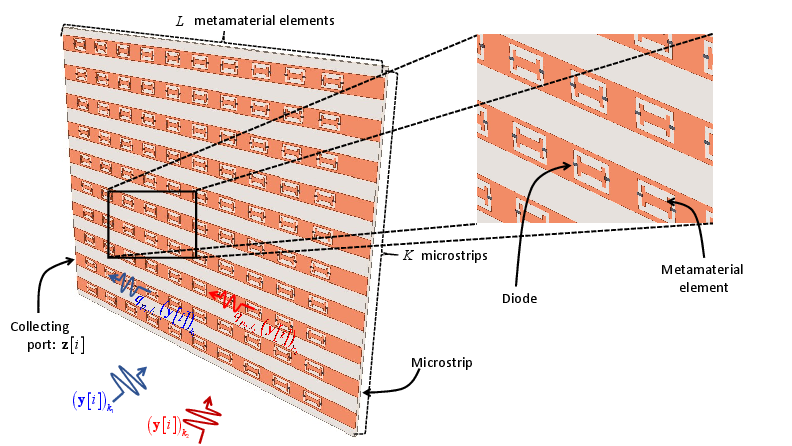
Figure 1: Metasurface antenna illustration.
Given a configuration of microstrips, each with subwavelength spacing, the received signals are processed through a metasurface, implementing functions like beamforming and compression without extra hardware. The mathematical formulation expresses received signals as linear combinations of elements subjected to both frequency-dependent behavior and spatial correlation, which are inherent properties of the DMA structure.
The study explores the achievable performance limits of DMA-based systems, contrasting them with traditional optimal MIMO systems. The evaluation is constructed on leveraging information-theoretic frameworks to quantify average sum-rates. From a practical perspective, the authors detail two distinct algorithms to configure DMAs: one focusing on identically responding frequency flat channels, and another catering to frequency-selective scenarios.
For fixed but unrestrained multicast channels, the introduced solutions effectively maximize sum-rate performance, closely approaching the theoretical limits. However, due to the physics of metasurfaces, trade-offs such as RF chain reductions influence practical implementations.
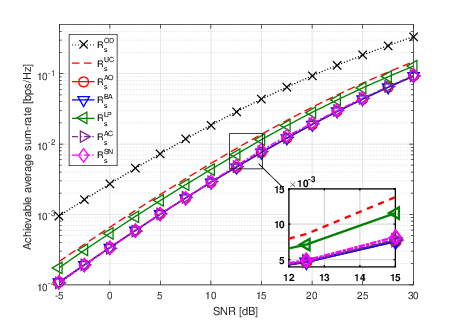
Figure 2: Rate vs. SNR, flat channel, L = 10.
The examination reveals that properly tuned DMAs can achieve efficiency comparable to conventional systems with a sufficiently large number of microstrips, denoting that critical performance metrics are not compromised by using DMAs.
Implications and Speculations
The implications of deploying DMAs in massive MIMO systems point toward scalable networks capable of accommodating the stringent demands of future wireless services. DMAs promise cost efficiency, reduced energy demands, and flexibility in spatial deployment.
Practically, DMAs are positioned to revolutionize the economics of deploying massive MIMO networks, easing the burden of infrastructure investment and enabling new deployment scenarios, such as urban dense environments or remote areas where traditional systems may struggle.
Furthermore, exploring the broader parameter spaces of DMAs can refine designs, facilitating the introduction of new paradigms like frequency-agile chips and smart reconfigurable surfaces, which adaptively optimize themselves for diverse operational contexts.
Conclusion
Dynamic Metasurface Antennas present a compelling evolution in the field of massive MIMO systems, as they align practical antenna array design with adaptive signal processing capabilities. This integration addresses fundamental physical constraints, promising efficiency and scalability that are crucial for modern and emerging wireless communication standards. Looking ahead, the successful deployment of DMAs will hinge on continued advancements in materials science and fabrication, bringing these theoretical insights into robust commercial implementations.