- The paper calculates the potential of mean force between silica and gold nanoparticles using molecular dynamics simulations.
- For silica nanoparticles, the PMF exhibits Lennard-Jones behavior that closely aligns with theoretical predictions based on the Hamaker theory.
- The coating of gold nanoparticles with polyethylene chains alters interparticle forces, shifting PMF minima as grafting density increases.
PMF Calculation Between Atomistic Nanoparticles
This study focuses on calculating the potential of mean force (PMF) between atomistic silica and gold nanoparticles in a vacuum using molecular dynamics simulations. The research aims to characterize the effective interactions between atomistic nanoparticles, which is crucial for describing the PMF in high-density coarse-grained polymer nanocomposites.
Models and Methods
The study investigates silica nanoparticles with diameters of 2.5 nm and 4.0 nm, and gold nanoparticles, both bare and coated with polyethylene (PE) chains. Representative snapshots of these nanoparticles are shown in (Figure 1).
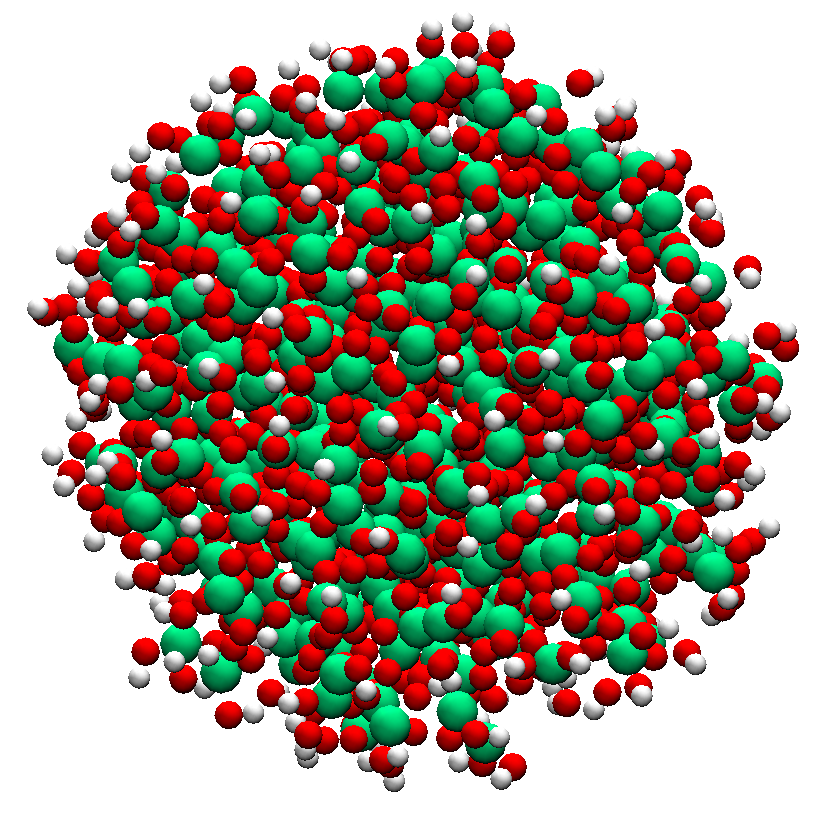
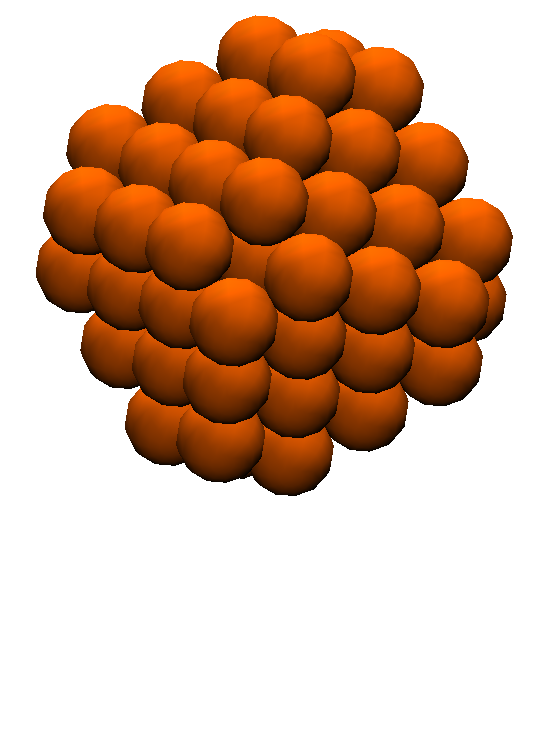
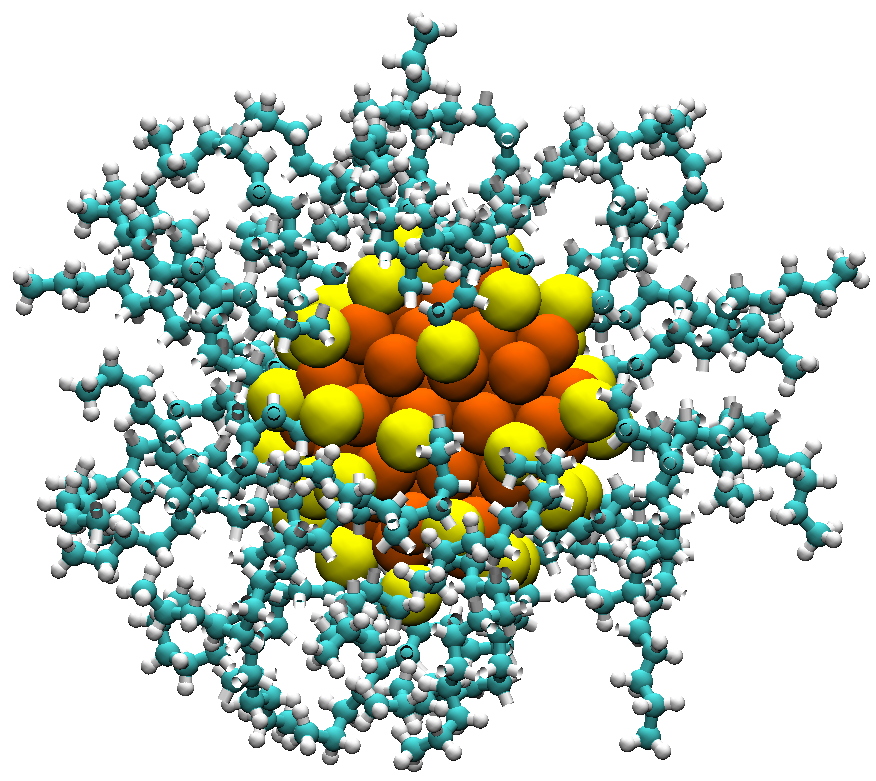
Figure 1: Representative snapshots of nanoparticles investigated in this work: silica NP (left), bare gold NP (center) and coated gold NP (right).
The PMF is calculated using molecular dynamics simulations in the NVT ensemble with the GROMACS package. The force experienced by the nanoparticles is computed while keeping their centers of mass fixed, and the PMF is evaluated by integrating these forces. For silica nanoparticles, the simulation results are compared with theoretical predictions based on the Hamaker theory. The average gyration radii and end-to-end distances of the coated PE chains are also computed to gain insight into their local structure.
Results and Discussion
Silica Nanoparticles
Forces and PMFs were calculated for silica nanoparticles. (Figure 2) and (Figure 3) show the forces and PMFs between silica nanoparticles with diameters of 2.5 nm and 4.0 nm, respectively, along with comparisons to the Hamaker theory predictions.
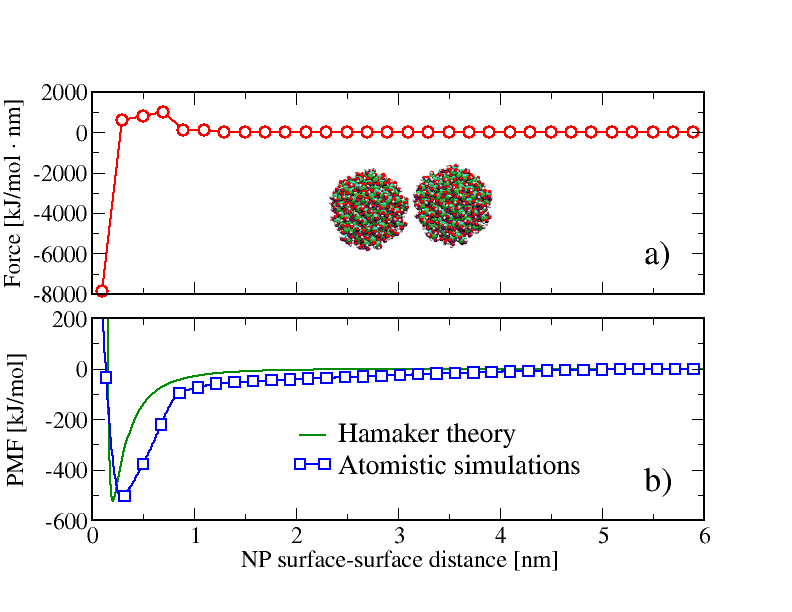
Figure 2: Force (a) and PMF (b) between a pair of silica nanoparticles of diameter 2.5 nm obtained from atomistic simulations (symbols).
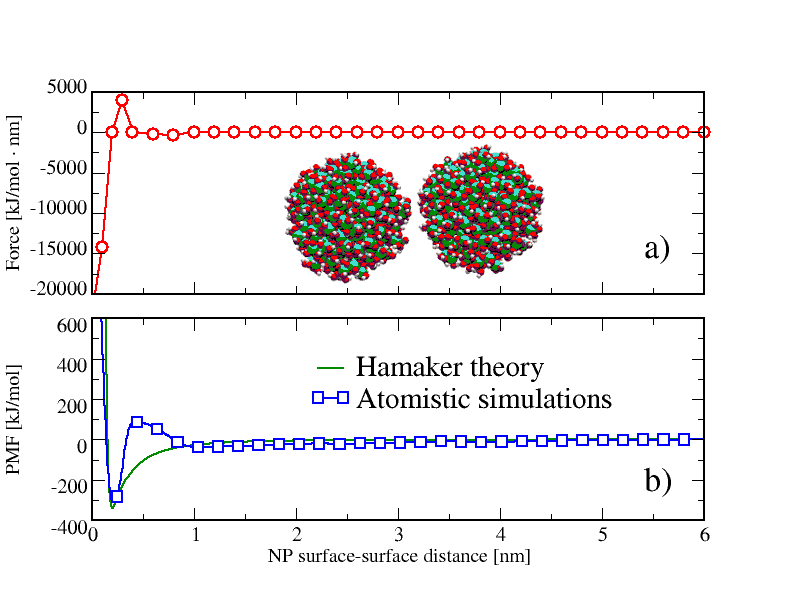
Figure 3: Force (a) and PMF (b) between a pair of silica nanoparticles of diameter 4.0 nm obtained from atomistic simulations (symbols).
The simulation results closely match the theoretical data, showing a Lennard-Jones behavior with a well-defined minimum. The agreement between simulation and theory validates the numerical procedure used for calculating the PMF and indicates the transferability of the Hamaker theory for these systems.
Gold Nanoparticles
The study also investigates the PMF between gold nanoparticles. (Figure 4) shows the force and PMF for bare gold nanoparticles. The force appears noisy, indicating weak interactions. The PMF is repulsive, confirming the low net interaction between the nanoparticles.
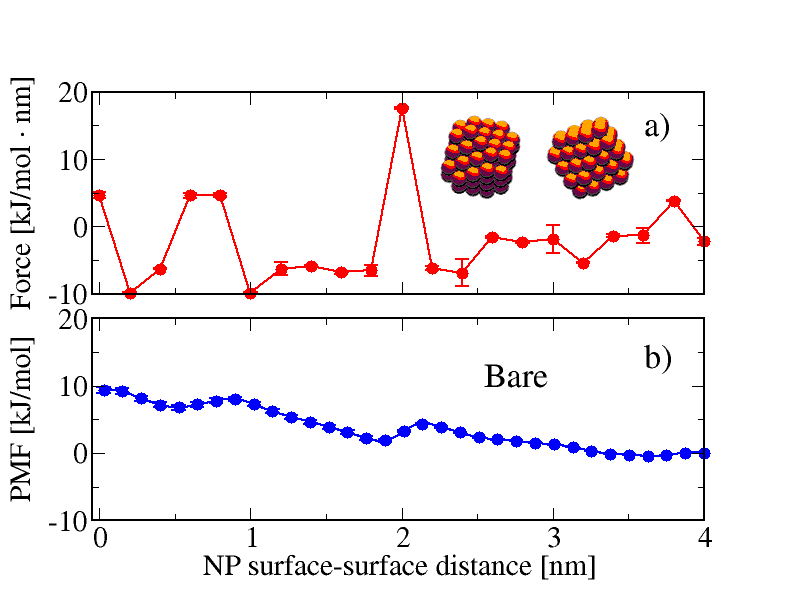
Figure 4: Force (a) and PMF (b) between a pair of bare gold nanoparticles as a function of their mutual distance.
When gold nanoparticles are coated with PE chains, the PMF behavior changes. (Figure 5), (Figure 6), and (Figure 7) show the force and PMF between gold nanoparticles coated with 19, 28, and 38 PE chains, respectively.
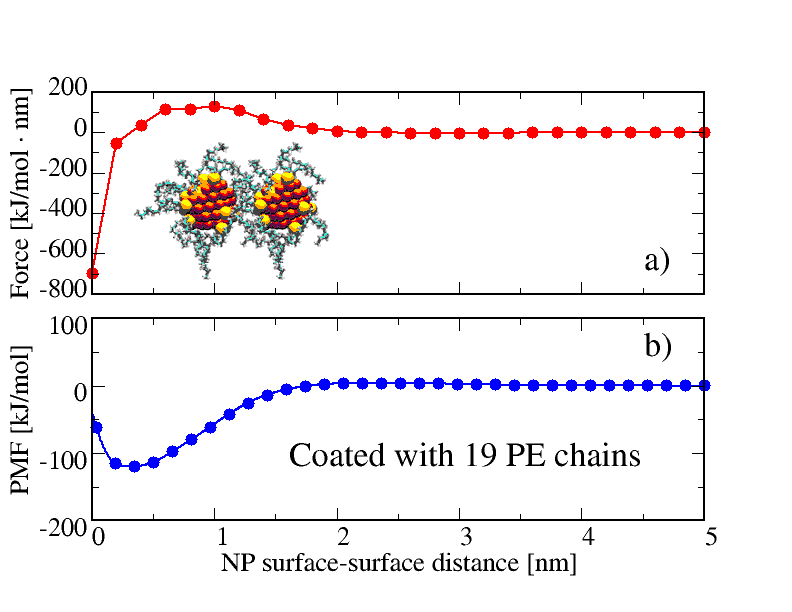
Figure 5: Force (a) and PMF (b) between a pair of gold nanoparticles coated with 19 PE chains as a function of their mutual distance.
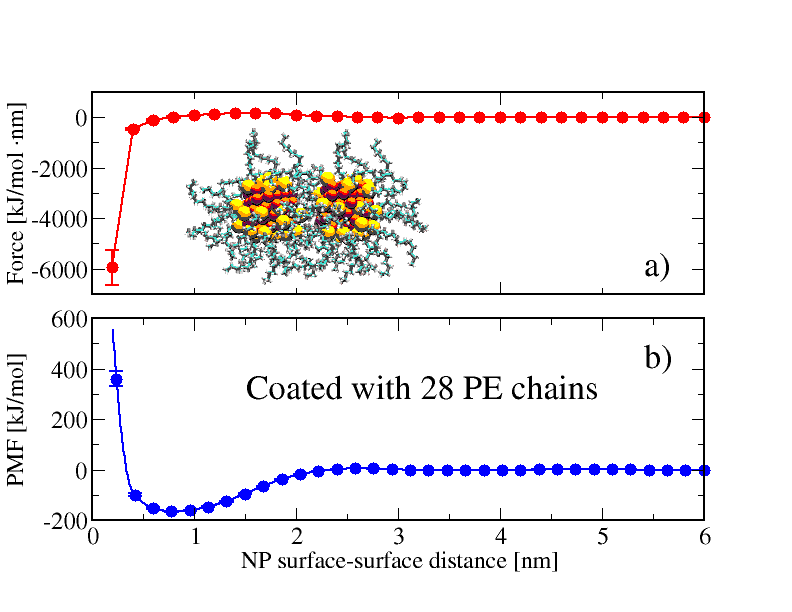
Figure 6: Force (a) and PMF (b) between a pair of gold nanoparticles coated with 28 PE chains as a function of their mutual distance.
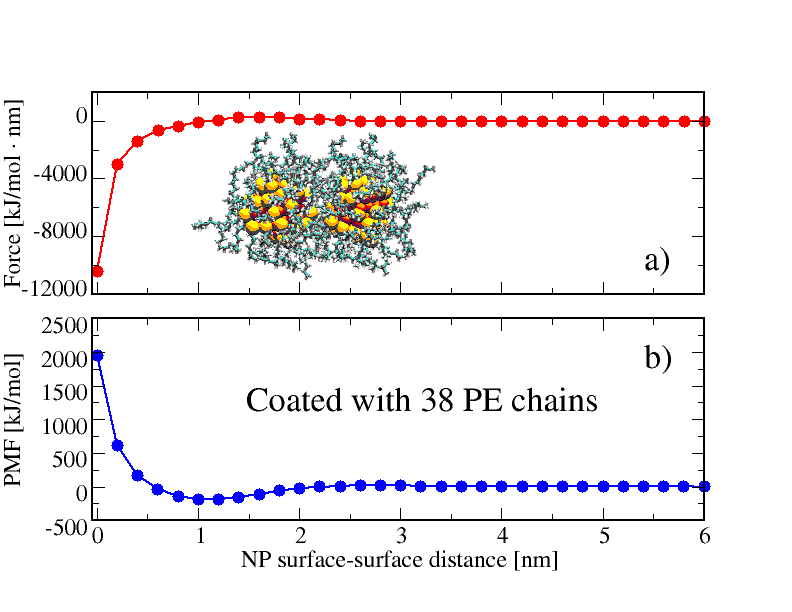
Figure 7: Force (a) and PMF (b) between a pair of gold nanoparticles coated with 38 PE chains as a function of their mutual distance.
The force becomes more regular, and the PMF exhibits a minimum, indicating an attraction at short interparticle distances. The grafting density of the PE chains significantly affects the PMF profile. Higher grafting densities lead to increased repulsion at close contact and a shift in the minimum position.
(Figure 8) shows the average gyration radius and end-to-end distance for PE chains with different grafting densities. The gyration radius and end-to-end distance increase with the number of coating chains, indicating that the chains are more stretched at higher grafting densities.
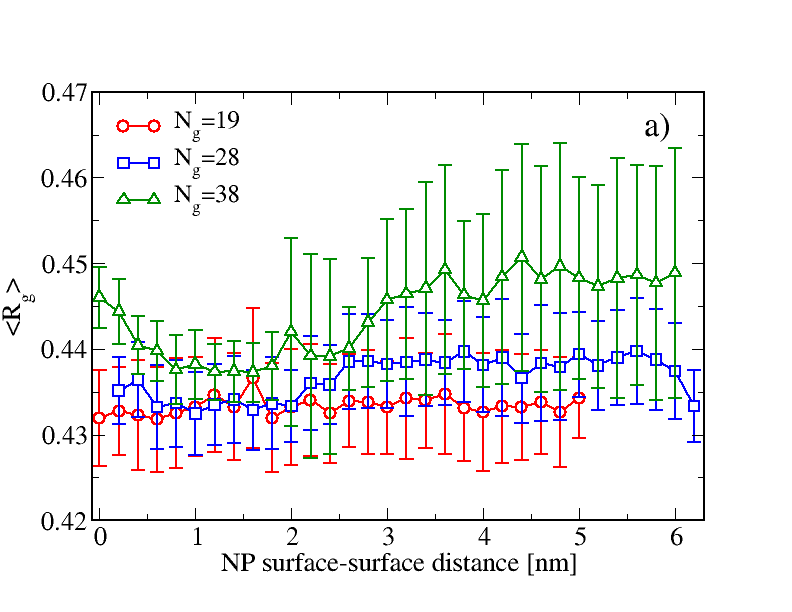
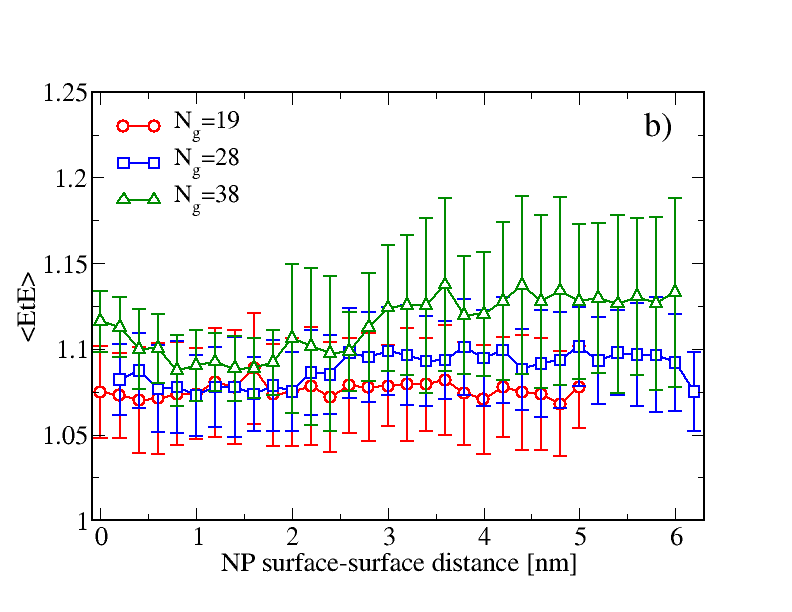
Figure 8: Average gyration radius (a) and average end-to-end distance (b) for PE chains with different Ng as a function of the distance between NPs surfaces.
(Figure 9) compares the PMFs of gold nanoparticles for different values of Ng.
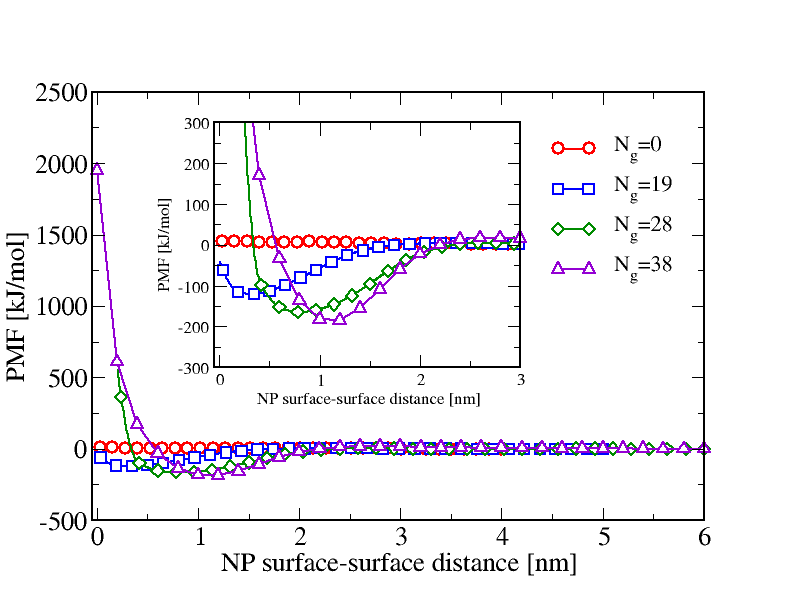
Figure 9: Comparison between PMF of a pair of gold nanoparticles for different values of Ng (in the legend) as a function of their mutual distance.
Conclusion
This study provides insights into the effective interactions between atomistic silica and gold nanoparticles. The findings highlight the importance of considering the particle size, surface properties, and the presence of coating chains when characterizing the PMF. The atomistic potentials obtained in this study can be used in subsequent investigations of high-density coarse-grained polymer nanocomposites.

