Abstract: Bitcoin is a electronic payment system where payment transactions are verified and stored in a data structure called the blockchain. Bitcoin miners work individually to solve a computationally intensive problem, and with each solution a Bitcoin block is generated, resulting in a new arrival to the blockchain. The difficulty of the computational problem is updated every 2,016 blocks in order to control the rate at which blocks are generated. In the original Bitcoin paper, it was suggested that the blockchain arrivals occur according to a homogeneous Poisson process. Based on blockchain block arrival data and stochastic analysis of the block arrival process, we demonstrate that this is not the case. We present a refined mathematical model for block arrivals, focusing on both the block arrivals during a period of constant difficulty and how the difficulty level evolves over time.
The paper proposes a refined model for Bitcoin block arrivals that accounts for variations in mining difficulty and hash rate.
It employs a piecewise nonhomogeneous Poisson process to better represent periods of constant difficulty and adjustment intervals.
The research provides numerical evidence against the homogeneous Poisson assumption, offering insights for improved blockchain optimization.
Block Arrivals in the Bitcoin Blockchain
Introduction
The paper "Block arrivals in the Bitcoin blockchain" (1801.07447) critically examines the assumption that block arrivals in the Bitcoin blockchain follow a homogeneous Poisson process. Contrary to the original Bitcoin white paper, the authors propose a refined mathematical model for block arrivals, accounting for variances in the block arrival rate caused by the dynamic nature of Bitcoin's mining difficulty and the non-constant global hash rate.
Theoretical Framework and Methodology
The paper disputes the homogeneous Poisson process assumption commonly attributed to Bitcoin block arrivals. It suggests that, due to periodic adjustments in mining difficulty, these arrivals cannot be accurately depicted as a homogeneous Poisson process. Instead, the authors model block arrivals as a piecewise combination of nonhomogeneous Poisson processes, considering both intervals of constant difficulty and the impact of difficulty adjustments on block arrival rates.
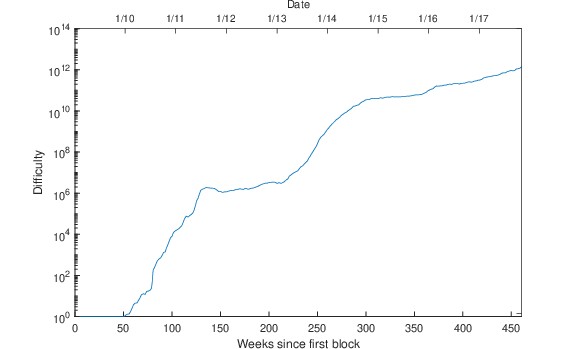
Figure 1: Plot of the difficulty over the life of the blockchain. This serves as an estimate of a constant multiple of the global hash rate.
Key Findings and Numerical Results
The paper presents strong numerical evidence that supports its claims against the homogeneous Poisson process model. Through a comprehensive stochastic analysis and block arrival data, the authors delineate periods where difficulty adjustments and hash rate fluctuations lead to significant deviations from the expected Poisson behavior.
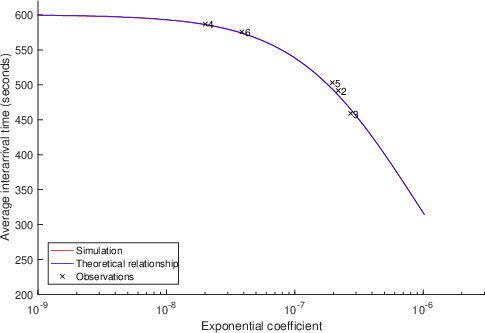
Figure 2: The relationship between the inter-arrival time and a, the slope of the logarithm of the hash rate over time, in theory, simulations, and observations. The global hash rate at time t is modeled by H(t)=eat+b.
Implications and Future Directions
The implications of this research are significant for both theoretical and practical applications within blockchain technology. By recognizing the adaptive nature of Bitcoin's difficulty mechanism and its interaction with hash rate dynamics, this research enables more accurate predictions of block arrival times and informs strategies for network optimization. Moreover, it opens avenues for future research into blockchain consensus models and their scalability, particularly in the context of evolving technological landscapes and increased computational power.
Conclusion
This paper advances the understanding of Bitcoin's block arrival process by moving beyond traditional Poisson process assumptions. The refined models and simulation results presented offer a more nuanced view, addressing the stochastic elements inherent in blockchain dynamics. These insights are crucial for developers and engineers seeking to optimize blockchain protocols and predict performance under varying conditions.
“Emergent Mind helps me see which AI papers have caught fire online.”
Philip
Creator, AI Explained on YouTube
Sign up for free to explore the frontiers of research
Discover trending papers, chat with arXiv, and track the latest research shaping the future of science and technology.Discover trending papers, chat with arXiv, and more.