- The paper presents a fine-grained taxonomy for classifying dialogue acts in Twitter customer service interactions.
- It employs a sequential SVM-HMM model that outperforms non-sequential baselines in predicting conversation flow.
- The study links dialogue act predictions to customer satisfaction, offering actionable insights for automated service systems.
Fine-Grained Dialogue Acts in Customer Service Conversations
The paper "How May I Help You?": Modeling Twitter Customer Service Conversations Using Fine-Grained Dialogue Acts, presents an innovative approach for automatically analyzing customer service interactions on Twitter. The work revolves around developing a detailed taxonomy for fine-grained dialogue acts that can be applied to Twitter-based customer service conversations. Utilizing a sequential SVM-HMM model, the methodology aims to predict these dialogue acts in real-time, providing actionable insights for the automated handling of customer service queries.
Taxonomy and Methodology
The researchers have crafted a new taxonomy tailored specifically for customer service on Twitter. Unlike the traditional generic dialogue act taxonomies, this taxonomy includes finely distinguished acts such as Complaint, Offer Help, Request Info, among others. This fine-grained approach significantly enhances the understanding of the interaction's flow and content, pertinent for driving automated systems.
The construction of this taxonomy involved detailed annotation of 800 Twitter conversations, exploring the distinct behaviors of customer and agent interactions. Majority-vote labeling was applied to characterize each turn within these conversations, taking into account the overlapping nature of dialogue acts.
Modeling Approach
A multi-label classification technique is adopted due to the inherent overlapping nature of dialogue acts within a single conversation turn. The research leverages a sequential SVM-HMM model to predict dialogue acts in real-time, outperforming traditional non-sequential models.
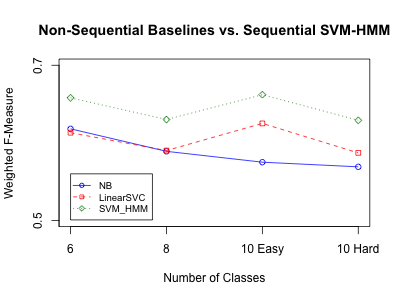
Figure 1: Plot of Non-Sequential Baselines vs. Sequential SVM-HMM Model
The model processes each conversation as a sequence of acts, enabling it to effectively predict the flow and evolution of dialogue in customer service interactions, thus embodying a real-time analysis capability.
Real-World Application and Insights
The study not only focuses on predicting dialogue acts but also correlates these predictions with desirable customer service outcomes such as satisfaction, resolution, and frustration. A key aspect of the research is its ability to derive data-driven rules that can guide automated systems in responding to customer interactions, optimizing the customer service experience. The weighted analysis of dialogue acts against conversation outcomes offers practical guidelines for enhancing interaction quality.
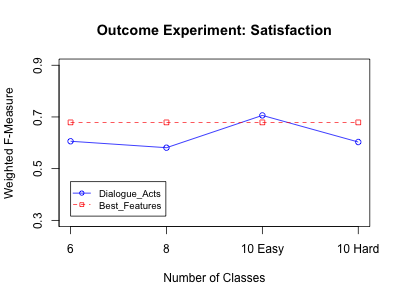
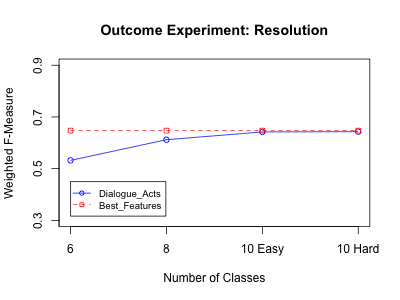
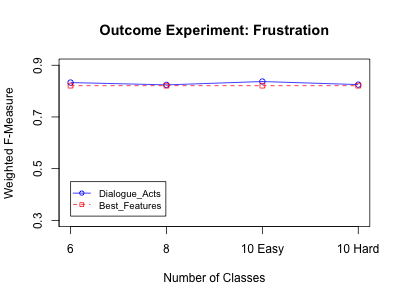
Figure 2: Satisfaction Outcome
These insights can be operationalized to train intelligent agents to recognize patterns indicative of positive or negative service outcomes. For instance, offering help or expressing gratitude at the end of conversations correlates strongly with customer satisfaction and problem resolution.
Conclusion
The paper advances the dialogue modeling field by presenting a unique fine-grained approach for classifying and predicting dialogue acts in a customer service context. By focusing on Twitter interactions, the study addresses the specific dynamics of brevity and public visibility inherent to the platform. This approach not only enhances analytical insights for customer service industries but also offers a blueprint for designing automated interlocutors that can effectively engage with customers in real-time, improving response strategies and outcomes across digital customer service platforms.