Proposed low-energy absolute calibration of nuclear recoils in a dual-phase noble element TPC using D-D neutron scattering kinematics
Abstract: We propose a new technique for the calibration of nuclear recoils in large noble element dual-phase time projection chambers used to search for WIMP dark matter in the local galactic halo. This technique provides an $\textit{in situ}$ measurement of the low-energy nuclear recoil response of the target media using the measured scattering angle between multiple neutron interactions within the detector volume. The low-energy reach and reduced systematics of this calibration have particular significance for the low-mass WIMP sensitivity of several leading dark matter experiments. Multiple strategies for improving this calibration technique are discussed, including the creation of a new type of quasi-monoenergetic 272 keV neutron source. We report results from a time-of-flight based measurement of the neutron energy spectrum produced by an Adelphi Technology, Inc. DD108 neutron generator, confirming its suitability for the proposed nuclear recoil calibration.
Paper Prompts
Sign up for free to create and run prompts on this paper using GPT-5.
Top Community Prompts
Explain it Like I'm 14
What this paper is about
This paper explains a new way to “calibrate” very sensitive dark matter detectors that use liquid argon or liquid xenon. Calibrating means checking how the detector responds to tiny hits, so scientists know exactly how big a real signal is. The new method uses a carefully controlled beam of neutrons (tiny neutral particles) to poke the detector and measure how much light and charge those pokes create at very low energies—the kind expected from light dark matter.
The main questions the researchers asked
- How can we measure, inside a full-size detector, exactly how much light and how many electrons are produced when an atom in the liquid gets a tiny “kick” (a nuclear recoil)?
- Can we make those measurements at very low energies—where light-weight dark matter would show up—without relying heavily on computer models?
- Can we build a compact, reliable neutron source that gives the right energy neutrons for this job, and can we shape that neutron beam to make the calibration cleaner?
How the method works (in everyday terms)
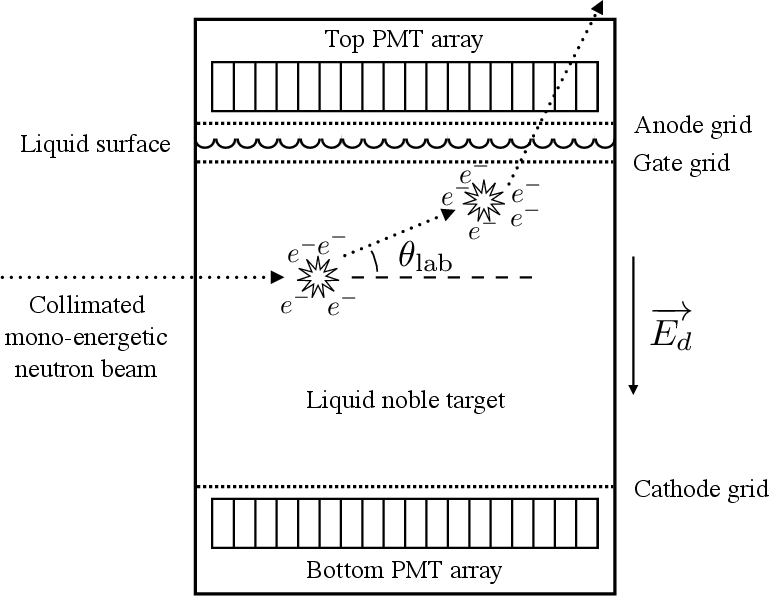
Think of the detector as a 3D camera filled with a clear liquid (argon or xenon). When a particle bumps into an atom in the liquid:
- A quick flash of light appears (called S1).
- Some electrons are knocked free and drift upward in an electric field, creating a second, delayed light signal when they enter the gas at the top (called S2).
By recording both the flash (S1) and the electron signal (S2), and by timing when the signals arrive, the detector can tell how much energy was deposited and where in the tank it happened.
Here’s the calibration trick:
- Send in neutrons whose energy and direction you know. Neutrons are like tiny, fast-moving billiard balls.
- Sometimes a neutron bounces twice inside the liquid. The detector can reconstruct the 3D positions of both bounces.
- From the angle between those two bounces, basic physics tells you exactly how much energy the neutron gave to the atom in the first bounce.
- Now you can directly compare that known energy to how big the S1 and S2 signals were. That tells you the detector’s true “light yield” (photons per energy) and “charge yield” (electrons per energy).
Why this is better: Many older methods used neutron sources with a wide spread of energies and lots of extra gamma rays, then relied on detailed simulations to interpret the data. This new, angle-based method sets the energy from geometry and timing, inside the real detector, cutting down on guesswork and uncertainties.
What tools and ideas they used
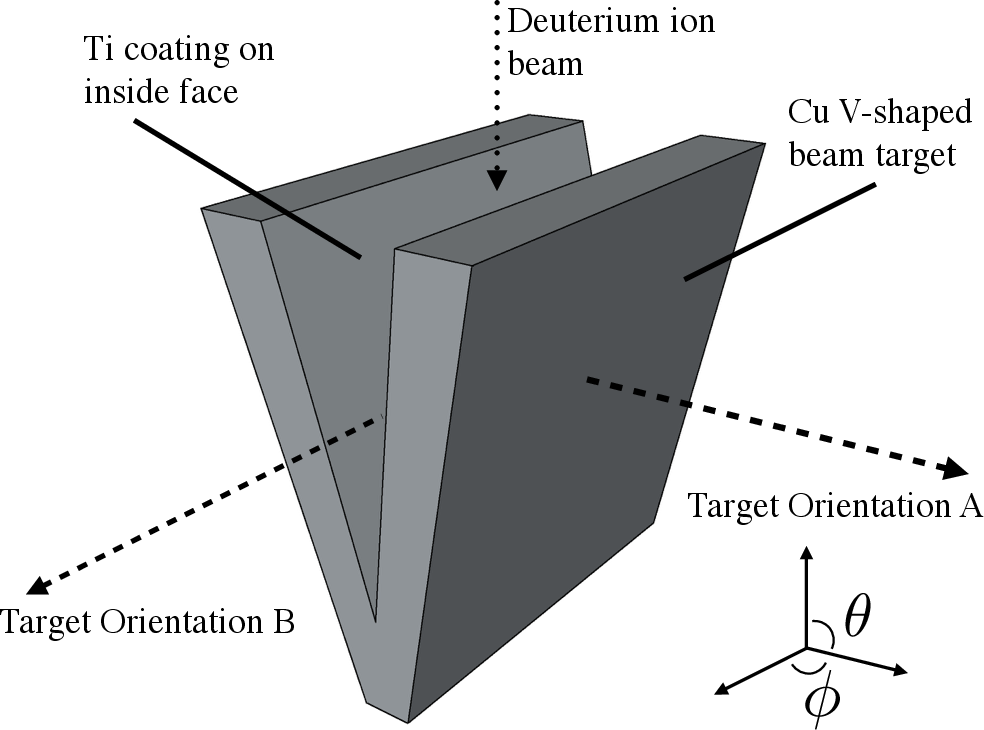
- A compact D–D neutron generator: This machine accelerates deuterium (heavy hydrogen) ions into a target, producing neutrons at about 2.45 MeV (million electron-volts). It’s small enough to use in underground labs and can be pulsed (turned on and off quickly).
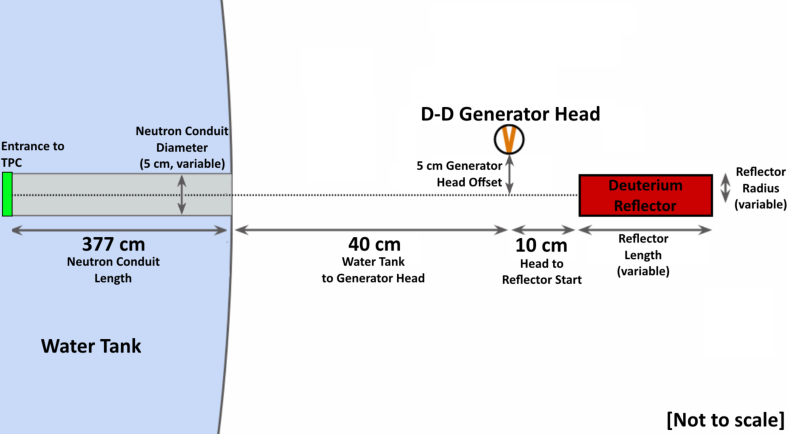
- A “neutron conduit”: A pipe-like path through water shielding that guides neutrons straight to the detector, keeping backgrounds low.
- Multiple-scatter kinematics: Using the measured positions of two neutron bounces to compute the scattering angle and the exact recoil energy at the first hit.
- Pulsed timing and time-of-flight (ToF): By pulsing the neutron beam and measuring how long neutrons take to reach or move between points, they can:
- Cut background (only look during the pulse window).
- Tag neutron energy event-by-event if the pulses are short enough.
- Calibrate S2-only events (very tiny signals where S1 is too small to see) because the pulse gives the start time.
- A lower-energy neutron option: They propose placing a deuterium-loaded “reflector” (like heavy water, D2O, or liquid D2) behind the generator. Neutrons that bounce backward off deuterium come out at about 272 keV—much lower than 2.45 MeV. Lower-energy neutrons make bigger scattering angles for the same tiny recoil energies, which improves precision and pushes calibration to even lower energies. They also study adding an iron “filter” that naturally lets through neutrons near ~274 keV while absorbing others to purify the beam.
To choose the best reflector setup, they ran detailed simulations comparing:
- Gaseous D2 vs heavy water (D2O) vs liquid D2
- Different sizes and positions
- How “pure” the resulting neutron beam is around 272–300 keV and how strong the beam remains
Finally, they performed a time-of-flight test of a commercial DD108 neutron generator to check the actual neutron energy distribution, confirming it’s suitable for this calibration.
The main findings and why they matter
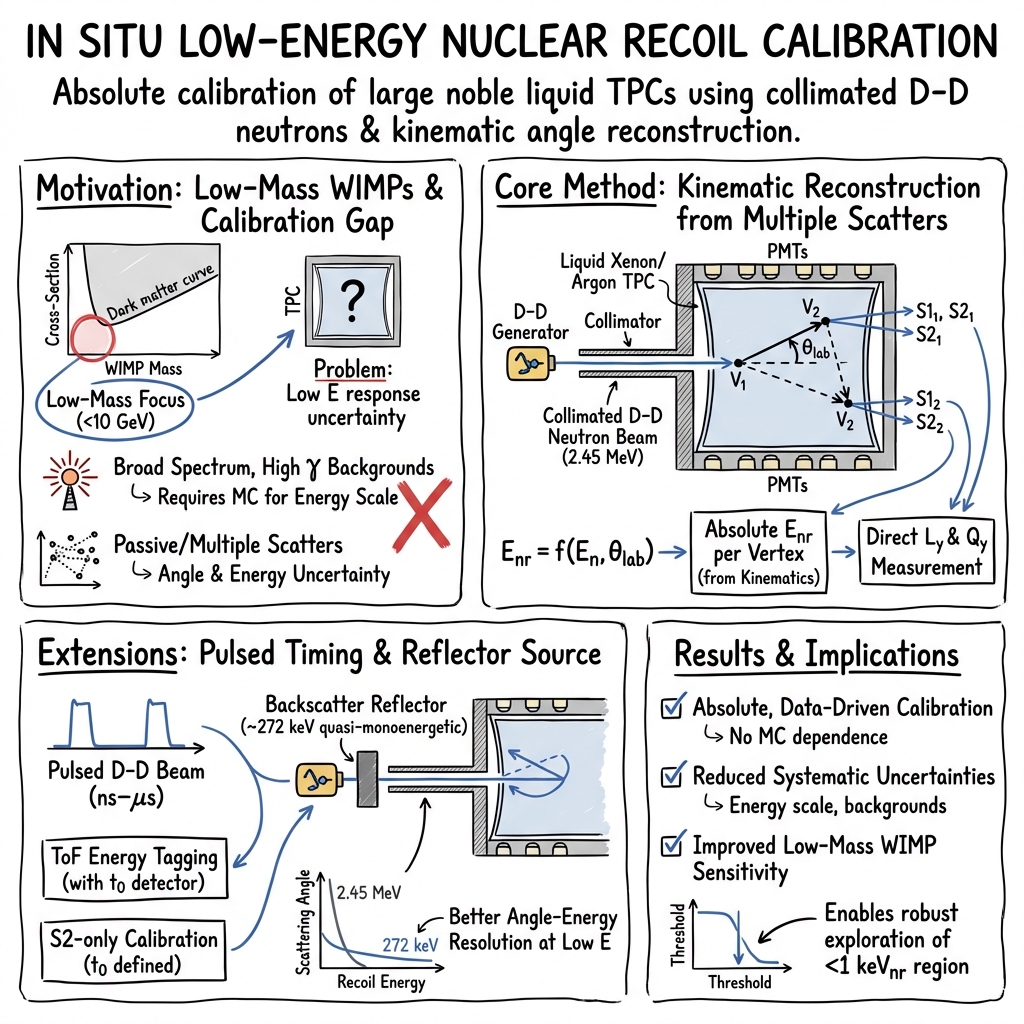
- The angle-based, in-detector method works in large liquid argon or xenon time projection chambers (TPCs). It can directly measure how many photons and electrons are produced by very low-energy nuclear recoils without depending mainly on simulations.
- Using 2.45 MeV neutrons already gives good results, but:
- Pulsing the generator improves background rejection and allows time-of-flight tagging.
- Short pulses can provide the “start time” for electron drift, enabling precise studies of extremely small signals (S2-only), which is key for pushing sensitivity to the lightest dark matter.
- The deuterium reflector approach can produce a quasi-monoenergetic beam around 272–300 keV. This lowers the recoil energies reachable and increases the scattering angles for the same tiny recoil, improving accuracy. Simulations show:
- Heavy water (D2O) reflectors are practical and boost low-energy neutron flux.
- Liquid D2 could perform even better but is more complex to handle.
- An iron filter near 274 keV can “clean up” the beam energy at the cost of intensity.
- A time-of-flight measurement of an Adelphi DD108 neutron generator confirms it produces the expected neutron energies and is suitable for the proposed calibration techniques.
Why this matters: Many dark matter searches now focus on low-mass WIMPs, which would produce very small nuclear recoils. Understanding the detector’s response at these tiny energies is crucial to tell a real signal from noise and to compare results across experiments. This method gives a cleaner, more precise, and more direct way to do that.
What this could change
- Better, lower-energy calibrations should strengthen the reliability of dark matter searches, especially for light WIMPs.
- The same tools can help prepare these detectors to see other rare signals, like coherent elastic neutrino–nucleus scattering (CENNS).
- Portable, well-characterized neutron sources and reflectors can be deployed in underground labs without huge facilities, making advanced calibrations more routine.
- Overall, the technique reduces uncertainty and could help resolve tensions between different experiments by putting everyone on a firmer, shared energy scale at the lowest recoil energies.
Knowledge Gaps
Knowledge gaps, limitations, and open questions
Below is a concise list of unresolved issues, uncertainties, and missing validations that future work should address to operationalize and quantify the proposed calibration technique.
- Lack of an in situ demonstration in a full-scale dual-phase TPC: no measurement of usable double-scatter rates, energy reach, acquisition stability, or end-to-end uncertainty budget with real detector data.
- Incomplete error budget for recoil-energy reconstruction from scattering kinematics: no quantitative breakdown of contributions from neutron energy spread, position reconstruction (x/y/z), multiple-scatter mis-ID, path-length uncertainties, and lab-to-CM angle conversion.
- D-D source characterization under realistic operating conditions remains incomplete: per-angle (especially at ) neutron-energy spectrum width (), angular dependence, time stability with target loading/aging, and pulse-to-pulse variations are not quantified.
- Validation of the claim that 95% of accepted events remain within 6% of the initial neutron energy (after fiducialization) is simulation-based; no experimental verification for different conduit lengths, diameters, and water-tank geometries.
- Backgrounds from inelastic scattering (n,n′γ) in Xe/Ar and surrounding materials at 272 keV and 2.45 MeV are not quantified; their rates, spectra, and impact on S1/S2 and discrimination cuts remain unestimated.
- S1 pulse-envelope decomposition for multiple scatters is proposed but not validated: no algorithmic demonstration (e.g., ML fits) on data or detailed study of biases due to PMT timing, light transport, detector reflections, afterpulses, and S1 overlap (especially in xenon).
- Feasibility of achieving ≤100 ns neutron pulse widths with compact, deployable D-D sources is not established; timing jitter and its impact on S2-only z-reconstruction and ToF-energy tagging are not quantified.
- ToF-based per-event energy tagging (using fast scintillator moderation) is only conceptual: required timing resolution, achievable energy resolution vs. flight path length, γ/n discrimination, and additional background contributions are not evaluated experimentally.
- The 272 keV deuterium-loaded reflector concept lacks empirical validation: no measured neutron peak energy, beam purity, flux, or stability for DO and liquid D reflectors in a realistic setup.
- Sensitivity of reflector performance to geometry and alignment is unquantified: tolerances on generator offset, reflector dimensions, conduit diameter, and their effects on beam purity and flux remain unmeasured.
- Oxygen-induced contamination in DO reflectors is identified but not mitigated experimentally; optimization of reflector size and composition versus purity/flux tradeoffs is unresolved.
- Liquid D reflector feasibility (engineering, cryogenics, safety) for underground deployment is not addressed; the practical path to implementation and operations is unclear.
- Use of an iron notch filter near 274 keV is suggested without design specifics: required thickness, expected transmission, line broadening due to scattering in Fe, and net impact on flux vs. purity need measurement.
- Neutron scattering in the water conduit and surrounding structures is only simulated; the actual contribution to energy smearing and off-energy tails reaching the TPC is not validated in situ.
- Activation and radiopurity impact of intensive neutron calibrations (108–109 n/s) are not assessed: production of long-lived isotopes (e.g., 129mXe, 131mXe) and cooldown times compatible with dark-matter operations remain unquantified.
- DAQ and operations constraints are not evaluated: PMT/SiPM rates, pulse pile-up, bandwidth, dead time, and dynamic range for overlapping S1s and multiple S2s at proposed fluxes are not studied.
- Selection efficiency for double scatters with adequate z-separation (to resolve S2s) and large-angle scatters at sub-keVnr is not quantified; required calibration times to reach target statistical precision are unknown.
- Detector-systematics control plan is missing: monitoring/corrections for electron lifetime, extraction efficiency, drifts, and electric-field nonuniformities—and their propagation into Qy/Ly uncertainties—are not detailed.
- S2-only calibration at O(100 eVnr) lacks a realistic noise/threshold study: single-electron backgrounds, delayed electron emission, photoionization/afterglow rates, and analysis biases are not quantified.
- Dependence on nuclear recoil models remains unexamined: while “absolute,” interpreting Qy/Ly at sub-keVnr requires disentangling recombination vs. Lindhard quenching and field dependence; a plan to compare to/validate models is not provided.
- Isotopic effects are not considered: averaging over natural isotopic masses in Xe/Ar could bias kinematic energy reconstruction; corrections and associated uncertainties are unquantified.
- Cross-section and transport inputs may be outdated (Geant4 4.9.4.p04, G4NDL3.14): no benchmarking against newer ENDF/B libraries or quantification of uncertainties in mean free paths and differential cross-sections impacting rates and angles.
- Contributions from passive-detector materials (PTFE, field cage, electrodes) to multiple scattering and off-energy backgrounds are not measured; strategies for data-driven validation of MC cuts are absent.
- Practical integration into water/shield infrastructure is not addressed: mechanical design of the conduit, sealing, neutron leakage control, safety/regulatory approvals, and impact on other systems are open.
- Applicability to liquid argon TPCs needs further study: effects of the long triplet lifetime on event pile-up and on S1 decomposition, and interactions with PSD methods, are not quantitatively evaluated.
- The DD108 ToF spectrum “confirmation” is referenced but results (peak energy, width, angular dependence, systematic uncertainties) are not included here; how these propagate to recoil-energy resolution is not shown.
- The approach for absolute Ly extraction from single scatters using S2-calibrated energy relies on MC; the extent to which this reintroduces model dependence and associated systematics is not quantified.
Practical Applications
Immediate Applications
The following applications can be deployed now or with modest integration effort using current technology (commercial D–D generators, standard TPCs, and existing analysis pipelines).
- In situ, absolute nuclear-recoil calibration for current dual-phase noble TPCs
- Description: Use a collimated D–D neutron beam through a gas (or evacuated) conduit into the water shield to create a well-defined, monoenergetic neutron direction for multi-scatter kinematic calibration inside the TPC. Reconstruct per-event scattering angles from 3D positions to obtain absolute recoil energies and extract Qy (and, where feasible, Ly).
- Sector: Scientific instruments; academia (dark matter, CEvNS).
- Tools/Products/Workflows:
- Neutron conduit design and alignment kit for underground water tanks.
- DD generator (e.g., Adelphi DD108) mounted at 90° to the ion beam to minimize angular energy dependence; duty-cycle control for rate tuning.
- Reconstruction/analysis modules: multi-vertex angle solver, absolute Qy extraction, fiducial selection aligned with beam projection.
- Assumptions/Dependencies: Underground geometry allows conduit installation; TPC delivers cm-scale 3D position resolution and stable g2; DD generator flux ≥107 n/s; radiation safety and operations approvals.
- Improved nuclear-recoil band (S2/S1) calibration with reduced backgrounds
- Description: Align the beam near the liquid surface to avoid reverse-field regions and reduce multi-S1/single-S2 contamination; use beam timing to suppress accidentals, improving the NR discrimination model in the low-energy region.
- Sector: Scientific instruments; academia.
- Tools/Products/Workflows: Beam-based NR band calibration runs; background-rejection cuts keyed to “beam on” windows; updated discrimination curves for WIMP analyses.
- Assumptions/Dependencies: PMT stability and S1/S2 calibration; DAQ synchronization with generator pulsing.
- Absolute charge yield (Qy) calibration from separable S2s in multi-scatter events
- Description: Resolve S2s from vertices separated by a few mm in z; use kinematic energy from angle to extract Qy in absolute e−/keVnr at the relevant drift field.
- Sector: Scientific instruments; academia.
- Tools/Products/Workflows: S2 peak-finding tuned for mm-scale separations; field-dependent Qy maps; uncertainty propagation including vertex position errors.
- Assumptions/Dependencies: Electron drift velocity known; S2 gain (g2) calibrated; D–D energy spread subdominant to positional uncertainties.
- Scintillation yield (Ly) inference via S1 envelope timing (especially in LAr)
- Description: Use the different singlet/triplet time constants (short vs. long in Ar) and known vertex separations to deconvolve S1 contributions from first/second scatters and extract Ly at low energies.
- Sector: Scientific instruments; academia.
- Tools/Products/Workflows: Likelihood-based S1 pulse-shape deconvolution; per-detector timing response calibration (PMT/electronics).
- Assumptions/Dependencies: Adequate vertex separation (tens of ns time-of-flight across ≥10–50 cm); precise timing calibration; in LXe this is more challenging due to similar fast components and overlap.
- S2-only calibrations using modestly pulsed DD beams
- Description: Use neutron pulse widths ~10–100 µs to provide an external t0 for z-reconstruction of S2-only events, enabling Qy studies below typical S1 thresholds.
- Sector: Scientific instruments; academia.
- Tools/Products/Workflows: Pulsed operation mode; S2-only reconstruction with coarse z (cm-scale) from t0; energy modeling of near-threshold S2s.
- Assumptions/Dependencies: Generator supports pulsing; DAQ time bases synchronized; backgrounds manageable in low duty-cycle windows.
- Vendor and facility integration for calibration readiness
- Description: Adopt the DD108 (or similar) with validated energy spectrum (via ToF) as a standard calibration source; implement standard operating procedures for angular placement (π/2) and duty-cycle control.
- Sector: Scientific instruments industry; underground lab operations.
- Tools/Products/Workflows: Mounts/jigs for fixed-angle installations; ToF verification kit; rate monitors.
- Assumptions/Dependencies: Space/access in caverns; power and cooling; regulatory compliance.
- Cross-experiment calibration data and MC benchmarks
- Description: Establish shared datasets and Geant4 configurations (e.g., G4NDL versions) to benchmark low-energy NR yields (LXe, LAr), reducing reliance on source-spectrum fits.
- Sector: Academia; software.
- Tools/Products/Workflows: Public repositories of waveforms/reconstructions; reproducible analysis notebooks; standardized uncertainty budgets.
- Assumptions/Dependencies: Collaboration on data sharing; version-controlled simulation stacks.
Long-Term Applications
These applications require additional R&D, engineering, or scaling (e.g., source development, ultra-short pulsing, beam purity control) before routine deployment.
- Quasi-monoenergetic 272 keV neutron source via deuterium-loaded reflector
- Description: Place a D2O (or liquid D2) “backscatter reflector” behind the DD source, collect ~180° scatters through the conduit to form a ~272–300 keV neutron beam, lowering recoil energies and increasing scattering angles for better kinematic resolution at 0.1–4 keVnr.
- Sector: Scientific instruments; academia (dark matter, CEvNS); energy (reactor-neutrino CEvNS programs).
- Tools/Products/Workflows:
- Reflector modules: D2O vessels (simple, near-term) and liquid D2 (higher purity/flux, more complex) with scalable diameters; offset source geometry; beam collimation.
- Beam-purity enhancement options (below) and analysis cuts to reject >1 MeV contamination.
- Assumptions/Dependencies: Source strength ~109 n/s to offset flux losses; reflector engineering (materials, cryogenics for D2); oxygen-scatter contamination managed; underground safety approvals.
- Ultra-short neutron bunches (≤100 ns) for S2-only t0 and ToF
- Description: Develop pulsing to the 1–100 ns scale to (a) supply t0 independent of S1 for ultra-low-energy S2-only calibrations down to O(100 eVnr), and (b) enable per-event neutron energy tagging via time-of-flight.
- Sector: Scientific instruments; academia.
- Tools/Products/Workflows: Fast pulser/chopper or gated ion source; low-jitter timing chain; DAQ synchronization; background model for very low duty cycle operation.
- Assumptions/Dependencies: Generator hardware capable of fast gating; timing calibration at ns scale; acceptable neutron yield under short-pulse operation.
- Per-event neutron energy tagging with moderator + fast scintillator
- Description: Use a hydrogenous moderator (e.g., BC501A) near the generator to broaden energies and tag t0 with a fast scintillator, measuring ToF over ~4 m transit to the TPC to assign neutron energies (1–2450 keV).
- Sector: Scientific instruments; academia.
- Tools/Products/Workflows: Moderator/scintillator module with PSD; timing calibration; ToF reconstruction pipeline coupled to TPC events.
- Assumptions/Dependencies: Ultra-short pulsing; sufficient statistics at low duty cycle; robust event matching between systems.
- Spectral cleanup using iron notch filter near 274 keV
- Description: Insert a 56Fe filter element in the line-of-sight to suppress off-peak energies and narrow the reflected beam around ~274 keV.
- Sector: Scientific instruments; instrument vendors.
- Tools/Products/Workflows: Interchangeable filter cartridges; alignment and flux-monitoring procedures; acceptance tests for energy purity vs. throughput.
- Assumptions/Dependencies: Acceptable flux loss; precise alignment; facility for modular deployment.
- Standardized low-energy NR calibration protocol and certification
- Description: Build community standards (geometry, pulsing, analysis, uncertainty budgets) for LXe/LAr TPC low-energy NR calibration, enabling cross-experiment comparability and auditability for discovery claims.
- Sector: Policy/standards; academia; labs.
- Tools/Products/Workflows: Best-practice documents; inter-lab round-robin calibrations; reference analyses.
- Assumptions/Dependencies: Collaboration buy-in; coordination across facilities; regulatory review for neutron operations.
- Portable 272 keV calibration source for field/industrial use
- Description: Engineer a compact reflector-based module to deliver a quasi-monoenergetic low-energy neutron beam for calibrating neutron detectors, non-destructive testing, or security systems (lower activation and improved contrast for light elements).
- Sector: Industrial NDT; security; instrumentation.
- Tools/Products/Workflows: Ruggedized source/reflector/beamline package; integrated shielding; on-board flux and purity monitoring.
- Assumptions/Dependencies: Sufficient source strength; transport/licensing; user training and safety.
- Extensions to other detector technologies
- Description: Adapt multi-scatter kinematic calibration principles to 3D-capable detectors beyond LXe/LAr (e.g., high-pressure gas TPCs, large LAr neutrino detectors, future semiconductor arrays with 3D tracking).
- Sector: Academia; scientific instruments.
- Tools/Products/Workflows: Detector-specific reconstruction and timing methods; tailored beam geometries.
- Assumptions/Dependencies: Ability to resolve multiple vertices; suitable neutron mean free paths and timing response.
- Model and global-fit improvements for low-mass WIMP and CEvNS analyses
- Description: Use absolute Qy/Ly calibrations at sub-keVnr energies to constrain recombination models (e.g., Lindhard, Thomas–Imel) and reduce systematics in global fits.
- Sector: Academia; software.
- Tools/Products/Workflows: Open datasets; global inference frameworks updated with new priors; cross-material comparisons (Xe vs. Ar).
- Assumptions/Dependencies: Sufficient statistics at the lowest energies; validated systematics (position, field, energy spread).
- Reactor monitoring via CEvNS with calibrated noble TPCs
- Description: Apply improved low-energy NR calibrations to CEvNS detectors for non-proliferation/reactor monitoring, improving signal efficiency and threshold control.
- Sector: Energy; security/policy.
- Tools/Products/Workflows: On-site calibration campaigns; background/systematics models anchored by in situ neutron data.
- Assumptions/Dependencies: Deployment constraints near reactors; regulatory approvals; background mitigation.
- Education and workforce training
- Description: University-scale demonstrators integrating a small TPC, pulsed DD source, and kinematic reconstruction to train students in low-background instrumentation and neutron physics.
- Sector: Education.
- Tools/Products/Workflows: Curriculum modules; safe micro-calibration setups; simulation-to-data exercises.
- Assumptions/Dependencies: Cost and safety compliance; institutional licensing.
Notes on global feasibility:
- The method’s core dependency is a monoenergetic, directional neutron source with controllable pulsing and sufficient flux; the paper’s ToF characterization of the Adelphi DD108 supports this requirement.
- Beam purity, geometry constraints in water tanks, and accurate 3D reconstruction (especially xy) are primary systematics to manage; reflector-based approaches trade flux for energy purity and require engineering for safety and scalability.
- Many gains (especially at ≤1 keVnr) hinge on advancing pulse width to ≤100 ns and/or deploying the 272 keV reflector with filtering, both of which are achievable but require targeted R&D and integration.
Glossary
- Adelphi Technology, Inc. DD108 neutron generator: A beam-on-target D-D neutron generator that accelerates deuterium ions across a potential difference to produce neutrons via the H(d,\,n)He reaction. Example: "The DD108 is a beam-on-target D-D neutron generator with a nominal maximum neutron output of ~n/s."
- Charge yield (): Measures the number of ionization electrons per energy unit deposited in nuclear recoils, expressed in electrons/. Example: "This allows the in situ calibration of both the light (L_y) and charge (Q_y) yields for nuclear recoils in absolute units of photons/ and electrons/, respectively."
- Coherent elastic neutrino-nucleus scattering (CENNS): A process where low-energy neutrinos scatter elastically off nuclei without detecting individual neutrons. Example: "This lower-energy source is well matched to the nuclear recoil energy region used for low-mass WIMP searches and the expected coherent elastic neutrino-nucleus scattering (CENNS) signal in upcoming large liquid noble dark matter detectors."
- Differential scattering cross-section: The probability of scattering events at specific angles, especially crucial for precise neutron energy measurements. Example: "Deuterium has the largest cross-section for 180 scatters of all potential reflector materials."
- Ionization signal (S2): A signal generated by electrons drifting to the surface and extracted into the gas phase in liquid noble TPCs. Example: "The ionization signal is produced by electrons that drift to the liquid noble target surface under the influence of an applied electric field ."
- Light yield (): Refers to the number of scintillation photons per energy unit deposited in nuclear recoils. Example: "This technique exploits the self-shielding properties of large TPCs to avoid contamination due to neutron scatters in passive materials that contribute to background events in more traditional ex situ scattering-angle-based measurements."
- Maximum Recoil (E_{nr,A}): Represents the highest possible nuclear recoil energy for interactions, affected by neutron mass and energy. Example: "To calibrate noble gas detectors in the nuclear recoil energy region of interest, the techniques described in this paper require an incident neutron beam with a mean energy between 100~keV and several MeV."
- Noble liquid: Liquid state of noble gases, often used in particle detectors for their self-shielding and scintillation properties. Example: "We propose a new technique for the calibration of nuclear recoils in large noble element dual-phase time projection chambers used to search for WIMP dark matter in the local galactic halo."
- Time projection chamber (TPC): A detector that measures both scintillation and ionization from particle interactions, used for locating interactions in space and time. Example: "The most common type of TPC used in the dark matter field uses photomultiplier tubes (PMTs) to record both the scintillation and ionization signals."
- Time-of-flight (ToF): A method to measure particle velocity by timing its travel between two points, influencing energy reconstruction precision. Example: "The calculated ToF for neutrons from 1--2450~keV is shown in Table~\ref{tab:neutron_tof_energy_dependence}."
- WIMP (Weakly Interacting Massive Particle): Hypothetical particles considered to be dark matter constituents, interacting through weak nuclear forces. Example: "This tension reinforces the need for new low-energy, high-precision calibration of the nuclear recoil signal response in liquid noble detectors."
Collections
Sign up for free to add this paper to one or more collections.

