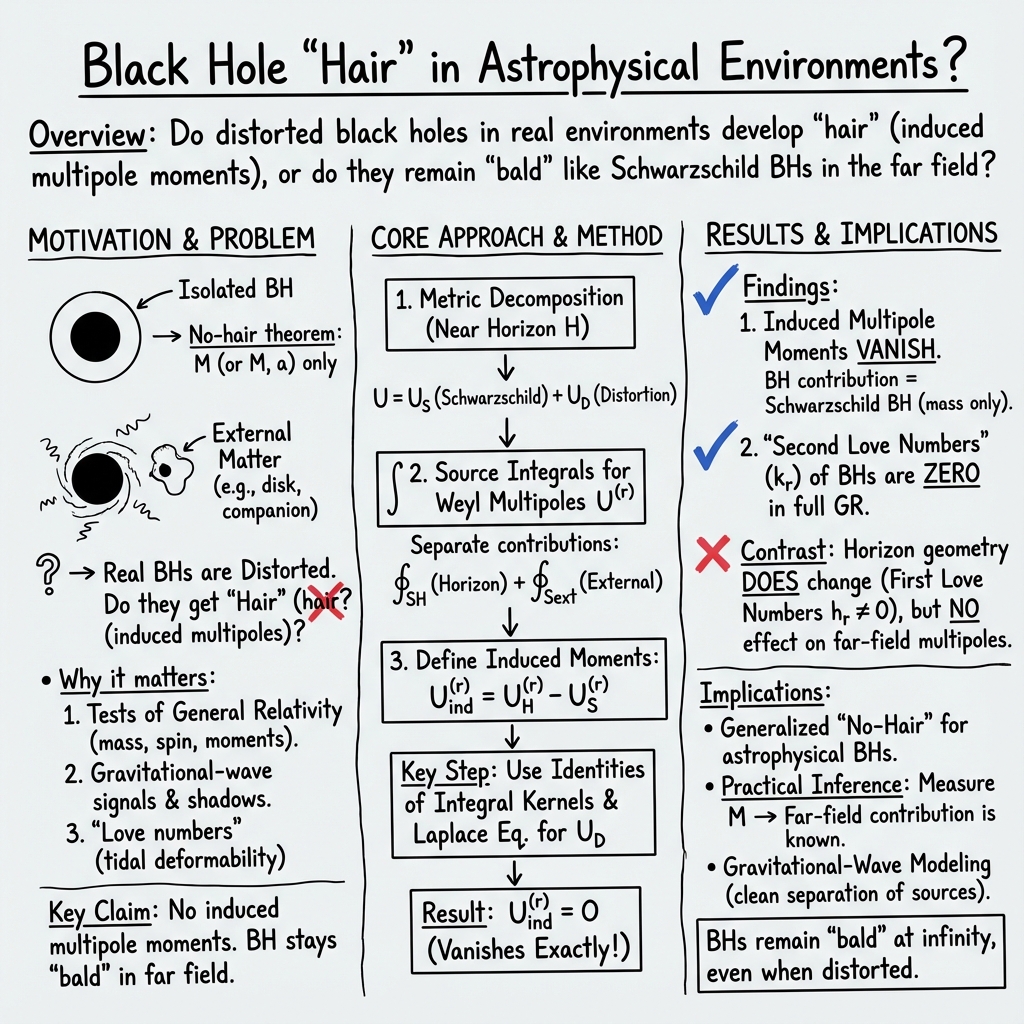
- The paper proves that tidal distortions from external sources do not induce additional multipole moments, preserving the black hole's 'bald' nature.
- Using full general relativity and Weyl metrics, the study analytically derives vanishing Love numbers under astrophysical perturbations.
- The results imply that black hole mass alone characterizes its gravitational influence, simplifying observational and gravitational-wave analyses.
Summary of "No-hair theorem for Black Holes in Astrophysical Environments"
Introduction
The paper "No-hair theorem for Black Holes in Astrophysical Environments" (1503.03240) addresses the application of the no-hair theorem to black holes in realistic astrophysical scenarios. The classical no-hair theorem posits that black holes are characterized solely by their mass, charge, and angular momentum, encapsulated fully in Schwarzschild or Kerr solutions for non-rotating and rotating black holes, respectively. This simplicity is often violated in astrophysical conditions due to the influence of external factors such as binary companions or accretion discs. The paper investigates whether black holes, when subjected to such influences, can still be considered "bald" with no additional multipole moments contributing to the asymptotic gravitational field.
Theoretical Framework and Methodology
Gürlebeck extends the no-hair theorem by considering perturbations induced by external sources while maintaining the core integrity of the black hole's characteristics. The research analyzes how these perturbations affect the multipole moments of the gravitational field at infinity. Using tools from general relativity, particularly Weyl metrics and source integrals, the paper demonstrates that any deviations in the multipole moments due to external distortions do not originate from the black hole but from external sources. This leads to the conclusion that, even under tidal distortions, the black hole retains its "bald" nature. This assertion is analytically proven for full general relativity, moving beyond earlier work that relied on approximation methods.
Key Results
- Vanishing Love Numbers: The paper establishes that the Love numbers of the second kind vanish for black holes under external distortions, confirming that the induced multipole moments are absent. This conclusion corroborates prior findings obtained through approximation techniques but validated here without those constraints.
- Weyl Multipole Moments: The decomposition of Weyl multipole moments reveals that while external sources contribute significantly to the gravitational field structure, the intrinsic contribution from the black hole remains unchanged—consistent with a Schwarzschild black hole model.
- Implications for Astrophysical Observations: In practical terms, the mass of a black hole remains the sole intrinsic parameter needed to account for its gravitational influence, even within complex systems like binaries or those with surrounding matter, simplifying potential observational approaches to characterizing such systems.
Implications and Future Research
This paper has profound implications for understanding the gravitational signatures of black holes in diverse astrophysical environments. The findings assure that despite complexities introduced by external sources, black holes maintain their fundamental character according to general relativity. This preservation implies that measurements of gravitational waves, such as those during inspirals involving neutron stars and black holes, can be reconciled with the predictions of the no-hair theorem. Further research could explore extensions to more dynamic settings, such as rapidly rotating or charged black holes, and test alternative theories of gravity under similar conceptual frameworks.
Conclusion
The study provides significant reinforcement to the no-hair theorem in astrophysically relevant conditions, affirming the resilience of the core properties of black holes amidst external distortions. Its analytical rigor and attention to full general relativity extend confidence in using black hole characteristics as fundamental probes for gravitational interactions in complex, realistic cosmic settings.