- The paper presents a porosity-based Biot model that accurately predicts acoustic wave behaviors in snow, including unexpected phase velocity inversion.
- It employs empirical relationships and plane wave solutions to quantify compressional wave attenuation and dynamic viscous effects across varying porosity levels.
- The findings have practical implications for remote sensing and avalanche detection by elucidating snow’s unique acoustic properties.
A Porosity-Based Biot Model for Acoustic Waves in Snow
Introduction
The paper develops a novel porosity-based Biot model to predict acoustic wave propagation characteristics in snow. Traditional elastic and viscoelastic models fall short in explaining phase velocities and attenuation observed in snow, motivating the need for Biot's theoretical framework for porous materials. This approach is particularly useful given the variable and high-porosity nature of snow, which influences acoustic wave behavior significantly, particularly the anomalous propagation and attenuation effects. The research provides insight into the acoustic properties of snow, which are vital for applications ranging from avalanche detection to snowpack stability analysis.
Methods
Porous Material Properties for Snow
The study utilizes Biot's model by characterizing snow as a porous material defined by properties such as bulk modulus, shear modulus, and tortuosity, framed in terms of porosity. Notably, snow's acoustic behavior is substantially affected by its porosity, with higher porosity leading to lower velocities for compressional waves, contradicting behavior predicted by elastic models. Empirical relationships allow for the derivation of parameters like permeability and specific surface area, essential for predicting wave velocities and attenuations.
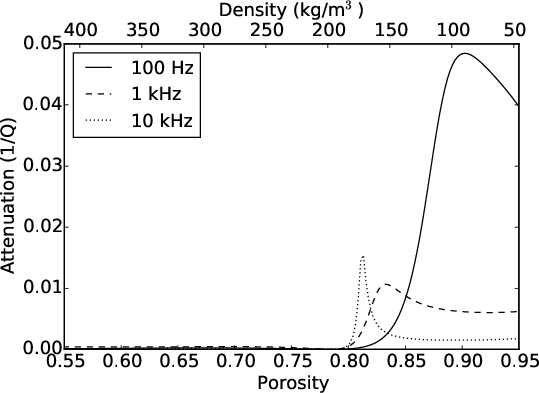
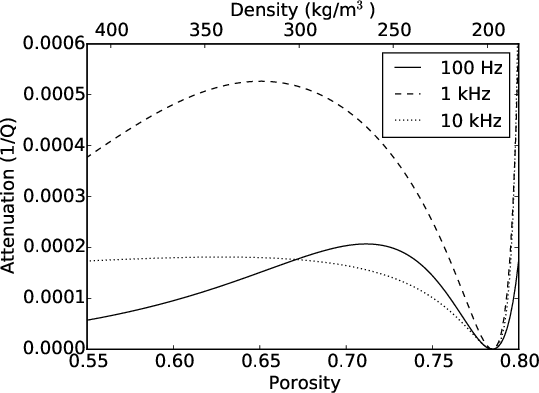
Figure 1: Predicted attenuation for the first compressional wave as a function of porosity. Figure b) shows a fragment of a) for porosities below phi = 0.8.
Phase Velocities and Plane Wave Attenuation
Phase velocities for compressional waves are computed using plane wave solutions to Biot’s equations. The study reveals that the first compressional wave travels primarily in the solid frame while the second moves within the fluid, leading to distinct sensitivities to changes in material parameters. This analytical method successfully correlates predicted velocities with empirical measurements, indicating its validity in capturing snow’s acoustic behavior.
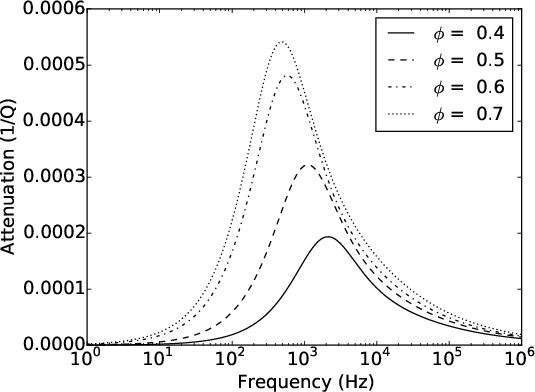
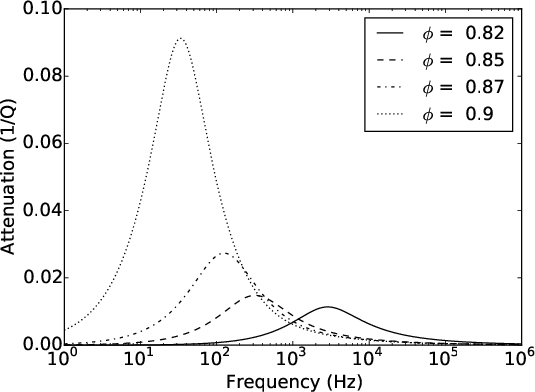
Figure 2: Frequency dependent attenuation for for the first compressional wave in (a) medium to dense and (b) light snow. The peak of the attenuation shifts toward higher frequencies for denser snow.
Results
Compressional Wave Characteristics
The results highlight a reversal in expected wave velocities, where light snow (ϕ≳0.8) exhibits lower velocities for the first compressional wave compared to the second, traditionally termed the "slow" wave. This inversion correlates with increased attenuation, aligning with the empirical observation that sound strongly absorbs in fluffy, fresh snow. Utilizing numerical simulations, the study confirms the theoretical predictions, showcasing the influence of porosity and structural properties on acoustic wave propagation.
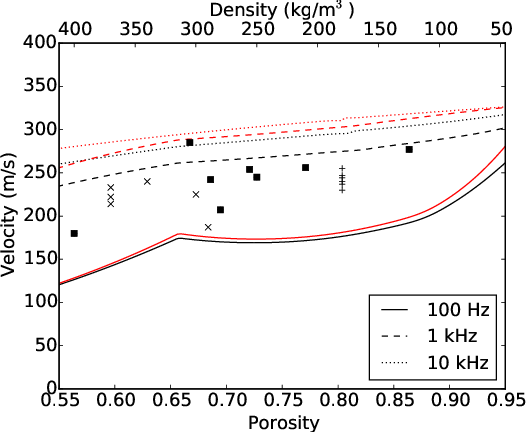
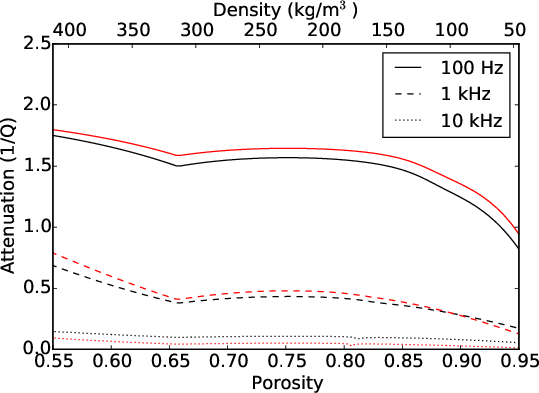
Figure 3: a) Phase velocity and b) attenuation for the second compressional wave for 100~Hz, 1~kHz and 10~kHz. The black lines correspond to solutions including dynamic viscous effects considered by Johnson.
Dynamic Viscous Effects
The inclusion of dynamic viscous effects, acknowledged by Johnson's modification, provides a nuanced understanding. While minimal for the first compressional wave, these effects are more pronounced at higher frequencies near the Biot frequency for the second wave. This accounts for observed deviations and reinforces the importance of considering frequency-dependent permeability in acoustic modeling for snow.
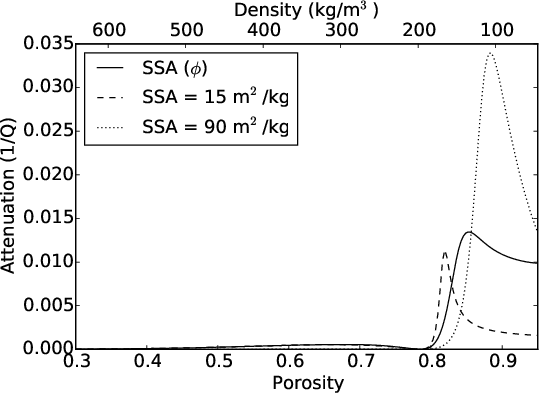
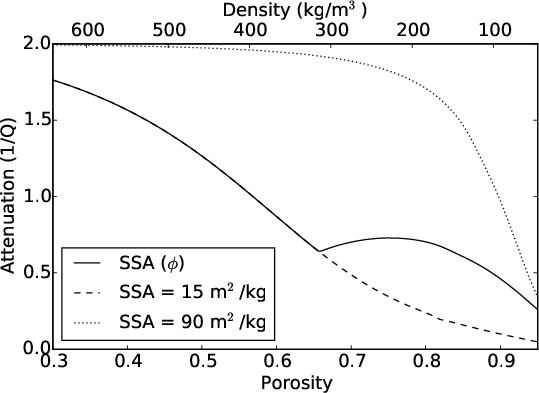
Figure 4: Predicted attenuation at 500Hz for the compressional wave of a) the first and b) second kind as a function of porosity. The dashed and dotted lines correspond to fixed values for specific surface area of SSA = 15 m2/kg and SSA = 90 m2/kg, respectively. The solid line corresponds to equation (\ref{eq:SSA)
Discussion
This paper advances the understanding of acoustic wave propagation in snow by elucidating the relationship between material properties and acoustic behavior, particularly the critical role of porosity. The revelations about wave inversion and distinct attenuation patterns have significant implications for remote sensing and avalanche detection technologies that rely on acoustic signatures.
Conclusion
The porosity-based Biot model successfully delineates the complex interplay of physical properties governing snow's acoustic characteristics. Offering a robust framework for numerical simulations and experimental analyses, this model is poised to facilitate further research and practical applications in snow acoustics, including improved design of acoustic experiments and enhanced avalanche prediction methodologies. Future work may explore the model's extension to account for liquid water content and dynamic environmental conditions, further broadening its applicability.

