Exploring the role of Leggett-Garg inequality for quantum cryptography
Published 1 Oct 2013 in quant-ph | (1310.0438v4)
Abstract: In the cryptographic context, an earlier unexplored application of the temporal version of the Bell-type inequality is shown here in the device-independent (DI) scenario. This is done by using the Leggett-Garg inequality (LGI) to demonstrate the security against eavesdropping in a quantum key distribution (QKD) scheme. This typically involves a higher dimensional attack against which the standard BB84 protocol is insecure. For this purpose, we invoke an appropriate form of LGI. While the key generation is done by the usual Bennett-Brassard 1984 (BB84) method, the security check against device attacks is provided by testing for the violation of the particular form of LGI used here.
The paper presents the LG-BB84 protocol, integrating LGI violation tests into BB84 to detect and quantify device attacks.
It employs sequential measurement correlations to certify security, showing that higher-dimensional cheat states fail to mimic genuine LGI violation.
The work derives error thresholds and highlights that temporal correlations can serve as a practical alternative to spatial entanglement in ensuring DI QKD security.
Leggett-Garg Inequality as a Tool for Device-Independent Quantum Cryptography
Introduction and Motivation
This work investigates the application of the Leggett-Garg inequality (LGI), a temporal variant of Bell-type nonlocality inequalities, for quantum key distribution (QKD) in the device-independent (DI) scenario. Classical QKD protocols—typified by BB84—assume trusted devices, which is generally impractical and exposes them to sophisticated device attacks exploiting higher-dimensional quantum systems. Standard device-independent QKD protocols employ spatially separated entangled states and violation of Bell inequalities, but this work explores the utility of LGI—based on temporal, sequential measurements on a single quantum system—to certify security in such hostile settings (1310.0438).
Device Independence, Security, and Attack Models
The paper highlights that QKD implementations are vulnerable to "device attacks" where untrusted devices (possibly supplied by an adversary, Eve) can simulate legitimate BB84 statistics through higher-dimensional separable "cheat states." Eve can thus deterministically recover secret keys without revealing her presence, rendering BB84 insecure in the DI paradigm. The essential criterion for DI security is nonfactorizable correlations, typically evidenced by violation of Bell-type inequalities.
A particular focus is given to the AGM attack, where Eve introduces cheat states such that Alice and Bob unknowingly measure across hidden degrees of freedom. Here, standard BB84 correlations are reproduced, but Eve obtains deterministic knowledge of the key.
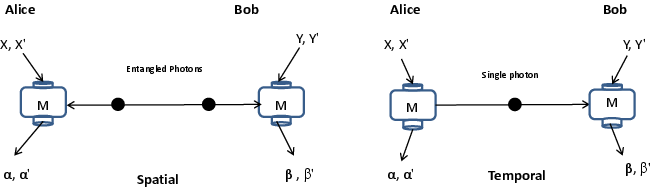
Figure 1: Temporal vs spatial correlations considered in the DI scenario; LGI involves sequential measurements on a single system (temporal), while Bell-inequality settings involve spatially separated entangled systems.
The Leggett-Garg Inequality in Device-Independent QKD
The paper introduces the Brukner et al. form of the LGI as a temporal analog to the CHSH inequality, which quantifies the non-classicality of sequential measurement correlations. Since LGI fundamentally depends on realism and non-invasive measurability, any device or state preparation attack that increases the accessible Hilbert space or mediates distinguishable cheating states will suppress LGI violation. Therefore, verifying LGI violation serves as a test for the absence of such device attacks.
A direct LG-protocol (in analogy with CHSH-based QKD) faces a fundamental limitation: the monogamy of temporal correlations is weaker than spatial correlations, potentially allowing Eve to simultaneously share LGI-violating correlations with both Alice and Bob. The weakened monogamy is quantitatively shown; the sum of Alice-Eve and Alice-Bob temporal correlator bounds exceeds the spatial monogamy value, necessitating stricter thresholds for LGI violation to guarantee security compared to spatial (Bell-based) approaches.
The LG-BB84 Protocol: Construction and Security Analysis
The authors propose the LG-BB84 protocol, which incorporates LGI violation testing into the BB84 framework. Alice prepares random states in X or Y basis; Bob randomly measures in X, Y, or the additional mutually unbiased basis M±=(X±Y)/2. Raw key generation uses standard BB84 postselection; mismatched basis cases with Bob measuring in M± produce the LGI test data.
This construction decouples key generation from device attack detection: the key rate is linked to standard BB84 statistics, while device attacks are revealed through the suppression of LGI violation. The protocol enables QKD in the DI scenario without requiring entanglement, provided Eve's attacks are restricted to the class considered (AGM).
Theoretical expressions for the error rate and LGI violation under combined channel and device attacks are provided. For no device attack (f=0), the LGI violation and security threshold coincide: θ≤4π, yielding eAB≲14.6% and Alice-Bob correlator ΛAB≥22cosθ. Under device attack (f>0), both the error rate and LGI violation degrade, and the secure key rate is explicitly reduced as a function of f. Notably, legitimate BB84 statistics alone would not signal Eve's presence; instead, a reduction in LGI violation indicates the presence and magnitude of the device attack.
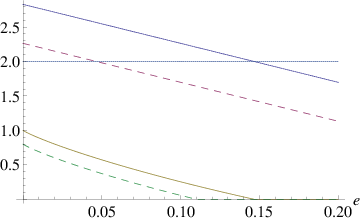
Figure 2: The upper lines show LGI test outcomes, while the lower lines show the positive secret key rate K=IAB−IE as a function of the observed error rate eAB; device attacks (f>0) reduce the tolerable error rate and LGI violation.
Theoretical and Practical Implications
This work establishes that temporal correlations, evidenced by LGI violation, can substitute for spatial nonlocality as a security resource in DI QKD, at least for certain classes of device attacks. The critical insight is that LGI violation cannot be faked by higher-dimensional cheat states or by sharing separable quantum resources across devices, in contrast to BB84 correlations.
The protocol's security is directly linked to observed LGI violations. The practical implication is that entanglement and spatial separation are not strictly required for DI QKD security verification against certain attacks; sequential, single-system protocols suffice, simplifying implementation. However, the analysis reveals that the weakened monogamy of temporal correlations reduces security margins compared to standard Bell-based DI QKD. For more sophisticated device attacks, including those exploiting device memory or leaking state information, further developments (potentially semi-device-independent approaches) are necessary.
Future Directions
The authors note that their security proof applies to the AGM attack and not to the most general device attacks, such as memory-assisted attacks or those allowed in fully device-independent scenarios. Extending LGI-based security tests to these general cases, potentially employing dimension witnesses or memory attack countermeasures, is indicated as an area for future research.
Further, a rigorous characterization of the quantitative relation between LGI violation and extractable key rates under realistic imperfections and experimental constraints would be invaluable for transitioning these ideas to practical QKD systems.
Conclusion
This work demonstrates that LGI violation, traditionally studied as a test of macrorealism and invasive measurement, provides a novel operational tool for certifying the security of QKD protocols in the device-independent scenario against specific device attacks. The LG-BB84 protocol combines efficient key generation with robust device attack detection via temporal correlator tests, revealing both the promise and inherent limitations of temporal non-classicality for quantum cryptography (1310.0438).
“Emergent Mind helps me see which AI papers have caught fire online.”
Philip
Creator, AI Explained on YouTube
Sign up for free to explore the frontiers of research
Discover trending papers, chat with arXiv, and track the latest research shaping the future of science and technology.Discover trending papers, chat with arXiv, and more.