- The paper introduces fundamental principles of algebraic topology, employing homotopy and homology to classify and analyze topological spaces.
- It presents computational methods, including persistent homology, to extract invariant features from complex data structures.
- The work highlights applications in physics, notably in analyzing defects in nematic liquid crystals through topological invariants.
Summary of "Algebraic Topology" (1304.7846)
Algebraic topology is a vital area within mathematics, focusing on the properties of spaces that are invariant under homeomorphisms. This manuscript introduces key concepts of algebraic topology, emphasizing applications relevant to the physical sciences, and provides a brief overview of computational aspects, including persistent homology.
Introduction and Fundamental Concepts
The chapter begins with an introduction to topology, which examines properties of spaces that remain unaffected by continuous deformations. One can understand topology through several branches: general topology, algebraic topology, and differential topology. Algebraic topology, the focus of this chapter, deals with deriving algebraic structures, typically groups, from topological spaces, assisting in recognizing when two spaces are equivalent in a topological sense. It uses tools like homotopy and homology to characterize topological spaces.
Homotopy theory is introduced as a mechanism for identifying when two spaces exhibit the same topological features, allowing continuous deformations. Homotopy equivalence is critical in relating paths within spaces to algebraic structures. Figures such as Figure 1 illustrate the homotopy between mappings involving circular and spherical spaces.
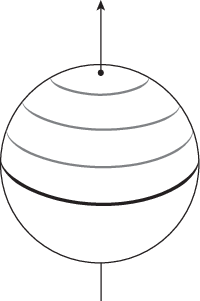
Figure 1: The function f:S1→S2 maps the circle onto the sphere's equator, demonstrating homotopic relationships.
Algebraic topology employs the fundamental group, an essential concept representing equivalence classes of loops based in a given space, thereby providing profound insights into its structure. Figure 2 details loop equivalences on the torus, demonstrating fundamental group operations.
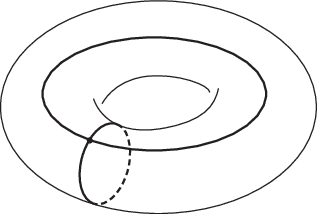
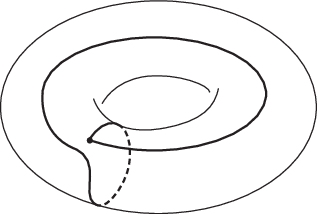
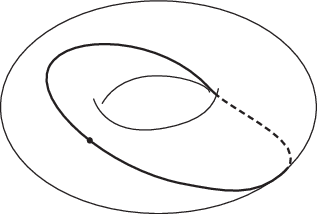
Figure 2: Non-homotopic loops on a torus illustrate equivalences through concatenated paths.
Homology and Cohomology
Homology theory complements homotopy, capturing higher-dimensional analogs and allowing characterization of spaces in terms of cycles and boundaries. Simplicial homology, built on triangulated complexes, offers computational advantages and is discussed in depth.
Complexes, including cubical and singular formulations, provide alternative approaches to homology, appropriate for various applications. Cohomology, a dual framework to homology, reveals additional algebraic structures such as products, enhancing capabilities beyond simple cycle and boundary analysis.
Applications in Physics
Homotopy and homology have profound implications in physics, particularly in understanding defects in nematic liquid crystals, as depicted in Figure 3, which examines the structural dynamics and defects in these systems.
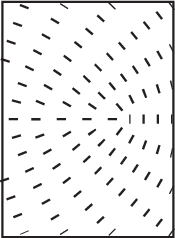
Figure 3: Line defects in nematic fluids, highlighting the molecular orientation's averaged direction.
Computational Topology
Computational topology advances the practical applications of mathematical concepts by providing algorithms to derive topological invariants from data. Persistent homology, a state-of-the-art development, tracks changes in topological features across parameterized modifications, offering robust insights for applications in data analysis and beyond. The efficacy of computational techniques is portrayed through algorithms for calculating the fundamental group and homology groups, critical for analyzing complex data structures.
Conclusion
The introductory nature of this chapter on algebraic topology establishes foundational principles, bridging the gap between abstract mathematical theory and tangible scientific applications. Future directions in both theoretical development and computational strategies are likely to expand the relevance and application of algebraic topology, particularly in complex physical and data-centric domains.