Abstract: All-linear-optical scheme for fully featured quantum router is presented. This device directs the signal photonic qubit according to the state of one control photonic qubit. In the introduction we formulate the list of requirements imposed on a fully quantum router. Then we describe our proposal showing the exact principle of operation on a linear-optical scheme. Subsequently we provide generalization of the scheme in order to optimize the success probability by means of a tunable controlled-phase gate. At the end, we show how one can modify the device to route multiple signal qubits using the same control qubit.
The paper introduces a linear-optical quantum router that routes signal qubits using controlled-phase, QND, and programmable-phase gates at the single-photon level.
It achieves genuine, non-demolition quantum routing with variable success probability by tuning the routing parameter via the control qubit.
The design scales to multi-qubit routing with a recirculating control photon, paving the way for resource-efficient quantum communication networks.
Resource-Efficient Linear-Optical Quantum Router: Scheme, Analysis, and Optimizations
Introduction and Motivation
The realization of robust quantum networks relies on efficient information routing mechanisms compatible with the fundamental restrictions of quantum information, notably the no-cloning theorem. While classical routers leverage the freedom to duplicate and fan out information, quantum routers must manage the routing operation at the single-qubit level while maintaining coherence and minimizing disturbance to the signal qubit. Previous proposals for quantum routers—both light-matter hybrid and linear-optical-only—commonly fail to simultaneously satisfy requirements such as qubit-based control, signal integrity, coherent superposition of outputs, elimination of destructive post-selection at the signal output, and resource efficiency per routed qubit.
This paper introduces an all-linear-optical quantum router that addresses the deficiencies of previous designs. The scheme achieves genuine, non-demolition quantum routing, required for scalable quantum communications networks, using only experimentally accessible optical elements and a minimal number of control qubits.
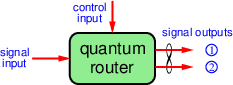
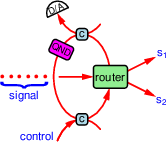
Figure 1: Conceptual illustration of a quantum router that directs quantum information according to the state of a control qubit.
All-Linear-Optical Router Design
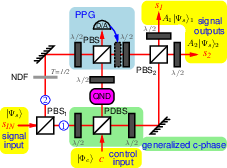
The core function of the router is to direct a photonic signal qubit, encoded in polarization, into either of two output spatial modes (or their superposition) conditional on the quantum state of a control qubit, also encoded in polarization. The design makes use of three essential quantum gates: the controlled-phase (c-phase) gate, the quantum non-demolition (QND) detection gate, and the programmable-phase gate (PPG). Signal routing occurs via the interaction of the control and signal photons in a series of linear-optical networks featuring polarizing beamsplitters (PBS), polarization-dependent beamsplitters (PDBS), half-wave plates (HWP), and neutral density filters (NDF).
Figure 2: Linear-optical implementation of the quantum router using polarization and spatial degrees of freedom, including key components: PBS, PDBS, HWPs, QND, PPG, and polarization analysis stages.
The router operates as follows:
The signal photon's polarization encodes the quantum information.
The control photon's polarization determines the routing ratio via parameter θ.
Interaction at a c-phase gate entangles the signal and control photons, and a QND gate ensures heralded operation without destructive measurement of the signal.
The output is a coherent superposition where the signal remains unaltered in the polarization degree of freedom, but emerges in a superposition of spatial modes determined by the control state.
A salient property is that the output state is ∣Ψs⟩OUT=A1∣Ψs⟩1+A2∣Ψs⟩2, where ∣A2/A1∣=tanχ=tanθ/3. The router therefore enables full quantum routing, including superpositions, with a single control qubit.
Performance Analysis: Success Probability and Control
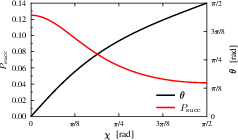
The router is inherently probabilistic due to the use of linear-optical gates. The overall success probability, Psucc, depends solely on the control parameter θ (or equivalently the routing ratio χ), as shown in Figure 3.
Figure 3: Success probability as a function of routing parameter χ and its relationship to the control qubit angle θ.
The best-case success probability is 81 (full routing to one output), and the worst case is 241 (equal superposition routing). Uniformization to a state-independent probability 241 is achievable by introducing an additional attenuation on one output. The router's signal-state independence is preserved—output probabilities are controlled solely by the control qubit and not the particular signal quantum state.
Optimization via Tunable c-Phase Gates
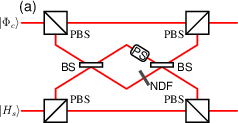
The original design uses a fixed π-phase c-phase gate; however, leveraging results from [Kieling et al., New J. Phys. 12, 013003 (2010)], the paper proceeds to generalize the router to exploit tunable c-phase gates. These gates can implement arbitrary phase shifts φ∈[0,π], with a success probability PC that monotonically increases as φ approaches zero.
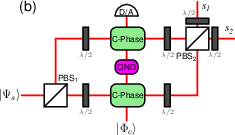
Tunable c-phase gates allow increased success probabilities for scenarios requiring limited routing superposition (i.e., small χ). The revised setup replaces the PPG with an equivalent c-phase gate, modifies the internal transformations accordingly, and leads to optimal performance for specific routing regimes.
Figure 4: Schematic (a) for tunable c-phase gate using an interferometric approach, and (b) modified router architecture featuring two tunable c-phase gates for enhanced performance.
For small routing ratios, success probabilities can approach 21, exceeding the fixed-c-phase design. However, for maximum superposition capability, the original design remains preferable. The paper provides explicit analytic forms for achievable routing ratios and the success probability as functions of the applied phase and control parameters.
Multi-Qubit Routing and Resource Scalability
The authors extend the router architecture to accommodate simultaneous routing of multiple independent signal qubits with a single control qubit by employing QND detection and recirculating the control photon. The routing operation is cascaded such that each signal qubit interacts sequentially with the control qubit, which is then projected jointly onto the desired basis only after all routing steps.
Figure 5: Extension of the linear-optical router concept to multi-qubit routing with a single recirculating control qubit, enabling resource-efficient scaling.
The success probability for the multi-qubit router decreases exponentially with the number of routed qubits: Ptotal=21−4n(1−98sin2θ)n. This formalism enables the construction of quantum routers for limited-size superpositions or as a primitive for generating NOON states for metrology and quantum lithography applications.
Implications and Outlook
This work provides, for the first time, a purely linear-optical post-selection-based quantum router that fulfills all required practical and theoretical criteria for genuine quantum routing with minimal quantum resources. The design is experimentally accessible, does not invoke strong light-matter couplings or nonlinearities, and affords high-fidelity transmission of arbitrary signal states, as control and routing are fully decoupled. The tunable c-phase enhancement represents an effective tradeoff between routing flexibility and operational success probability, directly supporting practical implementations in near-term quantum photonic networks.
Potential applications extend to adaptive quantum communications, programmable network architectures, and quantum-enhanced metrology through scalable generation of path-entangled states. Open directions include improved heralding strategies via detector advances and the integration of on-chip photonic platforms to further enhance experimental viability.
Conclusion
The presented linear-optical quantum router constitutes a resource-efficient and experimentally feasible approach to routing quantum information at the single-photon level with high control and fidelity. The scheme's compatibility with current quantum photonic technologies, its extension to multi-qubit scenarios, and opportunities for success probability optimization position it as a foundational building block for future quantum network infrastructure.