Roche volume filling of star clusters in the Milky Way
Published 10 Dec 2012 in astro-ph.GA | (1212.2021v1)
Abstract: We examine the ratios $r_h/r_J$ of projected half-mass and Jacobi radius as well as $r_t/r_J$ of tidal and Jacobi radius for open and globular clusters in the Milky Way using data of both observations and simulations. We applied an improved calculation of $r_J$ for eccentric orbits of globular clusters. A sample of 236 open clusters of Piskunov et al. within the nearest kiloparsec around the Sun has been used. For the Milky Way globular clusters, data are taken from the Harris catalogue. We particularly use the subsample of 38 Milky Way globular clusters for which orbits have been integrated by Dinescu et al. We aim to quantify the differences between open and globular clusters and to understand, why they form two intrinsically distinct populations. We find under certain assumptions, or, in other words, in certain approximations, (i) that globular clusters are presently Roche volume underfilling and (ii) with at least $3σ$ confidence that the ratio $r_h/r_J$ of half-mass and Jacobi radius is $3 - 5$ times larger at present for an average open cluster in our sample than for an average globular cluster in our sample and (iii) that a significant fraction of globular clusters may be Roche volume overfilling at pericentre with $r_t > r_J$. Another aim of this paper is to throw light on the underlying theoretical reason for the existence of the van den Bergh correlation between half-mass and galactocentric radius.
The paper quantifies Roche volume filling ratios (λ = r_h/r_J) for open and globular clusters, showing GCs are generally underfilling except near pericenter.
It refines tidal radius calculations by extending methods to eccentric orbits using improved Galactic potential models and robust N-body simulations.
The study highlights that open clusters' higher λ values make them more vulnerable to tidal stripping, while the compactness of GCs underpins their long-term stability.
Roche Volume Filling of Star Clusters in the Milky Way
Introduction
This work rigorously analyzes the dynamical state of open clusters (OCs) and globular clusters (GCs) in the Milky Way via their Roche volume filling properties. The study quantitatively examines the ratios of half-mass and tidal radii to the Jacobi (tidal) radius, refining previous methodologies by extending the calculation of rJ to eccentric orbits, thereby providing a more general and accurate framework for Milky Way clusters. Large, well-defined observational samples for OCs and GCs are leveraged, and robust error analysis is performed.
Theoretical Framework
The key parameter studied is λ=rh/rJ, where rh is the (3D) half-mass radius and rJ the Jacobi (tidal) radius for a cluster in the Galactic tidal field. An analogous parameter, λ=rt/rJ, uses the cutoff (tidal) radius rt. The analytic approach derives expressions for these ratios, considering both circular (characteristic of OCs) and eccentric orbits (characteristic of GCs). The calculation of rJ follows the formulation of King (1962), incorporating Galactic potential models, thus capturing the dependence on orbital eccentricity, local rotation curve, and angular momentum.
For clusters on circular orbits, the relation
rJ=[(4−βC2)ΩC2GMcl]1/3
is applied, where βC is a dimensionless epicyclic-to-circular frequency ratio and is roughly constant outside the solar radius.
Figure 1: The ratio βC at z=0 for different Milky Way potential models, showing its insensitivity to Galactocentric radius beyond $2-3$ kpc.
For eccentric orbits, an improved analytic scheme is presented, accounting for instantaneous orbital position and guiding-center radius, crucial for GCs' realistic orbital dynamics.
Observational and Simulation Data
Extensive datasets underpin the analysis. The Piskunov et al. sample of 236 OCs within 1 kpc of the Sun provides homogeneous measurements of core, tidal, and half-mass radii, corrected for projection effects. Orbital parameters (e.g., Torb, e) are statistically characterized. For GCs, well-characterized structural and orbital parameters are sourced from the Harris catalogue and the 38 GC orbit sample by Dinescu et al., with direct N-body simulations supplementing the theoretical modeling.
Results
Open Clusters
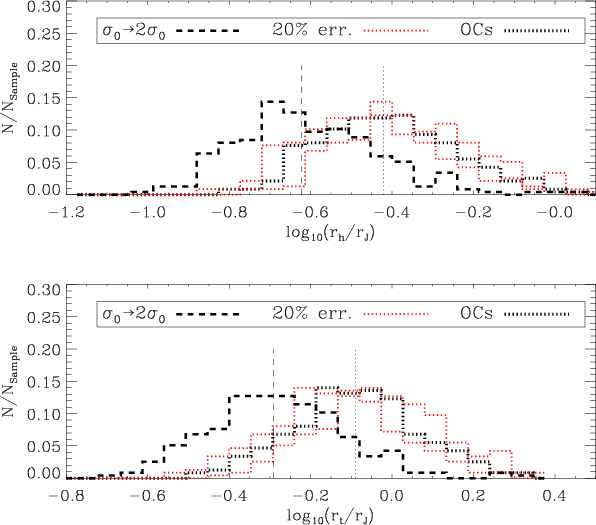
The distribution of λOC=rh,3D/rJ shows a broad range, with median values indicating that many OCs are Roche volume filling and a non-negligible fraction are overfilling. The typical λOC lies in the range $0.2-0.8$ depending on the estimator.
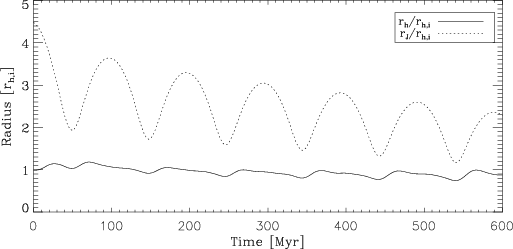
Figure 2: Time evolution of the half-mass and Jacobi radii in an N-body disc cluster simulation, showing rapid changes due to tidal effects.
Uncertainties in velocity dispersion (e.g., from unresolved binaries) are explored by varying σ0, with robust results for the distribution and median of λ.
Globular Clusters
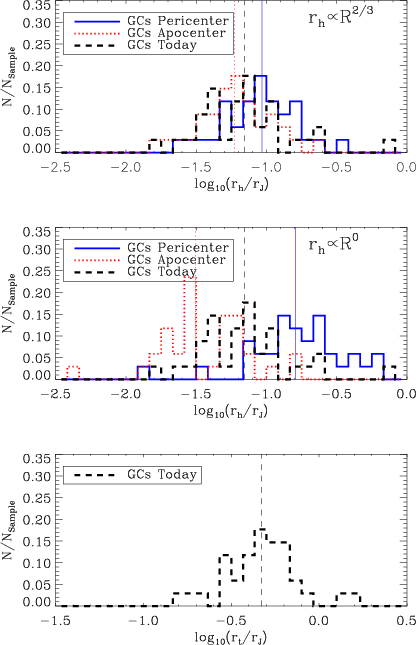
For GCs, the analysis at the present epoch and at peri- and apocenter demonstrates λGC values systematically an order of magnitude lower than for OCs, indicating that GCs are strongly Roche volume underfilling at most orbital phases. Only at pericenter does a substantial minority approach Roche volume filling, contingent on the compression state of the outer layers.
Figure 3: The ratios rh,3D/rJ for GCs across orbital phases, highlighting the consistently underfilling state except at pericenter.
Direct Comparison
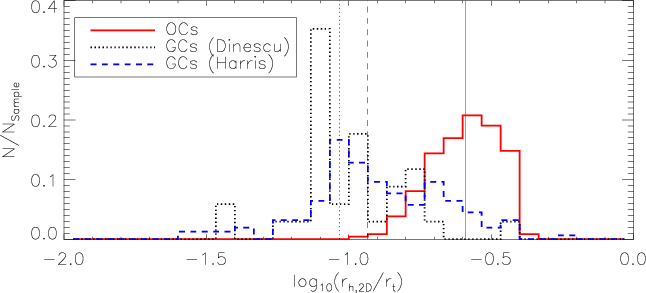
Figure 4: Ratio rh,2D/rt for OCs and GCs, quantifying differences in structural concentration; OCs have much lower concentration than GCs.
A striking result is that median λ values for OCs are $3-5$ times larger than for GCs, with high confidence (exceeding 3σ when uncertainties and systematic biases are considered). The ratio rt/rh further establishes a dichotomy between the two populations: OCs correspond to low W0 King models (low concentration), GCs to high W0 models (high concentration).
Discussion
Principal findings are:
GCs are presently Roche volume underfilling, with λGC=rt/rJ=0.3−1.0 and λGC≪1 in most cases.
OCs exhibit much larger λ, with typical values indicating Roche volume filling or overfilling, implying vulnerability to tidal dissolution.
The structural difference is robust: GCs have high central concentrations, OCs low, as quantified by both λ and rt/rh statistics.
These results imply that OCs are highly susceptible to tidal stripping beyond their Jacobi radius, and therefore short-lived, consistent with observations. In contrast, GCs’ compactness makes them stable against tidal dissolution, explaining their spherical morphologies and persistence over Gyr timescales.
The analysis supports a dynamical origin for the observed van den Bergh correlation (rh∝R2/3) for GCs, rooted in the scale-setting role of the Galactic tidal field.
Figure 5: The ratio rh,3D/rJ for GCs at various orbital phases, illustrating the limited fraction of GCs that become tidally filling at pericenter.
Implications and Future Perspective
These results have several implications for Galactic dynamics and star cluster evolution. They provide a coherent explanation for the morphological and survival differences between GCs and OCs, tying them to fundamental dynamical constraints imposed by Galaxy structure and cluster orbits.
The consistently underfilling state of GCs suggests that historical GC formation processes favored deep potential wells, whereas OC formation (post-gas expulsion) permits configurations at or beyond their instantaneous tidal limit. Hence, these findings constrain the initial conditions for cluster formation models and the physics of subsequent dynamical evolution.
On the theoretical side, this means the framework for calculating tidal radii (i.e., appropriate choice of rJ) must account for orbital eccentricity and the time-dependent Galactic potential, especially for GCs. The scaling arguments and statistical approach here will remain foundational for population synthesis and large-scale dynamical modeling.
Empirically, the study underscores the need for more complete GC orbital samples, improved constraints on OC kinematics (e.g., binary fraction corrections), and refined simulations that capture the full cluster mass spectrum and gas expulsion history.
Conclusion
This paper presents a comprehensive and quantitatively robust analysis of Roche volume filling factors for Milky Way star clusters, demonstrating a pronounced and statistically significant dichotomy between open and globular cluster populations. GCs are Roche volume underfilling except possibly at pericenter, while OCs are typically Roche volume filling or overfilling. This structural difference is intimately linked to cluster survivability, morphology, and dynamical evolution, and arises naturally from Galactic tidal constraints and cluster initial conditions. The work both improves analytic techniques for Roche calculations and sets an agenda for future data collection and modeling necessary to further refine our understanding of star cluster evolution in the Galactic context.