- The paper presents a cost-effective design for IsoDAR that balances high-rate antineutrino production with minimized operational risks.
- It details the use of H₂⁺ acceleration in a compact cyclotron to achieve low beam loss and precise extraction for efficient isotope and neutrino generation.
- Comparative assessments highlight IsoDAR’s advantages over alternative accelerator designs, emphasizing its scalability and potential for future industrial applications.
Cost-effective Design Options for IsoDAR: Technical Analysis and Comparative Assessment
Introduction
"IsoDAR" (Isotope Decay At Rest) is a high-intensity electron antineutrino source designed to enable stringent searches for physics beyond the Standard Model, including sterile neutrino oscillations, non-standard interactions, and possible exotic particle production. The experiment aims to supply 2.6×10²² νˉe per year, with mean energy 6.4 MeV, using 8Li beta-decay. The design synthesizes requirements for cost-effectiveness, compactness, technical feasibility, operational simplicity, and extensibility to broader neutrino and isotope production programs. This essay presents a technical summary and critical analysis of the IsoDAR design, based on (1210.4454), and evaluates alternatives with respect to achievable neutrino flux, operational risk, and implications for future research and industry applications.
Design Criteria and Experimental Motivation
The IsoDAR project is motivated by the need for a robust, high-rate νˉe source with well-defined spectral characteristics, minimal backgrounds, and compatibility with kilo-tonne-scale liquid scintillator detectors, exemplified by KamLAND. Key cost-effectiveness criteria include:
- Minimizing capital and operational costs
- Maximizing νˉe flux and optimizing energy spectrum for oscillation analysis and background suppression
- Reducing backgrounds (notably intrinsic νe and cosmogenic activities)
- Maintaining low technical and operational risks
- Ensuring underground-compatibility via compactness and modular assembly
- High reliability and schedule adherence
- Enabling future physics programs and industry collaboration, especially for isotope production
The baseline IsoDAR design is held as the reference, against which RFQ/sector cyclotrons, LINACs, β-beam concepts, and alternatives using existing accelerators are rigorously compared.
Baseline IsoDAR System Architecture
Ion Source and Acceleration
The experiment leverages a 60 MeV/amu compact cyclotron, accelerating 5 mA H2+ (delivering 10 mA of protons to target via the molecule's double nucleon content). The Versatile Ion Source (VIS) enables high-brightness, low-emittance H2+ production with low technical risk.
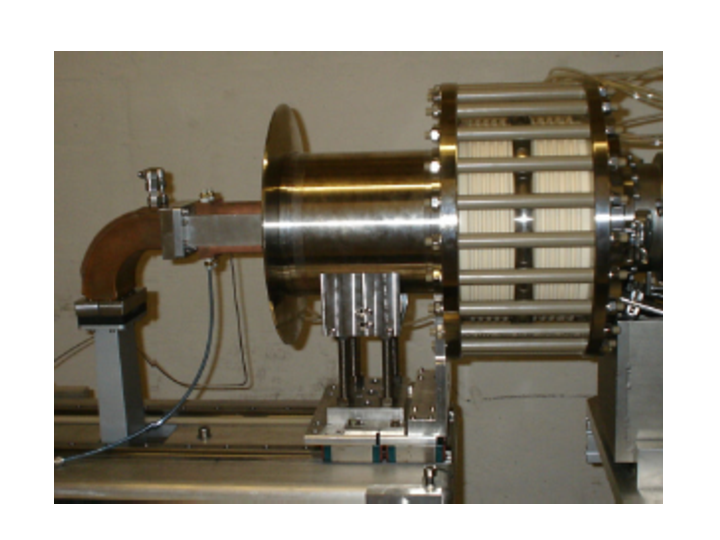
Figure 1: The Versatile Ion Source (VIS) supporting high-current H2+ extraction for cyclotron injection.
H2+ injection mitigates space charge effects (generalized perveance), a crucial consideration at high currents relevant for cyclotron-based drivers, making the approach superior over pure proton or H− acceleration in terms of manageable beam loss and downstream extractability.
Cyclotron Design and Extraction
The cyclotron applies a monolithic, four-fold symmetric dipole and hill-valley magnet configuration for isochronous acceleration, facilitating effective vertical focusing and high turn separation at extraction.
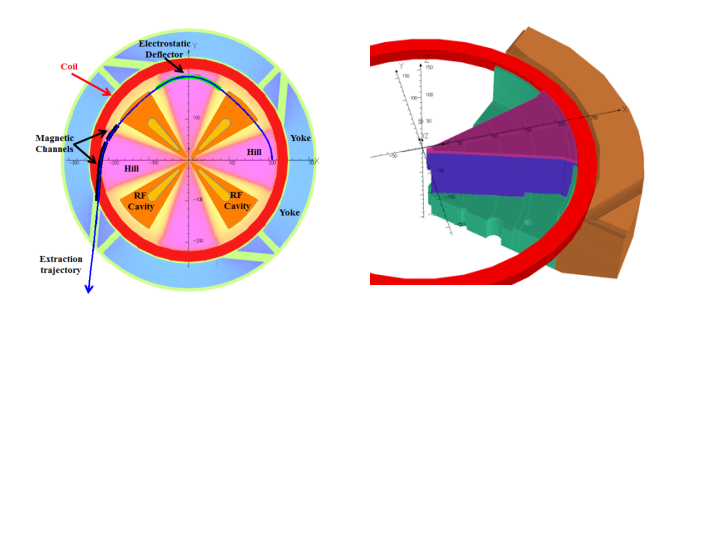
Figure 2: Cyclotron architecture: field map, RF cavity positioning, and finite-element breakdown.
Key features include:
- Isochronism precision <5×10⁻⁴
- 4 RF cavities at 49.2 MHz/harmonic 6th; 106 turns to final energy
- 20 mm last-turn separation
Electrostatic septum extraction achieves <1% beam loss (sub-150 W at full current) due to wide turn separation and minimal halo.
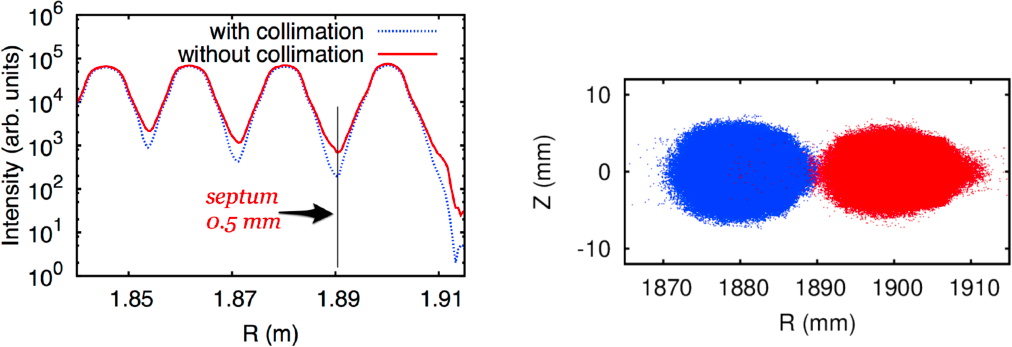
Figure 3: OPAL simulations show <1% beam loss on a 0.5 mm septum with tight control of last turn profile.
As backup and for distribution to multiple isotope production targets, a stripper-foil design is considered but is less attractive due to foil lifetime limitations at these high currents.
The cyclotron’s mechanical design is tailored for modular underground assembly; all components remain within the dimensional and weight constraints of existing tunnels (e.g., KamLAND access), with segmentable coils and scalable pole/yoke geometry.
Beam Transport and Target System
The 600 kW, 10 mA, 60 MeV/amu H2+ beam is uniformly distributed over a 20 cm target area using magnetic wobblers, lowering power density (∼2 kW/cm2) and enabling use of technically tractable target designs.
Neutron Source and νˉe Production
IsoDAR’s neutrino production concept is a 9Be target surrounded by a 150 cm-long, 99.99% pure 7Li sleeve, with an intermediate D2O moderator. Neutrons generated by p+9Be interactions are thermalized in D2O and captured by 7Li, yielding 8Li, whose β decay drives the high-rate νˉe emission.
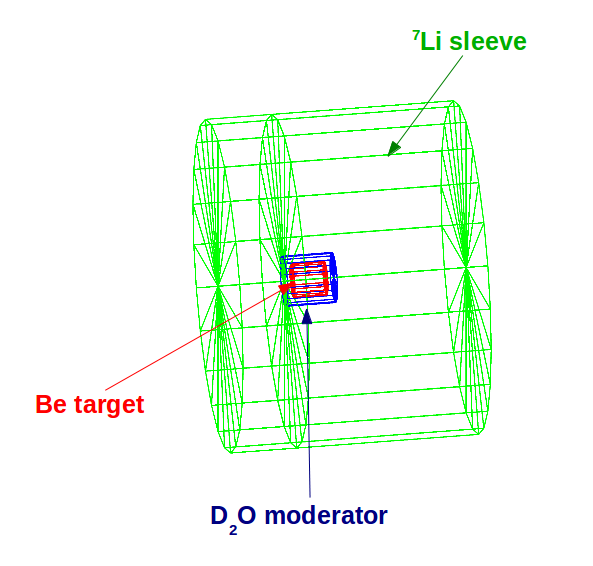
Figure 4: Baseline target/sleeve configuration: beryllium target within a 7Li sleeve.
Heat handling in the target considers both solid beryllium and segmental BeO at the Bragg peak for enhanced resilience. The use of pure 7Li in the sleeve is critical—natural lithium introduces orders of magnitude degradation in 8Li yield due to high neutron-capture competition from 6Li, as quantified in event simulations.
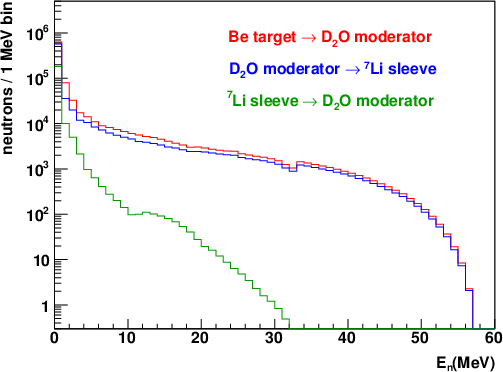
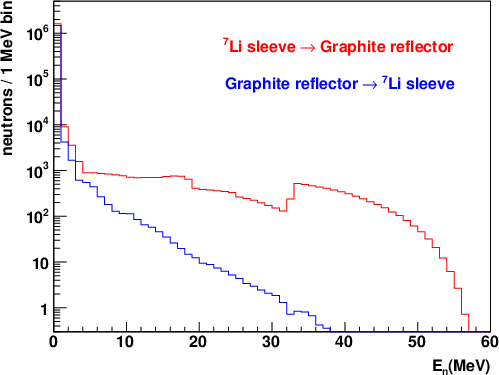
Figure 5: Neutron energy spectra at key geometric boundaries through target/moderator/sleeve.
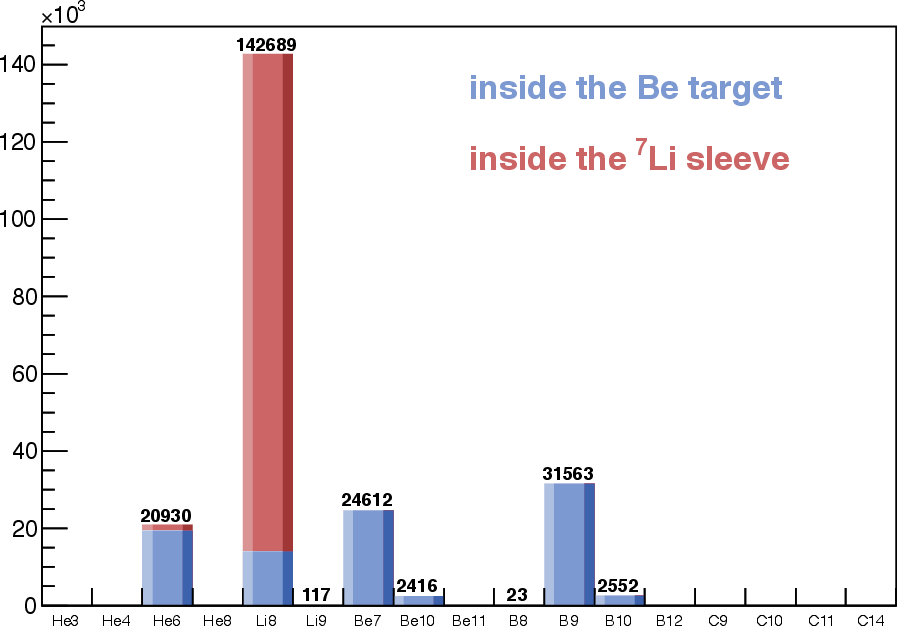
Figure 6: Isotope yields within the full target/sleeve geometry for 107 protons on target, validating production rates.
The system is enclosed in a 3.5 m combined steel/concrete shield, meeting both occupational and experimental background tolerances.
Event Rates and Sensitivity
Flux and event rate simulations demonstrate 1.29×10²³ νˉe for 5-year exposures, yielding 8.2×10⁵ IBD events and 7200 νˉe-electron scatterings in KamLAND.
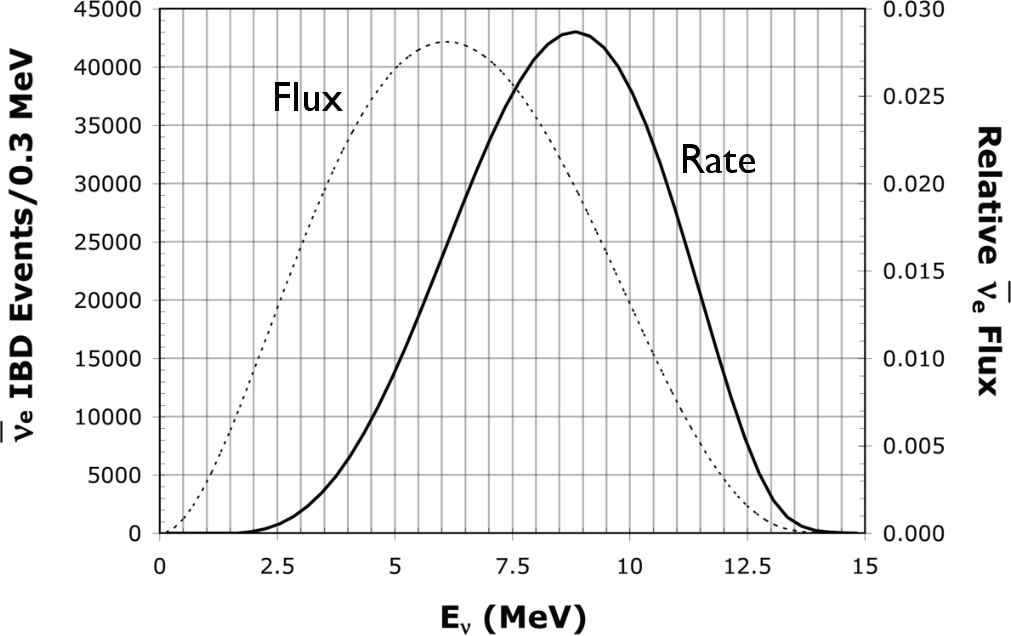
Figure 7: Simulated νˉe flux and IBD event distribution at KamLAND for baseline IsoDAR operation.
This unprecedented rate enables high-precision sterile neutrino oscillation and NSI searches, with the spectral quality and low background instrumental in isolating new physics.
Synergies and Broader Implications
Medical Isotope Production
The IsoDAR cyclotron’s high current and 60–70 MeV energy are optimal for synthesizing a range of medical isotopes inaccessible to lower-energy commercial cyclotrons. The architecture allows staged extraction to support multiple production lines via sequential stripper foils and dipoles, thus fulfilling both research and industrial demand for PET, SPECT, and tracer isotopes.
ADS and Future Neutrino Programs
The high reliability, compactness, and current handling of the IsoDAR booster are relevant to accelerator-driven subcritical reactor concepts and chained-cyclotron systems for CP-violation/long-baseline programs (e.g., DAEδALUS). The design choices, particularly the H2+ front-end, are structurally mandatory for multi-GeV acceleration and high-power ADS.
Comparative Evaluation of Alternatives
Particle and Energy Alternatives
An exhaustive analysis of alternative beam species and energies underscores the superiority of H2+ at 60 MeV/amu. Deuteron beams are rejected due to activation and neutron loss issues. H− and proton beams are limited by unmanageable space charge, greater required cyclotron size (cf. PSI Injector II), or foil lifetime constraints. Table- and simulation-based assessments show that moving either below or above 60 MeV drastically reduces industrially-realizable current or inflates costs and size beyond underground feasibility.
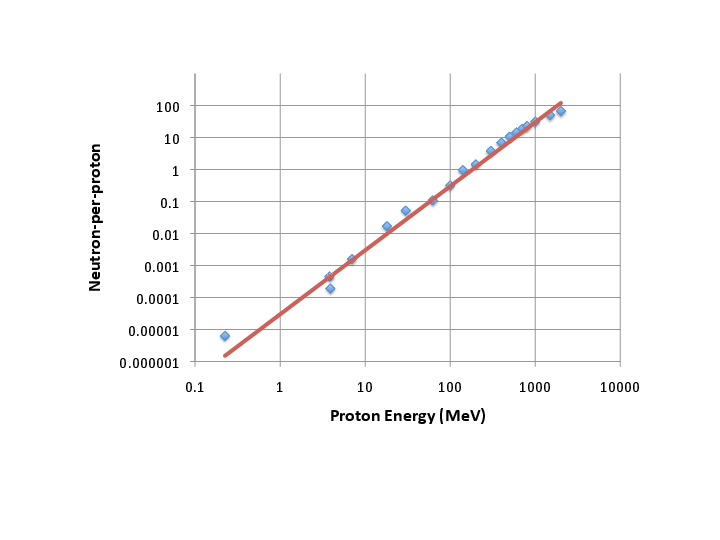
Figure 8: Neutron yield per incident particle vs. beam energy illustrates the quadratic scaling and rationalizes choice of 60 MeV for IsoDAR.
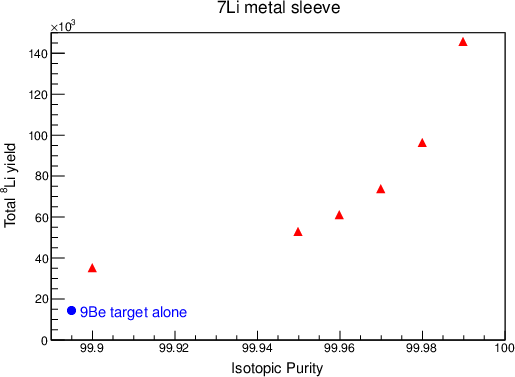
Figure 9: 8Li production as a function of 7Li sleeve purity demonstrates steep yield degradation even with minor isotopic contamination.
Target and Sleeve Material Variations
Copper and tungsten were considered as target materials for heat management and neutron output; while tungsten performs well for yield, radioactive activation and handling complexities make beryllium preferable for underground deployment. Alternative sleeves (boron-based, natural lithium) were ruled out for insufficient 8Li yield and/or practical supply concerns.
Accelerator Alternatives
- RFQ/separated sector cyclotron: Technically feasible via high-energy injection, but incurs a 40% or greater cost overhead and only marginal performance gains.
- High-current LINAC: Linear accelerators at 30 MeV/40 mA meet flux requirements but are cost-prohibitive ($\gg\$50Mprojected).</li><li><strong>FFAGs/RCS:</strong>FFAGdevelopmentimmaturityandrapidcyclingsynchrotroncurrentlimitationsorextractioninefficienciesprecludecompetitiveness.</li><li><strong>\beta−beaminspiredconcepts:</strong>Insufficient^8Liproduction(byanorderofmagnitude)andmajorcomplexitysimplyruleoutallsuchoptions.</li><li><strong>Newdetectorsatexistingaccelerators:</strong>Civilconstructionscalesandbackgroundrates(duetodutycycleandoverburdenconstraints)makethisunattractivecomparedtoIsoDARatanexistingundergrounddetector.<imgsrc="https://emergentmind−storage−cdn−c7atfsgud9cecchk.z01.azurefd.net/paper−images/1210−4454/parameterspace.png"alt="Figure10"title=""class="markdown−image"loading="lazy"><pclass="figure−caption">Figure10:ComparativemappingofIsoDAR’sparameterspace;thedesignisuniquelysituatedamonghigh−current,moderate−energycompactcyclotrons.</p><imgsrc="https://emergentmind−storage−cdn−c7atfsgud9cecchk.z01.azurefd.net/paper−images/1210−4454/finalconclusions.png"alt="Figure11"title=""class="markdown−image"loading="lazy"><pclass="figure−caption">Figure11:Multi−criteriacomparison—IsoDARversusmajoralternatives—acrosscost,yield,risk,background,reliability,extensibility,andindustrialvalue.</p></li></ul><h2class=′paper−heading′id=′conclusions−and−outlook′>ConclusionsandOutlook</h2><p>TheIsoDARbaselinedesigneffectivelybalancescompetingprioritiesofflux,backgroundsuppression,operationalrisk,undergroundrealizability,andcost,whilealsofosteringindustrypartnershipsandneutrinoprogramextensibility.Technicalchoices,notablytheH_2^+$/beryllium/lithium architecture, are tightly optimized in both phase space and practical engineering. The careful comparative study (1210.4454) establishes IsoDAR as the leading cost-effective solution among available technologies for high-statistics, low-systematics antineutrino physics.
The approach's modularity, industrial utility, and direct transferability to ADS and future accelerator-based experiments underscore its longer-term impact within and beyond neutrino physics. Future developments will likely build on the IsoDAR paradigm, with ongoing R&D to extend intensity, minimize losses, and further integrate isotope production flexibility.
References
- "Cost-effective Design Options for IsoDAR" (1210.4454)
- Cited primary and supporting technical literature as summarized above.