- The paper reveals that sublattice interference reduces Tc by undermining typical Fermi surface nesting at van Hove filling.
- It employs an analytic renormalization group to compare complex electronic instabilities in kagome and honeycomb lattice structures.
- The study shows that extended Hubbard interactions can restore nesting, suggesting pathways to unconventional superconducting states.
Sublattice Interference in the Kagome Hubbard Model
Introduction
The Kagome Hubbard Model (KHM) serves as a paradigmatic system for exploring unconventional electronic phases due to its intricate sublattice structure. Utilizing an analytic renormalization group (RG) approach, this paper addresses the sublattice interference that arises within the KHM. Specifically, the interference is highlighted at van Hove filling, revealing its influence on Fermi surface instabilities and superconducting properties. The study elucidates a surprising suppression of Tc for d+id superconductivity and posits that sublattice interference could be pivotal in hosting exotic states of matter at intermediate coupling.
Fermi Surface Analysis
The KHM is characterized by a nontrivial band structure due to its three site-per-unit-cell configuration, which leads to complex sublattice interactions and Fermi surface topologies. The model demonstrates two highly dispersive bands and a flat band, significantly affecting electronic properties near van Hove points.
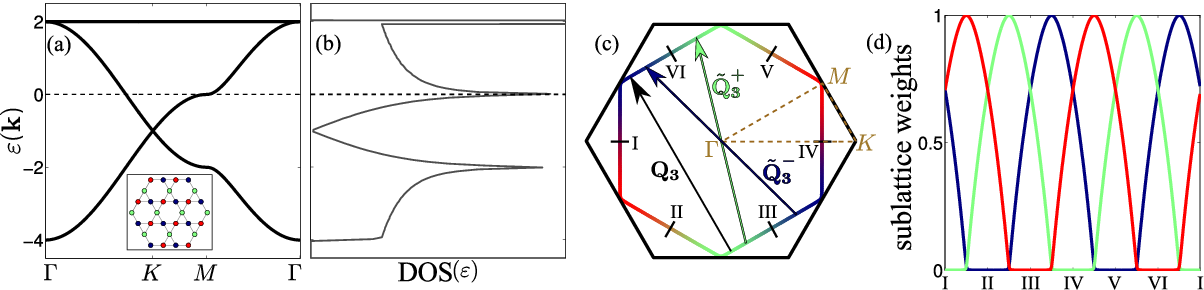
Figure 1: Fermi surface properties of the kagome tight binding model at n=5/12 total filling, showcasing the band structure influenced by sublattice configurations.
Mechanism of Sublattice Interference
Sublattice interference, a distinctive feature of the KHM, profoundly alters Fermi surface instability behavior by impacting the effective nesting of particle-hole fluctuations. Due to heterogeneous sublattice distributions of electronic states along the Fermi level, typical nesting benefits are undermined, thereby suppressing Tc. This phenomenon is absent in analogous systems like the honeycomb lattice, where homogeneous sublattice weights support robust nesting.
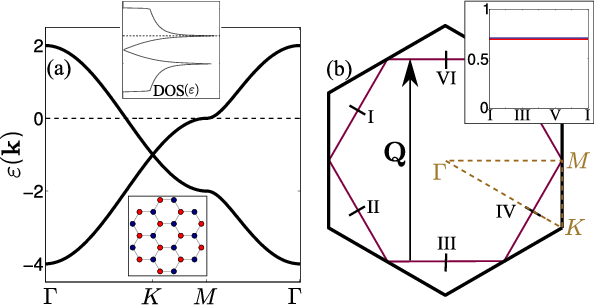
Figure 2: Band structure and density of states for the honeycomb tight binding model at n=5/8, providing a contrast with kagome sublattice characteristics.
Comparison Between Kagome and Honeycomb Models
The sublattice interference in the KHM contrasts with the homogeneous sublattice involvement in the honeycomb lattice. This stark difference elucidates why the KHM's d+id superconductivity emerges with atypical characteristics, particularly a lower Tc. The honeycomb lattice, in comparison, favors f-wave superconductivity at disconnected Fermi surfaces and transitions to d+id superconductivity upon forming a contiguous Fermi pocket.
Impact of Long-Range Hubbard Interactions
The inclusion of longer-range interactions (parameterized by U1) unexpectedly augments Tc within the KHM. The long-range interactions alleviate sublattice interference by re-establishing particle-hole fluctuation nesting over different sublattice components. This is contrary to traditional models where extended interactions tend to reduce the superconducting critical scale.
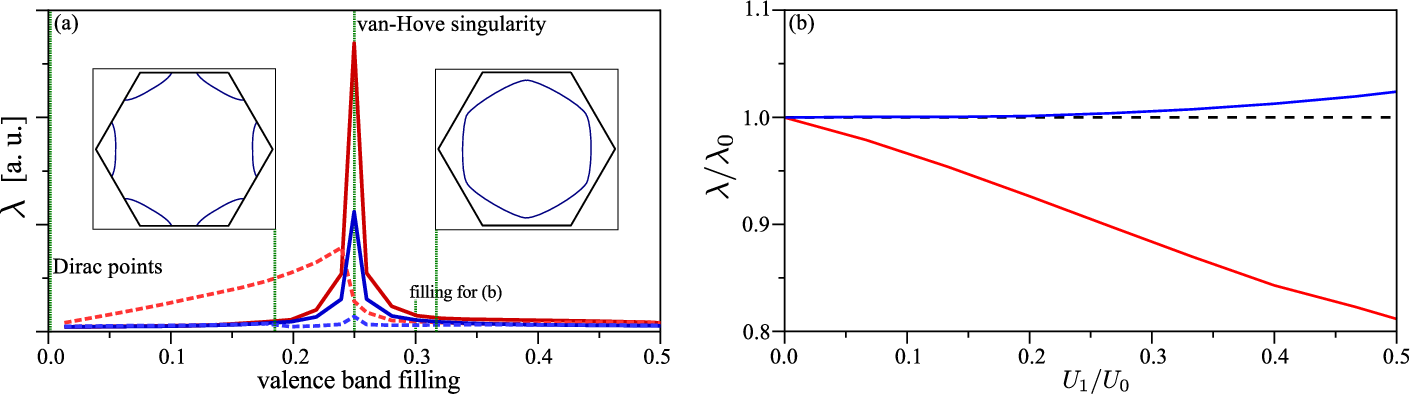
Figure 3: Differential impact of critical Tc scales between kagome and honeycomb structures across varying fillings, underscoring the suppression and enhancement dynamics in the kagome scenario.
Conclusion
This study emphasizes the critical role of sublattice interference in defining electronic phases within the KHM. The interaction dynamics in the weak coupling limit yield insights into potential intermediate coupling phenomena, proposing the KHM as a candidate for realizing unconventional electronic states. Future explorations could further leverage optical kagome lattices to empirically substantiate these theoretical insights, potentially enhancing the understanding of the Hubbard models' complex behavior.

