- The paper proves that spectral modulational stability implies nonlinear stability with explicit algebraic decay rates for periodic traveling waves under small localized perturbations.
- It employs a rigorous framework using Evans function analysis, hybrid Hill's method, and Whitham modulation theory to establish stability criteria.
- Numerical studies confirm stable parameter regimes, offering a blueprint for analyzing coherent structures in fourth-order dissipative-dispersive PDEs.
Nonlinear Modulational Stability of Periodic Traveling Waves in the Generalized Kuramoto-Sivashinsky Equation
Introduction and Theoretical Context
This paper rigorously resolves the nonlinear modulational stability of periodic traveling wave (PTW) solutions in the generalized Kuramoto-Sivashinsky (gKS) equation. The gKS equation, a prototype four-order dissipative-dispersive PDE, models pattern formation phenomena across multiple physical systems, including flame front propagation, plasma instabilities, and thin film flows. Its PTWs embody spatially periodic coherent structures which, while omnipresent in numerical simulations, lacked a fully general nonlinear stability theory.
The core innovation in this work is a proof that spectral modulational stability implies nonlinear modulational stability with respect to small, localized (integrable) perturbations for periodic waves of the gKS equation. This closes a long-standing gap highlighted in previous studies and numerics. The authors also expand the analysis to the Swift-Hohenberg (SH) equation, showing that the periodic wave stability paradigm extends to non-conservative fourth-order systems.
Spectral and Nonlinear Stability: Analytical Framework
Equation and Structural Hypotheses
Periodic traveling waves of the gKS equation,
ut+γuxxxx+uxxx+δuxx+(f(u))x=0,γ,δ>0,
with smooth nonlinearity f, are studied via their associated parameterized solution manifold. Key technical assumptions guarantee transverse intersection of periodic orbits and preclude degenerate cases in the bifurcation analysis.
Spectral Stability Criteria
The spectral stability of a PTW is characterized via the spectrum of the linearized operator about the wave. Three central conditions are required:
- (D1): The linearized spectrum sits in the closed left half-plane except at the origin.
- (D2): Spectrum of Bloch operators Lξ satisfies Reλ≤−θ∣ξ∣2, ensuring diffusive decay.
- (D3): The origin is a double eigenvalue for the Bloch operator at ξ=0, corresponding to symmetries (translation and parameter).
A Jordan block of height two at λ=0 arises generically, reflecting nontrivial interaction between phase and amplitude modulations. The spectral portrait in the neighborhood of the origin is captured by second-order modulation theory (Whitham equations).
Main Nonlinear Stability Theorem
Under these hypotheses, the central result is: if a periodic wave satisfies (D1)-(D3), then it is nonlinearly stable under small localized perturbations. The solution converges, modulo a space-time dependent phase modulation ψ(x,t), toward a modulated PTW in Lp norms with explicit algebraic decay rates: ∥u(⋅+ψ(⋅,t),t)−uˉ∥Lp≤C(1+t)−21(1−p1)∥u0−uˉ∥L1∩HK.
Full stability—convergence in L∞—is achieved only for the modulated problem.
Numerical Spectral Analysis and Validation
Numerical analysis substantiates and concretizes the theoretical framework. The authors apply a hybrid Hill's method + periodic Evans function approach to compute the full Bloch spectrum and rigorously exclude the existence of unstable eigenvalues for various parameter regimes.
Parameter Regimes and Bands of Stability
Extensive computations reveal bands of spectrally stable PTWs for generic parameter sets. Both in the classical KS limit and near the KdV regime, there exist open intervals in parameter space (period, mean, amplitude) where stability holds. The boundaries of these bands match previous findings and singular perturbation theory.
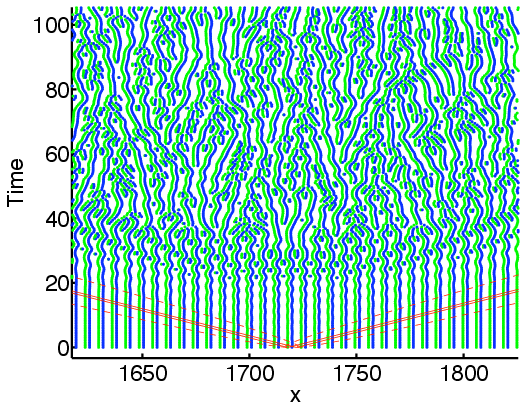
Figure 2: Numerical time evolution studies showcase three scenarios—waves below, within, and above the band of modulational stability—highlighting disturbances evolving into instability, asymptotic modulation, or enhanced viscoelastic oscillations respectively.
Time Evolution and Modulation Dynamics
Time evolution studies show that PTWs within the stable band persist under localized perturbations, with the disturbance manifesting as a phase shift evolving according to effective Whitham modulation dynamics. For waves outside the bands, instability emerges either through catastrophic phase demodulation (loss of hyperbolicity) or backward diffusion (loss of dissipativity), both cases predicted by analysis of the modulation equations.
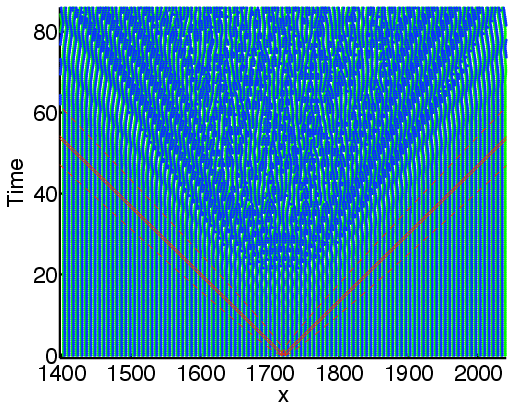
Figure 4: Time evolution in the modulationally unstable regime exhibits delayed instability and the emergence of amplified viscoelastic oscillations, consistent with the expectation from Whitham theory.
Analysis of the Modulation (Whitham) Equations
A salient part of the theoretical construction is the rigorous connection between the full gKS dynamics and the associated Whitham averaged system governing slow modulations of periodic wave parameters. The modulation equations predict the structure and nature of the instabilities at the edges of the stability bands, clarifying transitions associated with hyperbolicity loss (propagation dominated) versus loss of diffusion (viscoelastic "bouncing" behavior). This agreement between modulation theory, spectral analysis, and direct simulation provides a sharp criterion for both physical predictions and mathematical proofs of stability/instability thresholds.
Implications and Future Directions
The work establishes a complete program for analyzing the nonlinear stability of periodic traveling waves in dissipative-dispersive PDEs of fourth order. The main implications are:
- Modulational stability can now be certified via explicit (numerically computable) spectral conditions for a wide class of pattern-forming PDEs.
- The analytical technology and numerical methods (rescaled/balanced Evans function, high-precision Hill’s method) are broadly applicable, notably to Cahn-Hilliard equations, thin film models, and general $2r$-parabolic systems.
- The Whitham modulation approach provides a universal bridge from spectral data to macroscopic nonlinear evolution, enabling prediction and control of pattern selection and robustness.
Key open problems include full analytic proof of spectral (modulational) stability in the singular KdV regime and the detailed classification of secondary bifurcations and their impact on long-time dynamics. The results have profound implications in the mathematical theory of patterns, their stability, and their evolution under perturbations in fluid-mechanical and related systems.
Conclusion
The paper successfully constructs a unified, rigorous nonlinear stability theory for periodic waves in the generalized Kuramoto-Sivashinsky equation, connecting spectral data, modulation equations, numerics, and nonlinear PDE analysis. The Evans function-based approach, validated by high-precision numerics, yields both definitive stability results and a blueprint for analysis in related higher-order dissipative-dispersive systems. As a byproduct, new robust numerical techniques (including the method of moments for branch tracking) are introduced, setting a methodological standard for future investigations into the stability of coherent structures in PDEs.
References:
- (1203.3795)
- [Citations and methodology detailed at the end of the paper]