- The paper extends BCS superconductivity by incorporating the Lindblad master equation to model open quantum systems with pairing interactions.
- It derives closed-form dynamic equations for the covariance matrix, linking the evolution of the order parameter to the stability of fixed points.
- The analysis reveals temperature-dependent transitions, with a critical threshold triggering a shift from normal to superconducting states.
Lindblad Master Equation Approach to Superconductivity in Open Quantum Systems
Introduction
This paper presents an extension of the Bardeen, Cooper, and Schrieffer (BCS) theory of superconductivity to open quantum fermionic systems using the Lindblad master equation framework. The model considers a single fermionic level with pairing interactions immersed in a superconducting bath, allowing the exchange of Bogoliubov quasiparticles with the bath. The paper derives the equations for the covariance matrix and studies the stability of fixed points, providing insights into the behavior of the order parameter governing superconductivity.
Theoretical Framework
The core of the approach is the Lindblad master equation, which describes the time evolution of the reduced density matrix ρ(t) for an open system. The general form of this equation includes a Hamiltonian component and dissipative terms characterized by Lindblad operators. The Hamiltonian represents a single degenerate level with BCS-type pairing interactions, and the system exchanges Bogoliubov quasiparticles with the bath through specific Lindblad operators.
The evolution of the system is recast in terms of Hermitian Majorana fermions, leading to a closed set of equations for the covariance matrix Z(t):
dtdZ=−XTZ−ZX+Y.
This is supplemented by the self-consistency condition, which links the dynamics of the order parameter Δ to the covariance matrices.
Analysis of Fixed Points
The study of fixed points of the flow is crucial for understanding the phases of the system:
- Fixed Bath: When the superconducting reservoir is treated as fixed, the state of the embedded system invariably mirrors that of the bath, adopting a superconducting order for any temperature.
- Self-consistent Bath: For a bath that adjusts self-consistently with the system, the solution aligns with the standard mean-field approach, reproducing equilibrium results.
The stability of fixed points is examined by analyzing the eigenvalues of associated matrices. For temperatures below a critical threshold βc, derived as:
βc=−ϵ2artanh(U2ϵ),
the system finds itself in superconducting phase. Conversely, the normal state becomes unstable below this critical temperature, leading to a transition to a stable superconducting state.
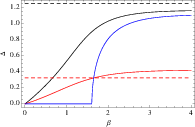
Figure 1: The phase diagram of the magnitude of the order parameter Δ versus the inverse temperature. Δ>0 signals the superconducting phase.
Dynamic Behavior
The dynamic equations for zj(t) reveal that the order parameter Δ(t) evolves through non-linear differential equations, chiefly independent of the other phase space variables. The system flows towards one of two stable fixed points: superconducting or normal—depending on temperature relative to the critical value βc—as illustrated in Figure 2.
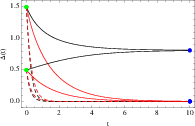
Figure 2: Time-dependent order parameter Δ(t) as a function of time, for β<βc (red curves) and β>βc (black curves).
Conclusion
The paper successfully extends the BCS theory to open quantum systems using the Lindblad formalism, elucidating the dynamic and stationary behavior of superconducting phases. It rigorously establishes the connection between self-consistent system and reservoir dynamics, aligning results with grand canonical ensemble predictions. The insights provide a minimal model for exploring non-equilibrium open BCS systems, possibly facilitating further exploration into systems with multiple particle/temperature reservoirs.