- The paper presents the design and systematic control strategies to achieve an unprecedented 0.14 ppm precision in muon g‑2 measurement.
- It outlines innovations in beamline, calorimetry, and magnetic field calibration to significantly reduce uncertainties compared to the E821 experiment.
- The new measurement will refine tests of the Standard Model and potentially expose physics beyond current theoretical predictions.
High-Precision Measurement of the Muon's Anomalous Magnetic Moment
Overview
The measurement of the muon's anomalous magnetic moment, aμ=(g−2)/2, constitutes one of the most incisive low-energy tests of the Standard Model (SM). The value of aμ is an observable sensitive to quantum electrodynamics (QED), electroweak, and hadronic vacuum polarization contributions, as well as potential new physics beyond the SM such as supersymmetry or extra dimensions. The Brookhaven E821 experiment previously determined aμ;expt=(116592089±63)×10−11 with a 0.54 ppm precision, finding a persistent ∼3.2σ discrepancy from the theoretical prediction, which remains unexplained. The work detailed in "Measuring the muon's anomalous magnetic moment to 0.14 ppm" (1009.0799) presents the physics motivation, technical roadmap, and systematic control strategies for a next-generation (g−2) measurement at Fermilab targeting a 0.14 ppm total uncertainty, a factor four improvement over E821.
Principles and Significance of the (g−2) Measurement
The experimental determination of aμ is achieved by storing polarized muons in a highly uniform magnetic field and observing the spin precession frequency ωa relative to the cyclotron frequency. The modulation in the distribution of high-energy decay electrons (from μ±→e±+ν+νˉ) is directly sensitive to ωa, while the absolute field B is calibrated via proton nuclear magnetic resonance (NMR). Achieving parts-per-million precision necessitates meticulous control of statistical and systematic uncertainties in both the frequency and field measurements.
The theoretical calculation of aμ is uniquely robust, with QED and electroweak (EW) contributions under excellent control through multi-loop computations. The dominant uncertainty arises from hadronic vacuum polarization (HVP) and hadronic light-by-light (HLbL) corrections, which depend on experimentally measured e+e−→hadrons cross sections via dispersion relations. Recent progress in data acquisition and analysis, such as those by CMD-2, SND, BaBar, and KLOE, has reduced uncertainties but also exposed tension with τ-decay-based determinations.
The precise history of aμ measurements and their evolution in relation to the SM expectation is illustrated in the following:
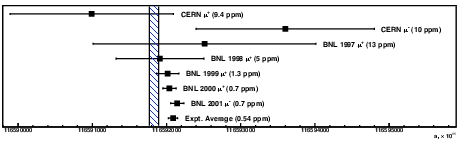
Figure 1: History of the precision of the measurements of aμ in the CERN III experiment and E821, compared with the Standard Model prediction.
Experimental Status and Systematic Control
Experiment E821 at BNL reached a statistical precision of 0.54 ppm, which was primarily statistics-limited. Its result, with a 3.2σ deviation from the SM prediction, gives
aμ;expt−aμ;SM=(255±80)×10−11
where SM theory is quoted at aμ;SM=(116,591,834±49)×10−11 (0.42 ppm). The source of this discrepancy has fueled ongoing theoretical investigation, with special emphasis on refining HVP and HLbL contributions using newer, higher-precision hadron production data.
Systematic uncertainties in E821 were dominated by pileup effects, detector gain changes, muon losses, coherent betatron oscillations, and field inhomogeneities. The impact of background neutrons from pion contamination was also significant, inducing baseline shifts in the calorimeters. The E821 experimental architecture and uncertainty management serve as the foundation for the experimental strategy in the new Fermilab measurement.
Relocating the BNL E821 apparatus to Fermilab is motivated by the need for higher statistics and reduced systematics. The key Fermilab advantages and upgrades include:
- Significantly Higher Muon Yield: Fermilab's intensity and beam structure support a planned 20-fold increase in stored muon decays, enabling a statistical reach of 0.10 ppm in less than two years.
- Improved Beamline and Detector Technology: The beamline features a much longer (900 m) pion decay channel for substantially reduced pion contamination (by a factor of 20), and an open-ended superconducting inflector to minimize multiple scattering.
- Advanced Calorimeters: New tungsten/scintillating fiber calorimeters provide >35-fold segmentation, each segment digitized separately with waveform digitizers, drastically mitigating pileup and enabling spatial disambiguation of temporally overlapping events.
- Suppression of Systematic Effects: Strategies to control coherent betatron oscillations—such as pulsed octupole and oscillating dipole interventions—are under active investigation.
- Enhanced Magnetic Field Uniformity and Measurement: Increased density and optimally placed NMR probes, refined shimming, and frequent trolley maps will further reduce magnetic field uncertainty.
- Efficient Data Acquisition: Automation and high-rate capability in DAQ facilitate handling of the increased event rate.
Theoretical Context and Future Prospects
Continued advances in the calculation of the hadronic contributions—especially via more precise low-energy e+e− cross sections and improved lattice QCD for HLbL—are projected to bring the SM theoretical error below 0.25 ppm. This, combined with a 0.14 ppm experimental uncertainty, yields a sensitivity to BSM contributions in the ∼0.3 ppm range, or ∼3×10⁻¹⁰ in aμ absolute terms. Given the strong scaling with tanβ and the sparticle mass in supersymmetry, the improved measurement will directly test high-scale BSM scenarios and complement LHC direct searches.
If the E821 discrepancy persists, the enhanced precision and systematic control of the Fermilab experiment will be decisive for determining whether the anomaly is a statistical artifact or a definitive sign of novel physical phenomena. Conversely, confluence between experiment and improved SM predictions will tightly constrain BSM model space.
Conclusion
The transition to a 0.14 ppm precision measurement of aμ at Fermilab represents a major methodological advancement, leveraging increased statistics, modern detector technology, and robust handling of systematic uncertainties. The experiment's sensitivity is well matched to anticipated progress in SM theory, ensuring the capacity to resolve the present aμ anomaly. This work will yield critical input for the interpretation of possible LHC discoveries and the global program of precision tests of fundamental physics.