- The paper introduces OWLAPY, a Python-native framework that rivals the Java-based OWLAPI by offering full OWL 2 ontology support and enhanced modularity.
- It employs native, embedding-based, and closed-world reasoners alongside LLM-assisted ontology construction to facilitate both symbolic and sub-symbolic reasoning.
- The work bridges traditional ontology tools with modern Python data science and AI pipelines, significantly improving developer experience and interoperability.
OWLAPY: A Pythonic Framework for OWL Ontology Engineering
Introduction and Motivation
OWLAPY is presented as a Python-native library that facilitates comprehensive engineering of OWL 2 ontologies, addressing a long-standing gap in Semantic Web tooling. While the Java-based OWLAPI has long dominated the ontology engineering landscape, the ascendency of Python in data science, AI, and knowledge-graph workflows demands tighter ecosystem integration and a more Pythonic developer experience. OWLAPY achieves parity with OWLAPI in terms of expressive coverage and object modeling, while also providing distinct features, including native and embedding-based reasoners, LLM-assisted ontology construction, and seamless workspace transitions for practitioners migrating from Java-centric stacks.
Architecture and Core Functionality
The architecture of OWLAPY is designed with modularity and extensibility at its core. The Ontology module manages import, in-memory manipulation, and serialization of ontologies across a range of OWL and RDF formats. Classes, properties, individuals, and literals are implemented as first-class Python objects, following the OWL 2 Structural Specification and ensuring full compliance with standard object models. Workflow-centric operations such as incremental axiom addition, type assertions, and entity modifications are supported with idiomatic Python interfaces.
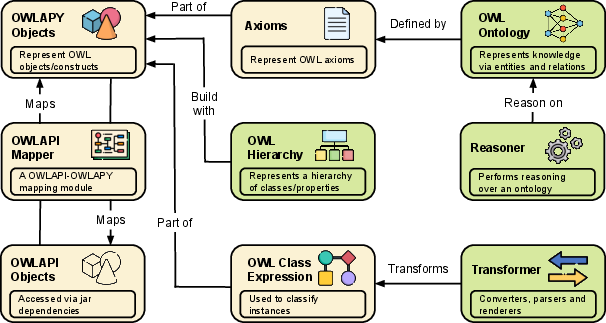
Figure 1: OWLAPY architecture overview. Top-level and sub-components highlight modularity and interoperability with external Java-based components.
A central contribution of OWLAPY is its rich support for reasoning. The Reasoner module includes:
- SyncReasoner: Integrates with high-performance Java-based OWL DL reasoners (e.g., HermiT, Pellet), using JPype for cross-language bridging. This enables open-world, DL-compliant inference, including core reasoning tasks (subsumption, consistency, and instance queries).
- Embedding-based Reasoner (EBR): A fully Python-native engine, using knowledge graph embeddings to approximate instance retrieval and concept membership, thus relaxing strict deductive semantics in favor of scalable, sub-symbolic scoring.
- Native Closed-World Reasoner: Supports scenarios where closed-world assumptions are appropriate, critical for certain data integration and ML settings.
Conversion utilities enable bidirectional translation between DL syntax, Manchester syntax, and programmatic representations. OWLAPY also supports SPARQL transformation, allowing for direct deployment in downstream triple store queries, and it offers basic parsing for SWRL-style rules. The OWLAPIMapper enables bidirectional mapping with Java's OWLAPI, supporting both legacy workflow integration and migration strategies.
LLM Integration and Automated Ontology Construction
OWLAPY incorporates capabilities for automated ontology construction from natural language, inspired by recent work on LLM-based entity and relation extraction. The workflow entails:
- Extraction of named entities and role relations from raw text using LLM prompts.
- Typing of new classes, either from a controlled vocabulary or via generative LLM completion.
- Assembly of RDF triples, supporting both symbolic and numeric values for enhanced expressivity.
This pipeline lays the groundwork for scalable, semi-automatic knowledge base construction and curation workflows, addressing a critical bottleneck for large-scale ontology authoring in scientific and industrial applications.
Example: Ontology Editing Workflow
A canonical ontology engineering workflow in OWLAPY involves loading an existing ontology, adding new entities and axioms, and persisting the modified graph:
1
2
3
4
5
6
7
|
from owlapy import Ontology, OWLClass, OWLNamedIndividual, OWLClassAssertionAxiom

onto = Ontology("path/to/father_ontology.owl")
male = OWLClass("http://example.com/father#male")
alkid = OWLNamedIndividual("http://example.com/father#alkid")
onto.add_axiom(OWLClassAssertionAxiom(alkid, male))
onto.save(path="updated_father_ontology.owl", rdf_format="rdfxml") |
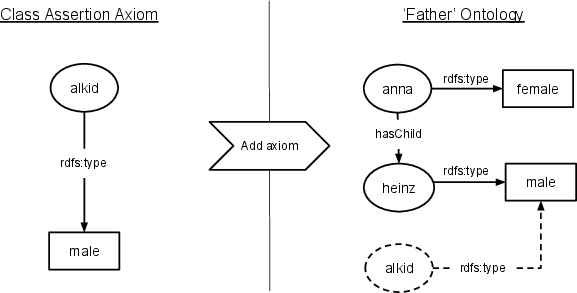
Figure 2: Visual graph fragment after programmatic insertion of a new individual and type assertion.
This API style emphasizes programmatic, fine-grained manipulation of the axiomatization, supporting both batch and interactive workflows.
Comparison with Existing Python Libraries
OWLAPY is most directly compared to Owlready2, the erstwhile reference Python library. Owlready2 emphasizes direct, class-centric ontology representations and basic Java reasoner integration, but provides limited API structure, insufficient for fine-grained, axiomatic manipulation and ML-focused workflows. In comparison:
- OWLAPY supports formal object models covering all OWL 2 constructs, robust cross-syntax conversions, and advanced reasoning options.
- RDFlib offers RDF graph utilities and SPARQL support without dedicated OWL or DL reasoning.
- Ontospy is focused on ontology inspection/visualization rather than logic-based engineering.
OWLAPY is thus positioned as the only Python library providing full-featured OWL 2 engineering with support for both symbolic and sub-symbolic reasoning.
Implementation and Ecosystem
The platform is open-source (MIT license), comprising ~15,000 LOC, over 50,000 downloads, 165+ unit tests, and 11+ example scripts. Documentation is continuously updated. Its modular architecture enables rapid extension with new reasoning modules or syntax transformers, and facilitates integration with third-party tools.
OWLAPY serves as the backbone for related frameworks:
- Ontolearn: Industrial-scale OWL class expression learning.
- OntoSample: Efficient ontology sampling infrastructure for ML and data science.
- Drill, EvoLearner, CLIP: ML-based class learning methods employing OWLAPY APIs for ontology manipulation and reasoning in research and industrial deployments.
Implications and Future Directions
The introduction of OWLAPY has notable implications:
- Bridging Symbolic and Sub-symbolic AI: The embedding-based reasoner facilitates hybrid neurosymbolic workflows within end-to-end Python data stacks, suitable for integrating ontological reasoning into ML pipelines.
- Automation via LLMs: The provided API for leveraging LLMs for ontology bootstrap maps directly to new applications in scientific document curation, automated knowledge graph population, and beyond.
- Toolchain Modernization: For organizations historically dependent on Java-centric stacks, OWLAPY offers a migration pathway, enabling Python-native ontology management in data science and AI ecosystems.
Future developments could include:
- Enhanced support for federated knowledge graph workflows.
- Deeper integration with tensor-based triple stores and graph neural network libraries.
- Further optimization of the embedding-based reasoner for large-scale, approximate queries.
- Expanded LLM integration for more robust ontology population, validation, and completion.
Conclusion
OWLAPY establishes a feature-complete, modular, and extensible framework for OWL ontology engineering in Python, matching and surpassing the expressive and functional reach of prior Python libraries while building bridges to modern AI-driven knowledge workflows. By consolidating symbolic, sub-symbolic, and automated (LLM) approaches, OWLAPY is positioned as a core infrastructure component for ontology-centric applications in research and industry.