- The paper introduces a novel likelihood‐free flow matching method for posterior sampling, enabling efficient inference without evaluating the likelihood.
- It leverages a dynamic block‐triangular velocity field to create deterministic transport maps that capture complex posterior structures.
- Experimental results demonstrate significant improvements over traditional MCMC, particularly in high-dimensional and geometrically challenging distributions.
Conditional Flow Matching for Bayesian Posterior Inference
Introduction
The paper "Conditional Flow Matching for Bayesian Posterior Inference" (2510.09534) introduces a novel generative approach for multivariate posterior sampling using flow matching. This method presents a simplified training objective that does not require likelihood evaluation, offering a computationally efficient alternative to traditional methods like MCMC and variational inference. The approach leverages a dynamic, block-triangular velocity field within the joint space of data and parameters, facilitating the generation of Bayesian credible sets through deterministic transport maps.
Methodology
The core of this research lies in the development of a likelihood-free posterior sampler that uses flow matching to capture complex posterior structures. The method operates in the joint space Y×Θ, transporting samples from a source distribution to the posterior distribution using a learned velocity field. This field yields a block-triangular map where velocity constraints ensure monotonicity, leading to efficient posterior sampling and uncertainty quantification.
The methodology revolves around configuring dynamic block-triangular maps via deterministic flows, culminating in solutions that ensure smooth transitions from noise to data parameters across a continuous time horizon.
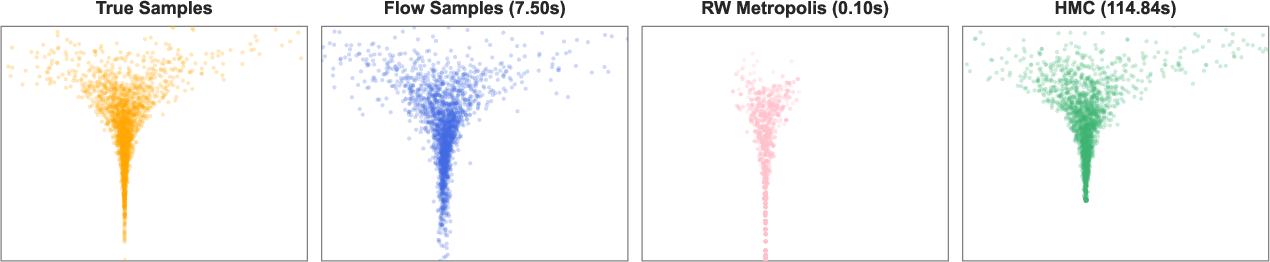
Figure 1: The traditional MCMC methods fail to search the entire region. The sampling time for each method is noted in the respective plot title. Our method requires one-time training (7.5 s); per sampling cost is nearly instantaneous and the model captures the underlying geometry.
Experimental Evaluation
The paper presents extensive experimental evaluations showcasing the flexibility and efficiency of the proposed method across various challenging distributions, such as Neal's funnel. The findings demonstrate that the model significantly outperforms traditional MCMC methods in capturing distributions with challenging geometric structures due to its global transport efficiency.
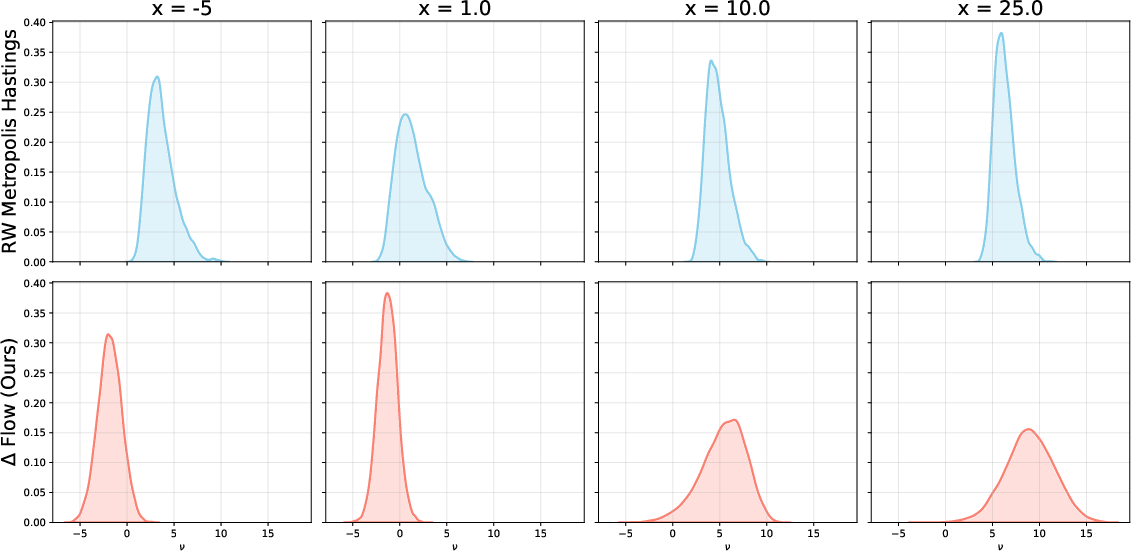
Figure 2: Posterior recovery of Neal's funnel.
Through different test cases, the method illustrated robust scalability with respect to data dimensionality. It accurately tracks posterior distributions without overshrinking, unlike methods constrained by adversarial architectures, which show diminishing accuracy as dimensions rise.
Implications and Future Work
This work provides a significant advancement in the simulation-based inference domain, particularly addressing computational inefficiencies inherent in existing methods. The proposed approach allows for simultaneous generation of Bayesian credible sets and fast posterior sampling, paving the way for applications requiring adaptive and scalable uncertainty quantification.
Given its innovative application of flow matching and velocity field monotonicity, there is potential for further enhancements in high-dimensional settings, as well as exploration into alternative statistical model configurations.
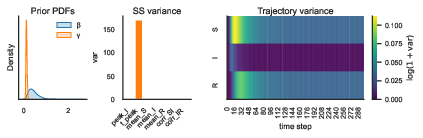
Figure 3: The prior for the infection rate beta is much more dispersed than the prior for the recovery rate gamma.
Conclusion
The study concludes with a reaffirmation of the flow matching technique’s potential to transform Bayesian inference by enabling effective posterior sampling in a likelihood-free setting. While the method excels in computation efficiency and adaptability, challenges in high-dimensional scalability remain to be addressed. Future work will focus on refining the inferential frameworks and extending methodology to incorporate richer structural prior information.

