- The paper introduces FeatProto, a framework merging global and local features from WSIs and genomic data for interpretable cancer survival prediction.
- It employs an Exponential Prototype Update Strategy and hierarchical matching to effectively capture tumor heterogeneity, achieving C-index improvements up to 4.04%.
- The framework offers transparent decision-making pathways that enhance diagnostic utility and pave the way for personalized oncology and real-time prognostic monitoring.
Multimodal Feature Prototype Learning for Interpretable and Discriminative Cancer Survival Prediction
Introduction
The paper "Multimodal Feature Prototype Learning for Interpretable and Discriminative Cancer Survival Prediction" (2510.06113) introduces FeatProto, an advanced framework aimed at enhancing the interpretability of cancer survival predictions through the unification of global-local features of whole slide images (WSIs) and genomic data. This is achieved by implementing a prototype library that supports decision-making and diagnosis with greater accuracy and interpretability compared to traditional models.
Survival Analysis Context: Survival analysis is integral to cancer prognosis, offering insights into patient outcomes over time. This paper highlights the inadequacies in traditional models, particularly their "black-box" nature, which obscures the interpretative pathways essential for clinical decision-making. The integration of WSIs with genomic profiles addresses these challenges by leveraging the synergistic potential of multimodal data in cancer progression modeling (Figure 1).
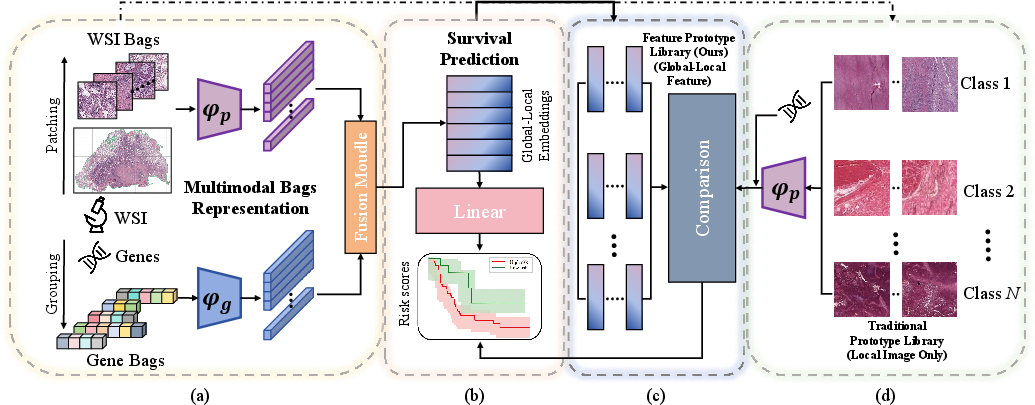
Figure 1: Schematic of survival prediction. (a) Multimodal feature embedding {content} fusion; (b) Conventional survival prediction (decision head: linear fully-connected layer); (c) Proposed feature prototype learning: prototype library with global-local fused features and multilevel deep prototype matching for accurate, interpretable survival prediction; (d) Traditional prototype library (local image only).
Methodology
Framework Architecture
FeatProto introduces a unified feature prototype space, which harmonizes both WSI and genomic data to facilitate precise prognostic modeling. By synthesizing local and global information, it rectifies the limitations of existing prototype learning methods that emphasize local similarities at the expense of broader contextual understanding. The architecture dismantles the "black-box" perception by enabling tracable decision-making pathways that encompass three primary innovations:
- Phenotypic Representation: FeatProto embraces a robust phenotype characterization, merging essential patches with global contexts, which are aligned with genomics to minimize local biases.
- Prototype Update Strategy: A unique Exponential Prototype Update Strategy (EMA ProtoUp) is designed to maintain cross-modal associations. By employing "Wandering Prototypes" that adjust dynamically to tumor heterogeneity, the framework achieves superior adaptability.
- Hierarchical Matching: A novel hierarchical prototype matching scheme captures global centrality and local typicality, enhancing prototype inference with superior resolve across cohort-level trends.
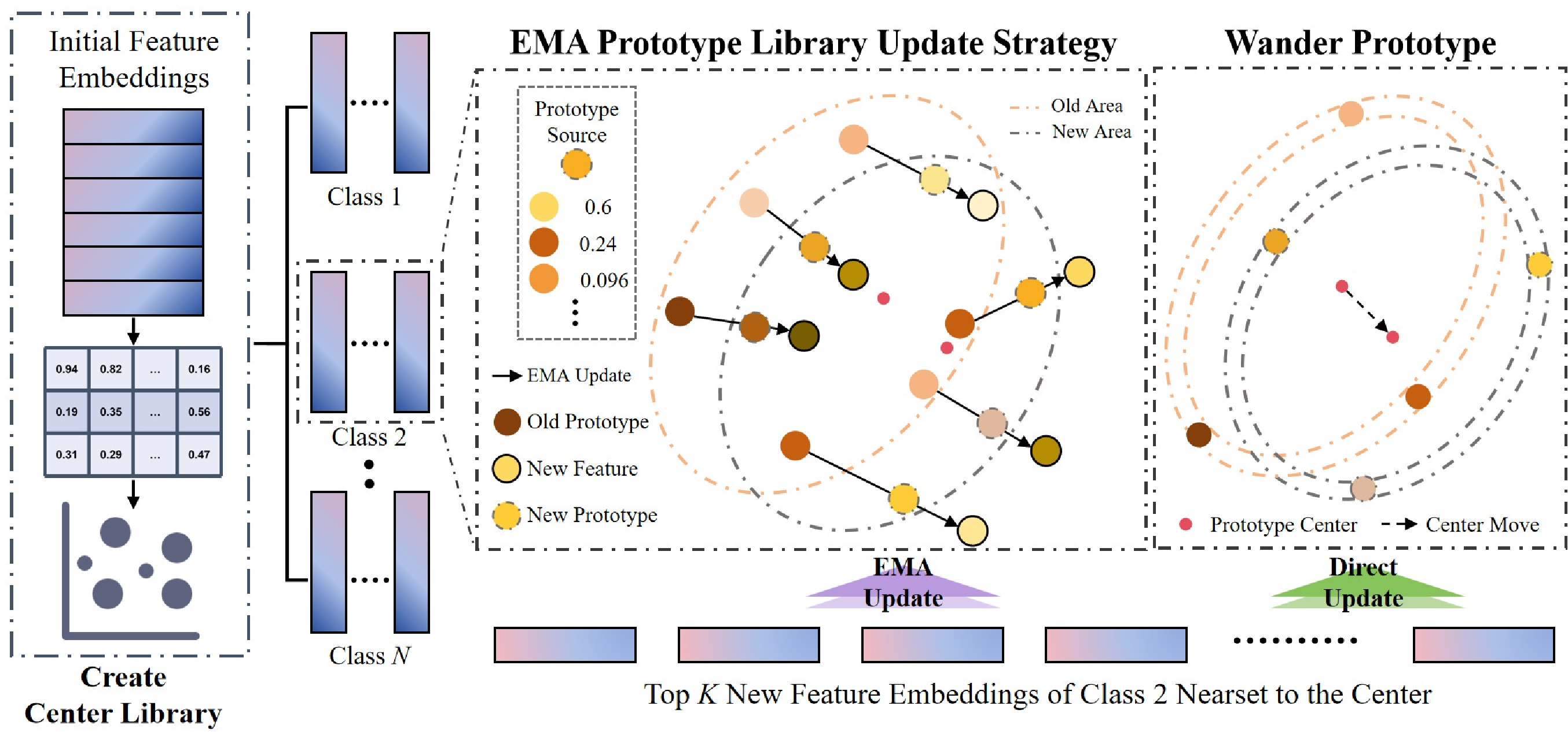
Figure 2: Prototype Library Construction and Update. Left: Prototype library construction. The initial model generates feature embeddings to derive a similarity matrix, which is clustered to form a central prototype library. Feature prototypes are categorized by survival risk levels. Middle: EMA ProtoUp. Old prototypes migrate toward new features via EMA-based updates to generate new prototypes, representing typical samples. Right: Design and update mechanism of Wandering Prototypes. During prototype library construction or update, edge cases are selected from new features to represent special samples.
Experimental Evaluation
Experiments extend across four datasets: LUAD, BLCA, GBMLGG, and UCEC, comparing FeatProto against various state-of-the-art models encompassing unimodal and multimodal approaches. Notably, FeatProto achieved marked improvements in the concordance index (C-index) across datasets, underscoring its superior predictive accuracy and traceability.
Performance: Incorporating FeatProto led to C-index improvements of up to 4.04% in some datasets compared to existing models, demonstrating its efficacy in survival prediction accuracy. The framework's multimodal integration further replaces traditional output layers with a more interpretable structure that links feature prototypes with biological manifestations directly (Figure 3).
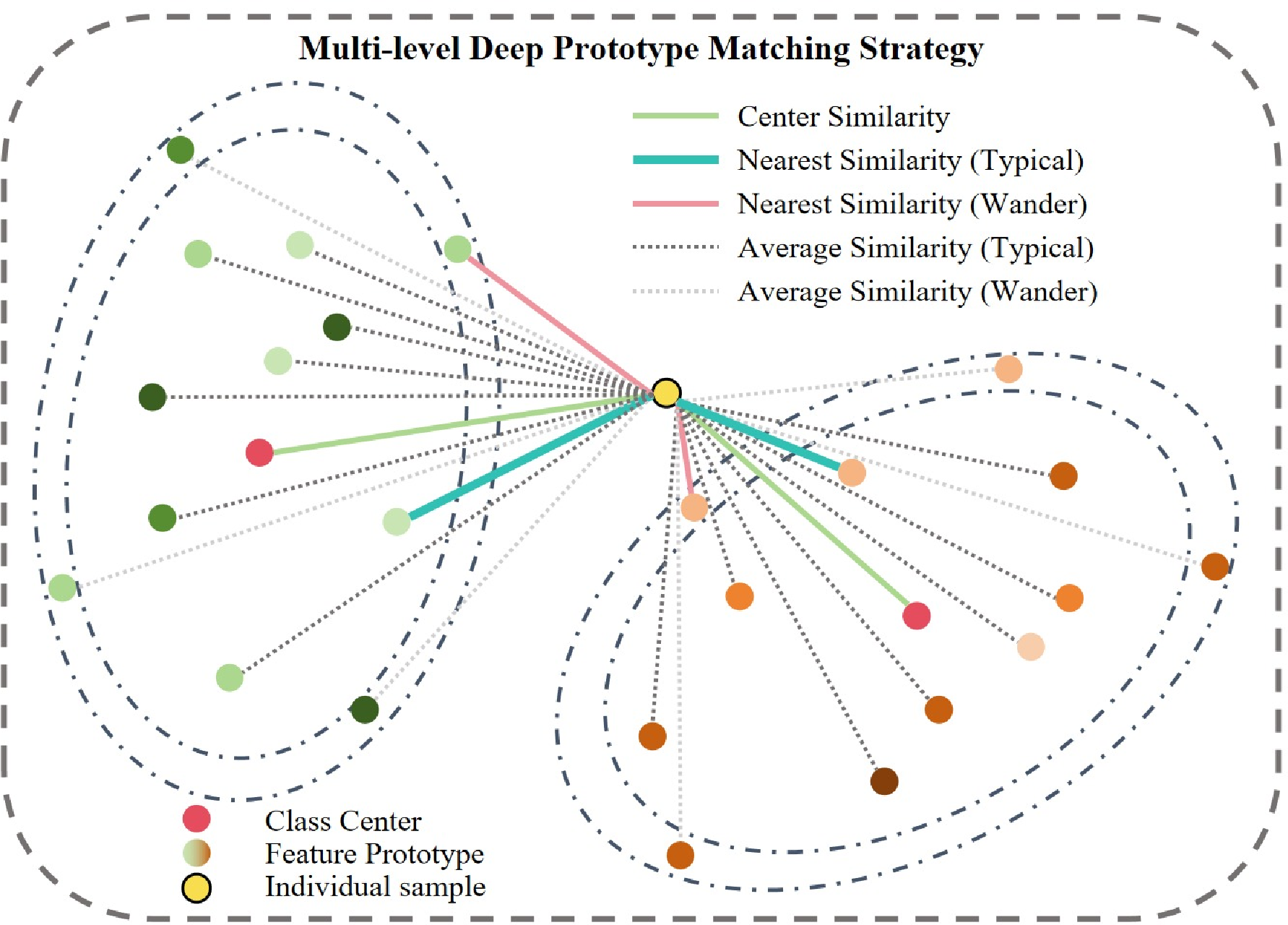
Figure 3: Demonstration of the multilevel deep prototype matching strategy. Through weighted fusion of center similarity, class average similarity, and nearest prototype similarity, it synergistically optimizes local feature alignment and global class guidance. Meanwhile, through similarity visualization, it further enhances the interpretability of the model.
Implications and Future Directions
The paper postulates substantial clinical implications, advancing how multimodal data is leveraged for both precise and interpretable prognosis in oncology. This methodology not only outperforms existing deep models but also lays the groundwork for future developments in personalized oncology and real-time monitoring systems.
Future Work: Prospective adaptations may involve dynamic optimization strategies for prototype selection and integrations with flexible, lightweight models suitable for real-time prognostic assessments. This aligns the framework toward translating research into practical, clinical applications.
Conclusion
FeatProto epitomizes a significant stride in cancer prognosis, marrying interpretability with discriminative analysis via innovative prototype learning. By seamlessly integrating multimodal data, it offers a substantive leap in both predictive accuracy and clinical applicability over conventional approaches. The framework’s pioneering contributions set a new benchmark in AI-driven cancer survival prediction, promising expansive applicability in personalized medicine and healthcare evolution.