- The paper introduces TAIRA, a Thought-Augmented Interactive Recommender Agent that enhances planning and reasoning for complex and ambiguous user intents.
- It employs a novel Thought Pattern Distillation module to extract high-level cognitive templates from both agent interactions and expert demonstrations, enabling robust multi-scale planning.
- Experiments on Amazon datasets show TAIRA outperforms baselines with significant improvements in SR, HR@10, and NDCG@10, especially for medium and hard queries.
Thought-Augmented Planning for LLM-Powered Interactive Recommender Agent
Motivation and Problem Statement
The manuscript introduces TAIRA, a Thought-Augmented Interactive Recommender Agent system designed to remedy the shortcomings of LLM-powered interactive recommendation agents in handling complex, ambiguous, and diverse user intents. Empirical observations underline limitations in current LLM agents regarding robust planning, reasoning, and generalization abilities, especially for requests that lack explicit detail or embrace multifaceted, scenario-driven requirements. Existing agentic approaches—ranging from direct task decomposition (e.g., CoT, Plan-and-Solve) to reflection-based strategies (e.g., Reflexion)—demonstrate suboptimal SRs (failure rates >60%) in these settings.
System Architecture and Methodology
TAIRA is formalized as an LLM-driven multi-agent system comprising three principal modules: the Manager Agent, Executor Agents, and Thought Pattern Distillation (TPD). The key architectural novelty is the integration of distilled high-level thought patterns—derived from both agent and human interactions—which support multi-scale planning and reasoning for complex recommendation tasks.
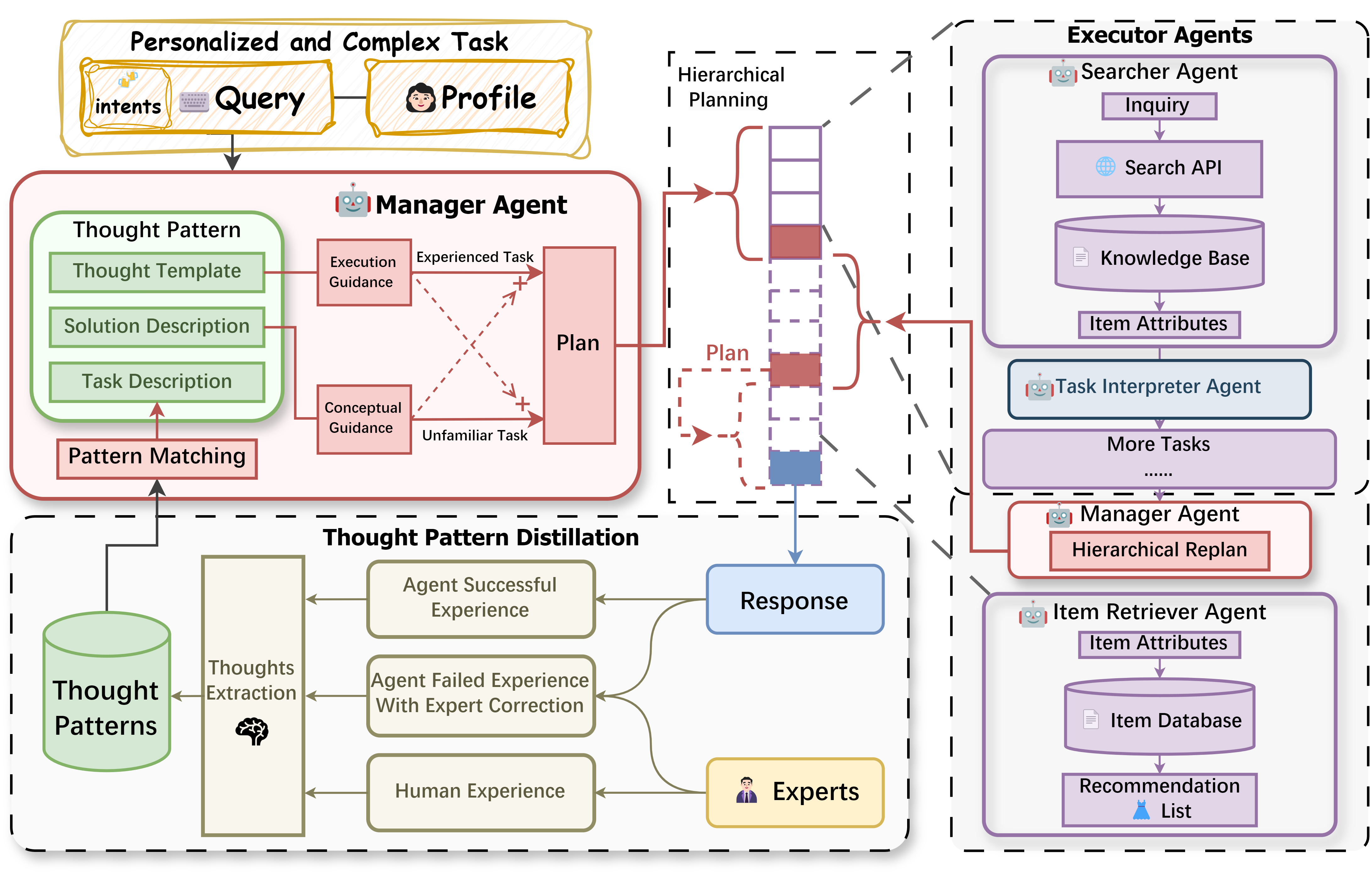
Figure 1: TAIRA's overall architecture illustrating the Manager Agent's orchestration, sub-task decomposition, and the TPD mechanism across agent and expert experiences.
Thought Pattern Distillation (TPD)
TPD extracts actionable and reusable high-level cognitive templates from three sources: successful agent trajectories, human expert demonstrations, and correction of failed agent paths via expert feedback. Each distilled pattern is hierarchically structured into a task description, solution description, and thought template, enabling both conceptual and execution-level guidance.
Hierarchical Planning and Thought Pattern Matching
Upon receiving a user query, the Manager Agent retrieves and matches top-K relevant thought patterns using semantic similarity metrics. Once matched, the agent incorporates the pattern into the prompt and decomposes the original intent into a multi-phase plan, continuously refined via environmental feedback and real-world execution signals.
Executor Agents
Three Executor Agent types underpin TAIRA's execution framework:
- Searcher Agent: Retrieves domain knowledge and attribute mappings using APIs and retrieved outputs for downstream item filtering.
- Item Retriever Agent: Leverages dense retrieval (BGE-Reranker) for item ranking and selection from candidate pools.
- Task Interpreter Agent: Bridges subtask descriptions to input formats for executor module compatibility, preserving context across planning stages.
User Simulation and Experimental Design
A suite of user simulation protocols emulates interaction with diverse intent complexities, drawing on Amazon Clothing, Beauty, and Music datasets. Queries are stratified into three difficulty levels—easy, medium, and hard—mirroring real-world scenarios ranging from explicit item requests to open-ended, ambiguous, or multi-item bundle demands.
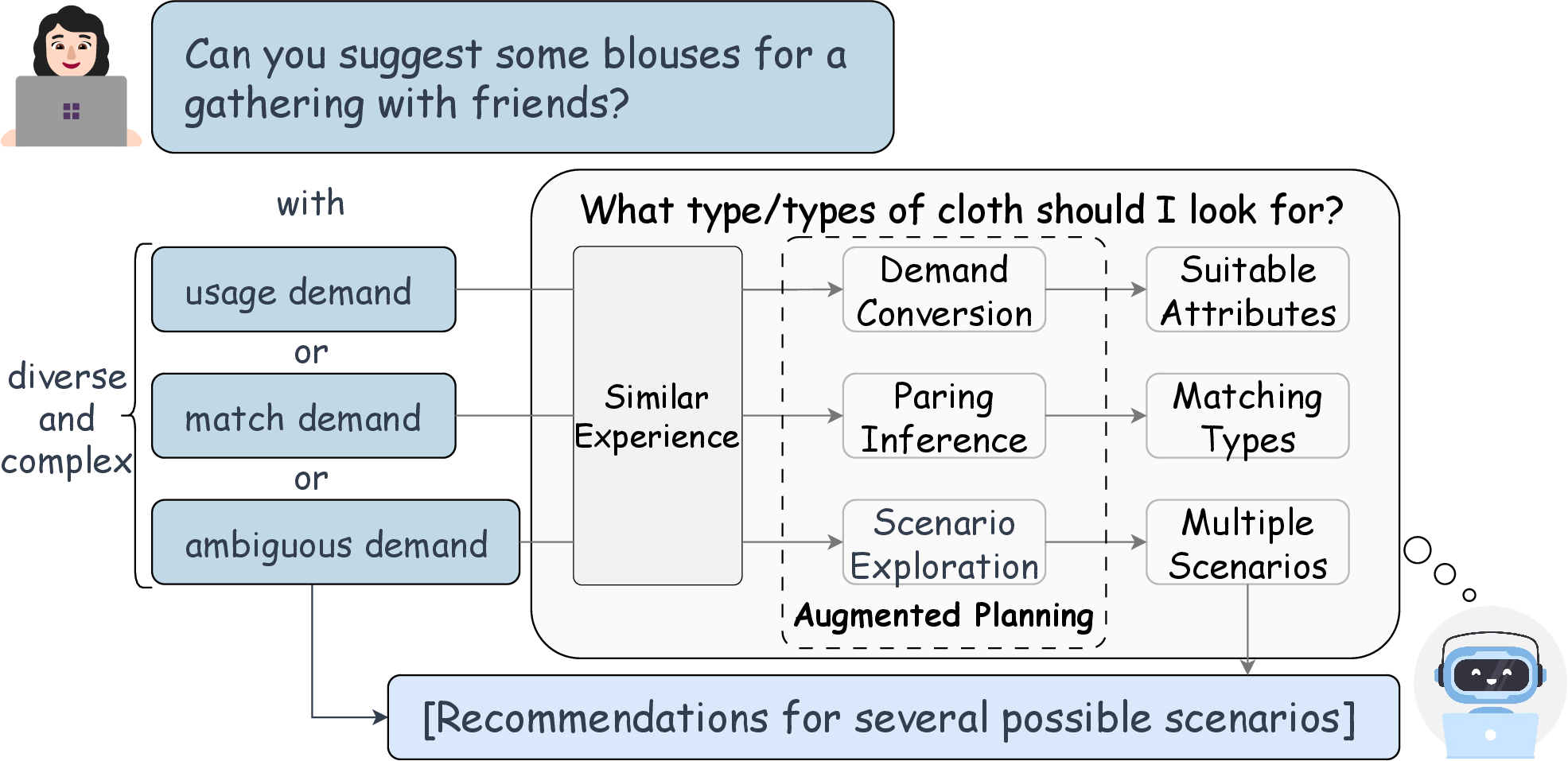
Figure 2: Diverse user intents spanning explicit product requests, scenario-driven bundles, and ambiguous requirements.
An LLM-driven user simulator, prompt-engineered for the evaluation context, assesses recommendation quality using SR, HR@10, and NDCG@10 metrics, penalizing recommendations incongruent with user profiles.
Empirical Results and Comparative Analysis
Comprehensive experiments benchmark TAIRA against ranking baselines (BM25, BGE-M3/M3-Reranker), agent planning methods (Zero/One-shot, CoT, Plan-and-Solve, ReAct, Reflexion), and state-of-the-art multi-agent recommenders (MACRec, MACRS, InteRecAgent). Across all datasets and metrics, TAIRA demonstrates statistically significant improvement:
| Dataset |
SR Improvement over SOTA |
HR@10 |
NDCG@10 |
| Amazon Clothing |
+9.72% |
+4.54% |
+3.97% |
| Amazon Beauty |
+13.16% |
+6.80% |
+5.72% |
| Amazon Music |
+15.34% |
+8.40% |
+11.40% |
The performance boost is especially pronounced for medium and difficult queries, validating the efficacy of thought-augmentation in handling higher-order reasoning tasks. Ablation studies designate Thought Pattern Matching as the single most critical component, with further performance drops observed upon removal of agent or expert experiential knowledge.
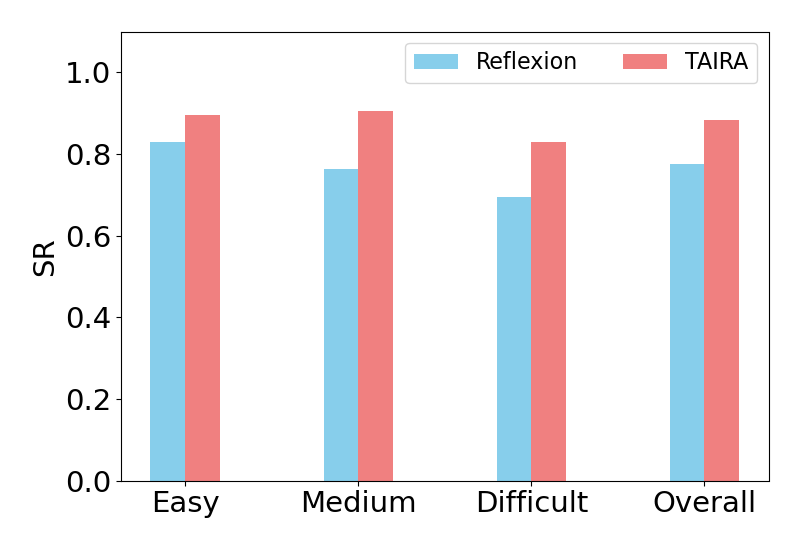
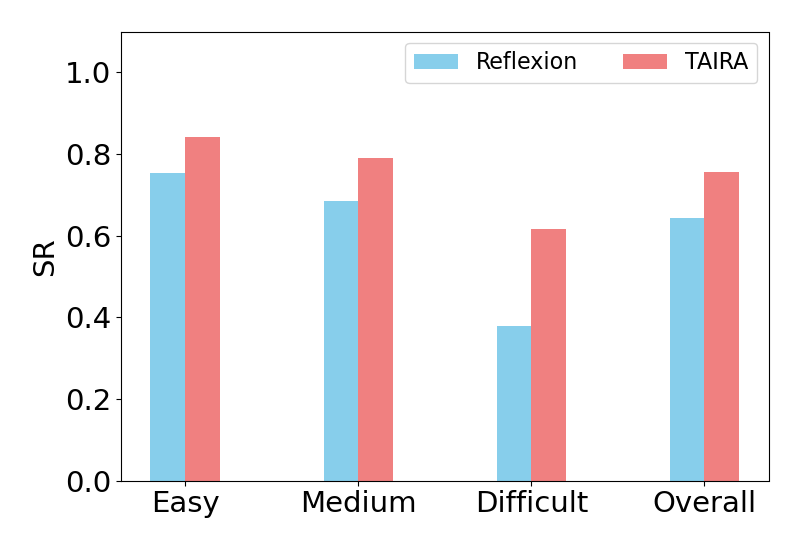
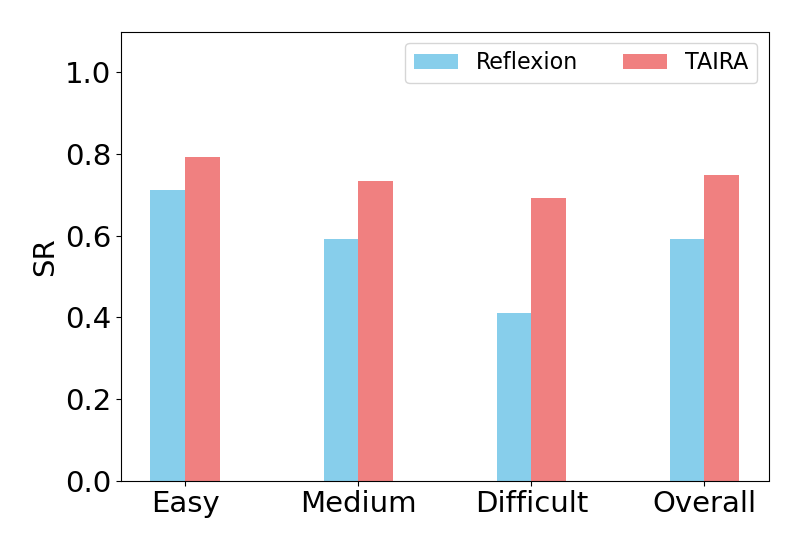
Figure 3: SR of Reflexion and TAIRA across three difficulty levels, aggregating results for easy, medium, and hard user queries.
Generalization experiments on novel scenarios (i.e., removal of corresponding thought patterns) establish that TAIRA preserves a robust SR even without prior direct experience—surpassing Reflexion—via conceptual solution guidance and structural planning templates.
Practical Implications and Application
TAIRA offers a blueprint for integrating multi-scale experiential reasoning into agentic recommendation architectures. The hierarchical nature of distilled thought patterns supports recursive planning refinement and robustness against ambiguous or poorly specified user queries. The modular design of Executor Agents facilitates tool integration (web search, dense retrieval, attribute mapping) compatible with real-world deployment constraints and variable latency environments.
TAIRA's prompt and planning efficiencies—though modestly impacted by larger input token sizes—are counterbalanced by reduced ineffective tool invocations and more reliable recommendation cycles, making the system suitable for production-scale ML pipelines.
Theoretical Implications and Future Directions
Thought Pattern Distillation bridges cognitive scaffolding from human and agent experiences to LLM-based system reasoning, promoting transfer and compositionality. The proposed architecture generalizes well even in absence of direct prior knowledge via abstraction-anchored solution patterns. Extending TAIRA to multi-turn dialogues and broader verticals (e.g., service recommendation, expert consultation) represents a natural progression, with prospective enhancements in dynamic pattern updating and generalized schema distillation.
Conclusion
TAIRA advances interactive recommendation by marrying agentic collaboration with thought-augmented reasoning, robustly managing complex, diverse, and ambiguous user intents. Its empirical superiority across multiple metrics, supported by multi-level experiential guidance and hierarchical planning, establishes TAIRA as a substantial reference point in LLM-powered recommender research. Future work will benefit from extending multimodal inputs, richer user simulation, and more nuanced multi-agent collaboration paradigms to further enhance robustness and adaptability in open-domain dialog systems.