- The paper introduces a novel PIDON model that integrates domain decomposition and physics-informed constraints to enhance design optimization in composite curing.
- The methodology leverages gradient-based optimization with the Adam optimizer, achieving a 3× speedup over gradient-free methods while reducing function evaluations.
- Results demonstrate superior accuracy and versatility in managing complex, high-dimensional design variables for aerospace-grade composite processing.
Introduction
The paper addresses the challenges in engineering design optimization, specifically in composite material processing using autoclave curing. Traditional methods reliant on finite element analysis can be computationally expensive and time-consuming. Physics-Informed Neural Operators (PINOs) offer an alternative by reducing inference time and enhancing data efficiency, yet their efficacy is limited in high-dimensional spaces. The research introduces a novel Physics-Informed DeepONet (PIDON) architecture to enhance predictive modeling in complex engineering systems, overcoming limitations of current models in handling nonlinear dynamics across expansive design spaces.
PIDON Architecture and Methodology
The PIDON framework extends traditional DeepONet by integrating physics-informed constraints into the neural network's loss function, thereby circumventing reliance on extensive datasets. The architecture consists of branch and trunk networks, with the latter encoding the system's spatiotemporal coordinates. A key innovation is the inclusion of a nonlinear decoder and domain decomposition strategies, allowing PIDON to better capture complex thermochemical dynamics typical in composite curing processes.
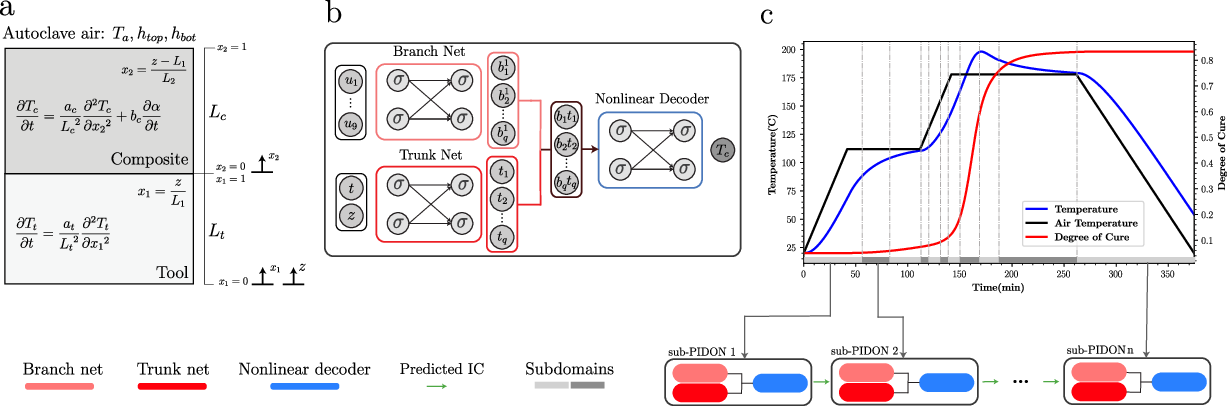
Figure 1: a) Schematic representation of the composite-tool system inside an autoclave, including local coordinates x1 and x2. b) Architecture of the proposed sub-PIDON model.
PIDON employs domain decomposition across temporal subdomains, leveraging multiple DeepONets, each tailored to specific intervals in the curing timeline. This modularity improves prediction accuracy and mitigates spectral bias, enhancing the model's learning capacity over extended temporal horizons.
Optimization Framework
The framework couples PIDON with gradient-based optimization, utilizing the Adam optimizer. This end-to-end accelerated design optimization strategy focuses on achieving an optimal cure cycle for aerospace-grade composites. The optimization problem is formulated to minimize a compound loss function targeting multiple objectives: desired Degree of Cure (DOC), minimized cure gradients, controlled exotherm (part temperature), and thermal lag.
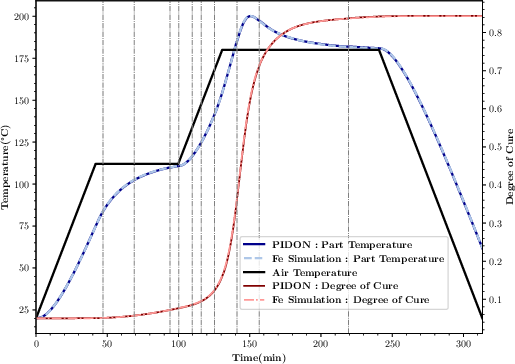
Figure 2: Comparison of predicted part temperature and DOC from the PIDON model with FE simulation at the midpoint of the composite.
The differentiable nature of the PIDON model allows seamless gradient computation, significantly reducing necessary function evaluations compared to gradient-free methods. This results in a computationally efficient exploration of design variables.
Results and Comparison
The PIDON framework was benchmarked against other operator-based models such as PINO and FNO, demonstrating superior accuracy via reduced mean absolute errors. Figure 3 illustrates the optimization of a composite curing process, where the PIDON-driven framework achieves a ×3 speedup over gradient-free optimizers like Particle Swarm Optimization and Genetic Algorithms.
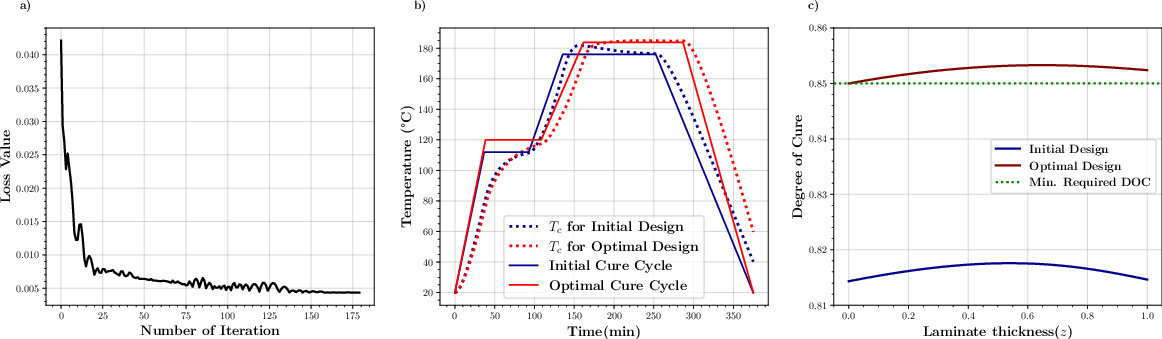
Figure 3: Evolution of the total loss during optimization and comparison of initial and optimized cure cycle profiles.
In tasks involving 20 mm and 30 mm thick composites, the framework efficiently balanced conflicting objectives such as maximizing DOC while controlling part temperature. With fewer function evaluations, the Adam optimizer exhibited robust performance across varying initial conditions, underscoring the framework's versatility in managing complex design scenarios.
Conclusion
The paper presents a robust accelerated design optimization framework employing a PIDON model, which advances the state-of-the-art in composites autoclave processing. By effectively addressing limitations of existing models, this approach facilitates rapid exploration and optimization of high-dimensional design spaces. The framework's adaptability suggests broad applicability beyond composites, potentially revolutionizing engineering design in digital twin systems and other advanced manufacturing contexts. Future research may focus on extending the model's capabilities to accommodate even more complex multi-physics phenomena.

