YOLOv11: An Overview of the Key Architectural Enhancements
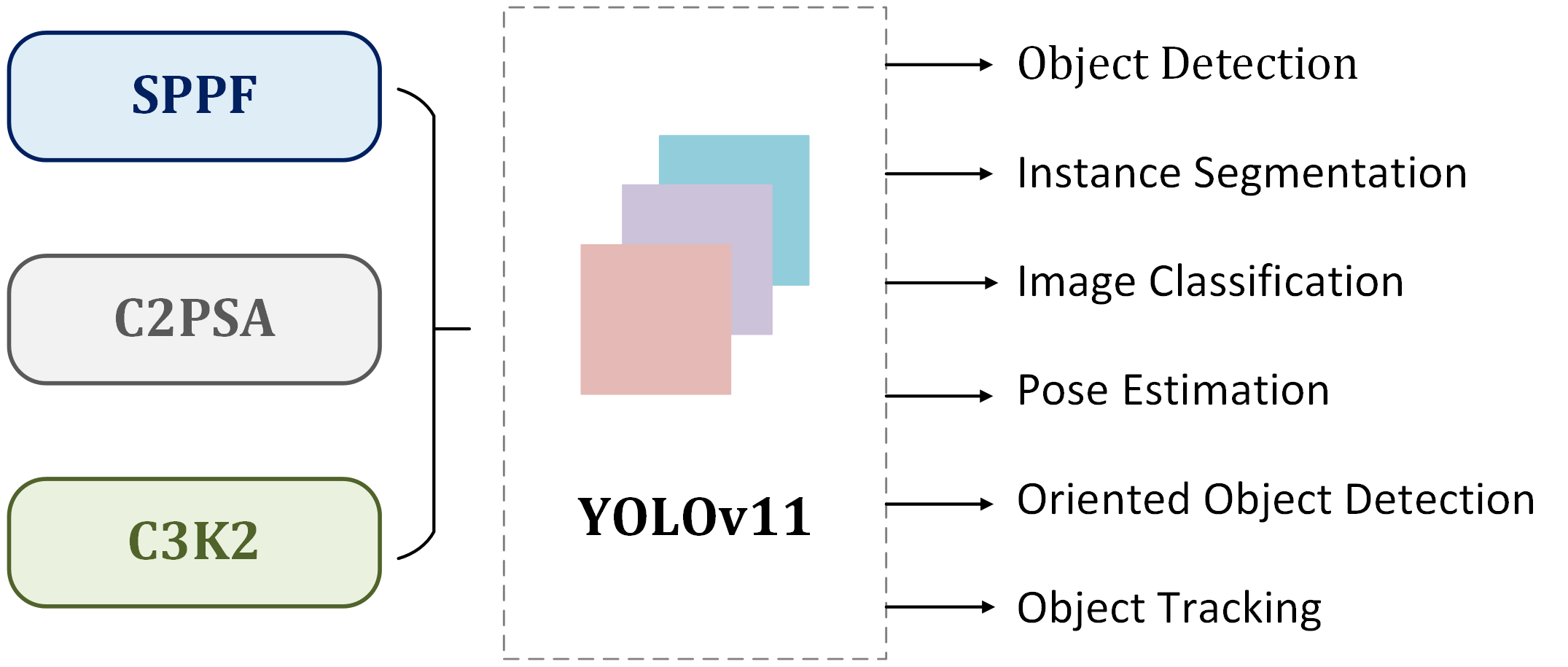
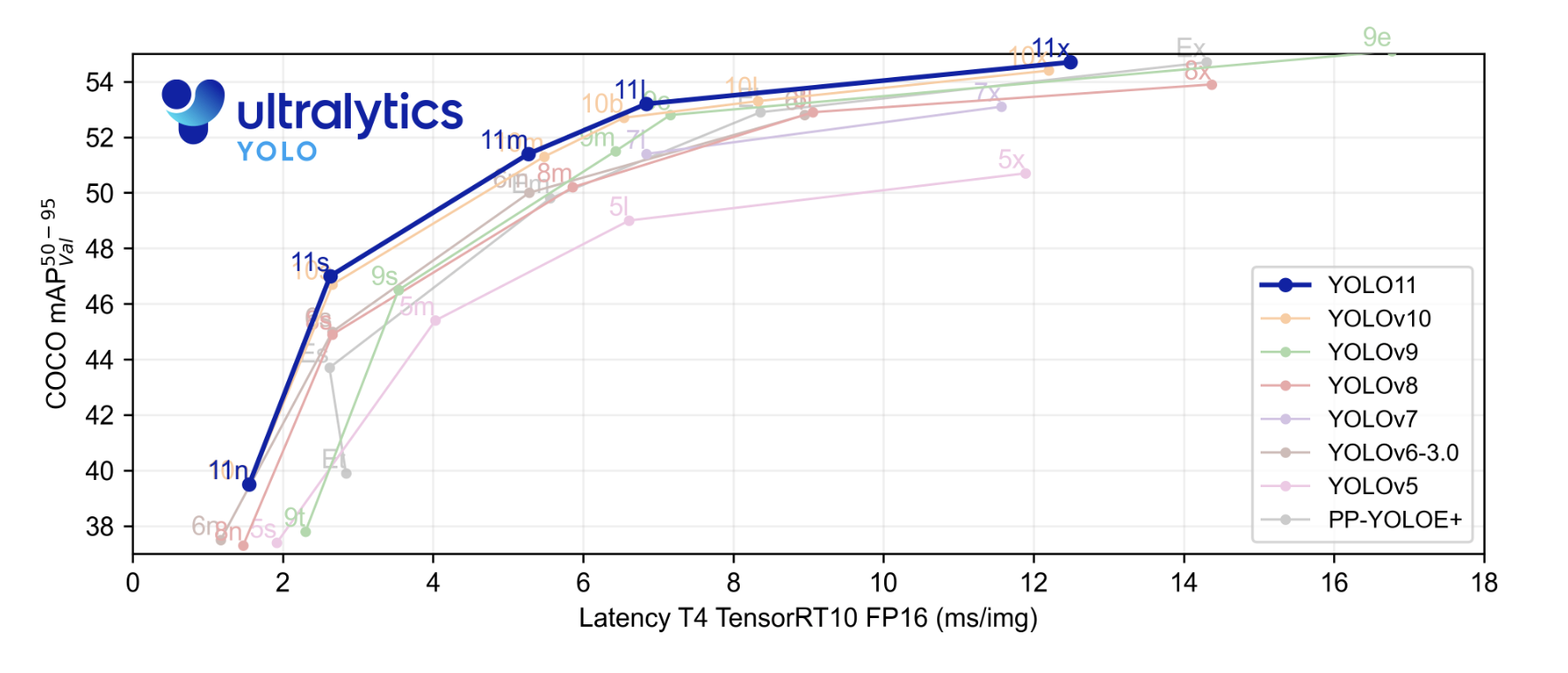
Abstract: This study presents an architectural analysis of YOLOv11, the latest iteration in the YOLO (You Only Look Once) series of object detection models. We examine the models architectural innovations, including the introduction of the C3k2 (Cross Stage Partial with kernel size 2) block, SPPF (Spatial Pyramid Pooling - Fast), and C2PSA (Convolutional block with Parallel Spatial Attention) components, which contribute in improving the models performance in several ways such as enhanced feature extraction. The paper explores YOLOv11's expanded capabilities across various computer vision tasks, including object detection, instance segmentation, pose estimation, and oriented object detection (OBB). We review the model's performance improvements in terms of mean Average Precision (mAP) and computational efficiency compared to its predecessors, with a focus on the trade-off between parameter count and accuracy. Additionally, the study discusses YOLOv11's versatility across different model sizes, from nano to extra-large, catering to diverse application needs from edge devices to high-performance computing environments. Our research provides insights into YOLOv11's position within the broader landscape of object detection and its potential impact on real-time computer vision applications.
- Image processing, analysis and machine vision. Springer, 2013.
- Object detection in 20 years: A survey. Proceedings of the IEEE, 111(3):257–276, 2023.
- Object detection with deep learning: A review. IEEE transactions on neural networks and learning systems, 30(11):3212–3232, 2019.
- In-depth review of yolov1 to yolov10 variants for enhanced photovoltaic defect detection. In Solar, volume 4, pages 351–386. MDPI, 2024.
- You only look once: Unified, real-time object detection. In Proceedings of the IEEE conference on computer vision and pattern recognition, pages 779–788, 2016.
- Juan Du. Understanding of object detection based on cnn family and yolo. In Journal of Physics: Conference Series, volume 1004, page 012029. IOP Publishing, 2018.
- Yolo9000: better, faster, stronger. In Proceedings of the IEEE conference on computer vision and pattern recognition, pages 7263–7271, 2017.
- Yolov3: An incremental improvement. arXiv preprint arXiv:1804.02767, 2018.
- Yolov4: Optimal speed and accuracy of object detection. arXiv preprint arXiv:2004.10934, 2020.
- Roboflow Blog Jacob Solawetz. What is yolov5? a guide for beginners., 2020. Accessed: 21 October 2024.
- Yolov6: A single-stage object detection framework for industrial applications. arXiv preprint arXiv:2209.02976, 2022.
- Yolov7: Trainable bag-of-freebies sets new state-of-the-art for real-time object detectors. In Proceedings of the IEEE/CVF conference on computer vision and pattern recognition, pages 7464–7475, 2023.
- Francesco Jacob Solawetz. What is yolov8? the ultimate guide, 2023. Accessed: 21 October 2024.
- Yolov9: Learning what you want to learn using programmable gradient information. arXiv preprint arXiv:2402.13616, 2024.
- Yolov10: Real-time end-to-end object detection. arXiv preprint arXiv:2405.14458, 2024.
- Ultralytics yolo11, 2024.
- A comprehensive review of convolutional neural networks for defect detection in industrial applications. IEEE Access, 2024.
- Satya Mallick. Yolo - learnopencv. https://learnopencv.com/yolo11/, 2024. Accessed: 2024-10-21.
- Application of yolov7-tiny in the detection of steel surface defects. In 2024 5th International Seminar on Artificial Intelligence, Networking and Information Technology (AINIT), pages 2241–2245. IEEE, 2024.
- Ultralytics. Instance segmentation and tracking, 2024. Accessed: 2024-10-21.
- Ultralytics Abirami Vina. Ultralytics yolo11 has arrived: Redefine what’s possible in ai, 2024. Accessed: 2024-10-21.
- Viso.AI Gaudenz Boesch. Yolov11: A new iteration of “you only look once. https://viso.ai/computer-vision/yolov11/, 2024. Accessed: 2024-10-21.
- Ultralytics. Ultralytics yolov11. https://docs.ultralytics.com/models/yolo11/s, 2024. Accessed: 21-Oct-2024.
- What is yolov5: A deep look into the internal features of the popular object detector. arXiv preprint arXiv:2407.20892, 2024.
- DigitalOcean. What’s new in yolov11 transforming object detection once again part 1, 2024. Accessed: 2024-10-21.
- Child emotion recognition via custom lightweight cnn architecture. In Kids Cybersecurity Using Computational Intelligence Techniques, pages 165–174. Springer, 2023.
- Domain modelling for a lightweight convolutional network focused on automated exudate detection in retinal fundus images. In 2023 9th International Conference on Information Technology Trends (ITT), pages 145–150. IEEE, 2023.
Paper Prompts
Sign up for free to create and run prompts on this paper using GPT-5.
Top Community Prompts
Collections
Sign up for free to add this paper to one or more collections.

