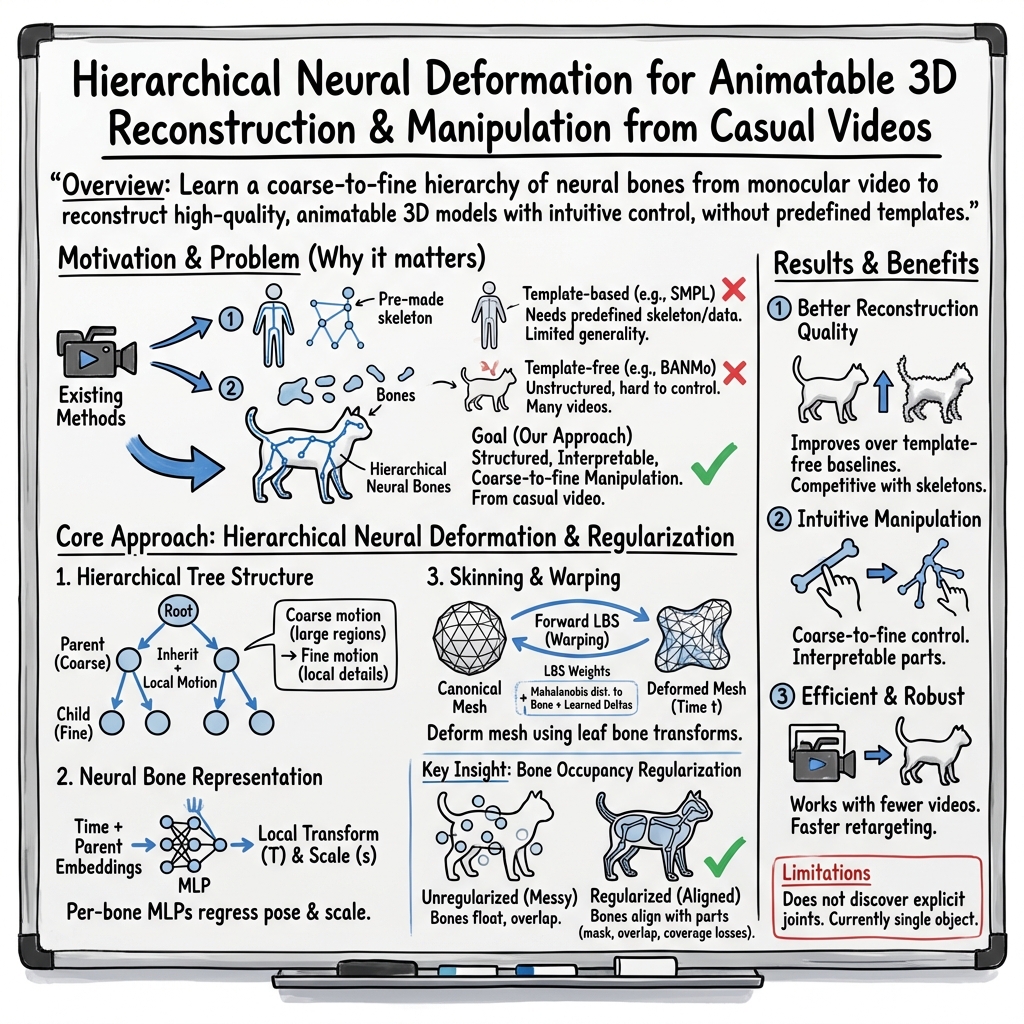
- The paper presents a novel hierarchical neural deformation model that uses a tree structure of bones for multi-scale motion capture.
- It employs a bone occupancy function based on Mahalanobis distance to align neural bones with actual object shapes for robust 3D reconstruction.
- The framework allows intuitive, user-friendly manipulation of 3D models, enabling high-quality animation of diverse objects from casual videos.
Overview of Hierarchically Structured Neural Bones for Reconstructing Animatable Objects from Casual Videos
The paper "Hierarchically Structured Neural Bones for Reconstructing Animatable Objects from Casual Videos" presents an innovative framework designed to create and manipulate 3D models derived from casual video recordings. The central element of this framework is a novel hierarchical deformation model leveraging tree-structured neural bones. This approach enables the decomposition of object motions at varying granularity levels, capturing and correlating parts dynamically without relying on any pre-existing structural templates.
Key Contributions
- Hierarchical Neural Deformation Model: The proposed model introduces a hierarchy of neural bones, arranged in a tree-like structure. Parent bones define coarse movements for broader regions of an object, while child bones allow for finer adjustments within more specific areas. This hierarchical system supports coarser-to-finer motion progression during both training and manipulation, facilitating intuitive control over complex animations.
- Bone Regularization Using the Bone Occupancy Function: To align the scale, orientation, and position of neural bones with actual object shapes, the authors propose a bone occupancy function. The function leverages the Mahalanobis distance to evaluate the occupancy of 3D points concerning neural bones. The paper extends ideas from part-based generative methods to enforce spatial alignment between bones and object structures without requiring predefined templates.
- User-Friendly Manipulation and Animatability: This framework offers significant advantages in user-friendliness. By optimizing the hierarchical neural bones, the derived 3D models can be intuitively manipulated, allowing users to add or remove bones dynamically. Such flexibility is critical for animating in novel poses and deploying 3D models in varied applications including films and virtual reality.
Experimental Validation
The efficacy of the proposed framework is exhibited through extensive experiments across diverse datasets, such as human motion, animals, and synthetic objects. Quantitative evaluations using Chamfer Distance and F-Score metrics reveal that the hierarchical approach yields superior 3D reconstruction quality compared to existing methods like BANMo and RAC. The framework demonstrates robust animatability, performing well in scenarios where fine motions and coarsely defined controls are crucial.
Theoretical and Practical Implications
Theoretically, this work contributes to the understanding of motion capture and representation in neural fields, pushing forward the capabilities of animatable neural radiance fields (NeRF). The unsupervised discovery of joint structures and correlations among object parts underscores a significant leap in reducing dependency on predefined structural templates, heralding greater flexibility and adaptive behaviors in AI-based reconstruction systems.
Practically, the hierarchical neural bone model advances the creation and manipulation of 3D models from casual videos, dramatically reducing the entry barrier for 3D content creation. The integration of these systems could democratize content creation, offering robust tools to industries reliant on animation, such as gaming and digital media production.
Future Directions
There are several promising avenues for future exploration. Extending the method to accommodate scenes with multiple interacting objects could enhance its applicability in more complex settings. Additionally, integrating dynamic learning for joint discovery and conjunction might further optimize the hierarchical structure, improving motion capture fidelity. Continuous advancements in neural rendering suggest potential for more realistic and physically plausible 3D reconstructions, even in challenging environments with rich textures and dynamic lighting conditions.
Overall, this paper presents a compelling advancement in the field of animatable 3D model reconstruction, laying foundational work that could catalyze wide-ranging improvements and innovations in AI-driven modeling frameworks.