Characterization of individual charge fluctuators in Si/SiGe quantum dots
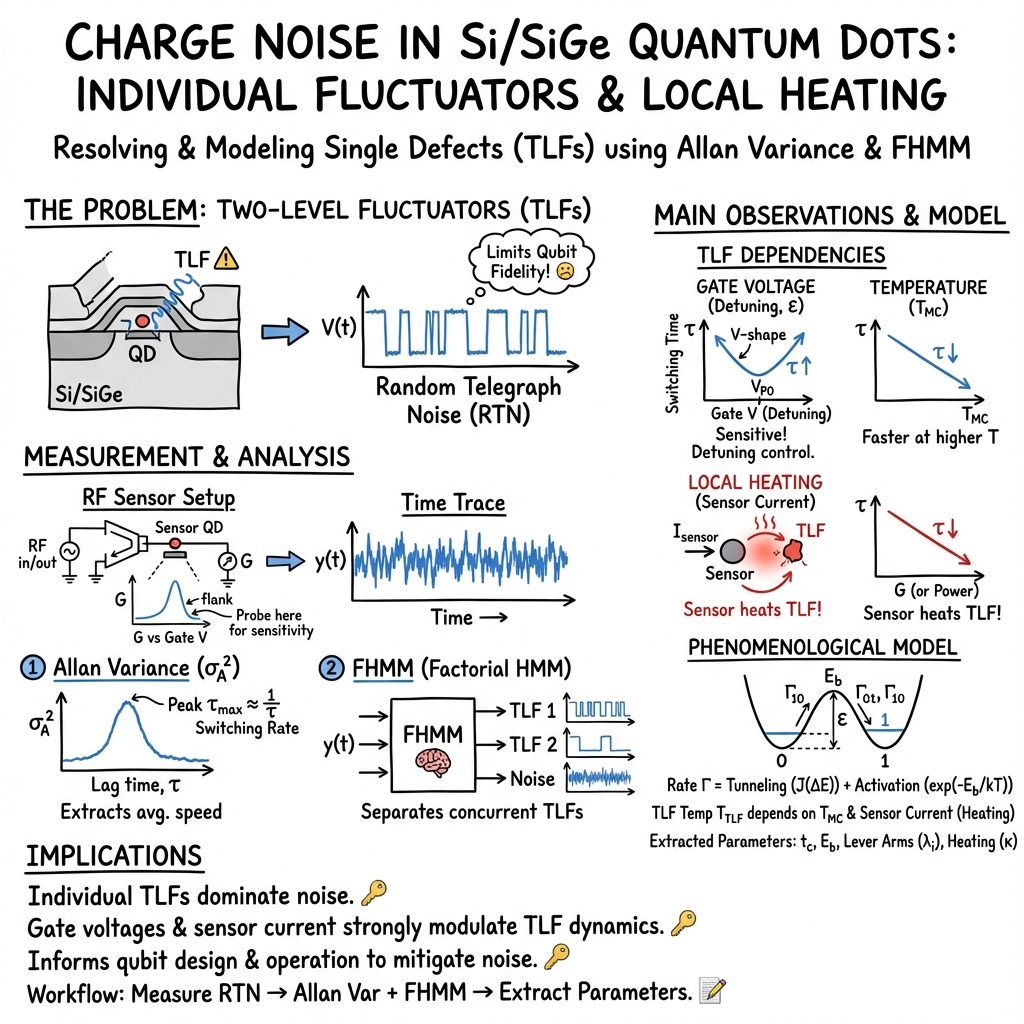
Abstract: Electron spins in silicon quantum dots are excellent qubits due to their long coherence times, scalability, and compatibility with advanced semiconductor technology. Although high gate fidelities can be achieved with spin qubits, charge noise in the semiconductor environment still hinders further improvements. Despite the importance of charge noise, key questions about the specific nature of the fluctuators that cause charge noise remain unanswered. Here, we probe individual two-level fluctuators (TLFs) in Si/SiGe quantum dots through simple quantum-dot transport measurements and analyses based on the Allan variance and factorial hidden Markov modeling. We find that the TLF switching times depend sensitively on gate voltages, decrease with temperature, and depend on the current through a nearby quantum dot. A model for the data of the primary TLF we study indicates that it may be a bistable charge dipole near the plunger gate electrode, heated by current through the sensor dot, and experiencing state transitions driven not by direct electron-phonon coupling but through some other mechanism such as coupling to electrons passing through the sensor dot.
Paper Prompts
Sign up for free to create and run prompts on this paper using GPT-5.
Top Community Prompts
Glossary
- 1/f noise: A noise spectrum where power scales inversely with frequency, common in electronic systems and materials. "In semiconductor quantum dots, charge noise typically has a $1/f$-like power spectrum"
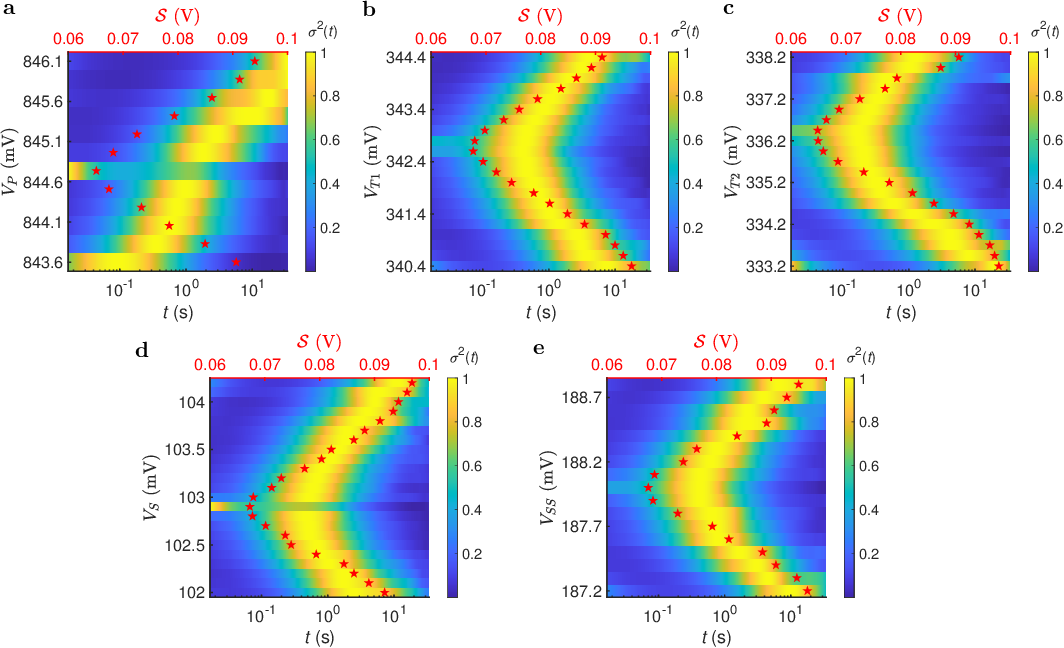
- Allan variance: A time-domain statistic that quantifies fluctuations over different averaging times and can reveal characteristic switching times of fluctuators. "Here, we probe individual two-level fluctuators (TLFs) in Si/SiGe quantum dots through simple quantum-dot transport measurements and analyses based on the Allan variance and factorial hidden Markov modeling."
- Arrhenius form: The exponential temperature dependence of a thermally activated transition rate, typically proportional to exp(−E_b/k_BT). "We allow for the presence of an additional thermally activated rate taking the Arrhenius form"
- Atomic layer deposition: A thin-film growth technique that deposits materials in atomic-scale layers for precise control of thickness and composition. "Both devices have a 15-nm-thick aluminum oxide gate dielectric deposited via atomic layer deposition."
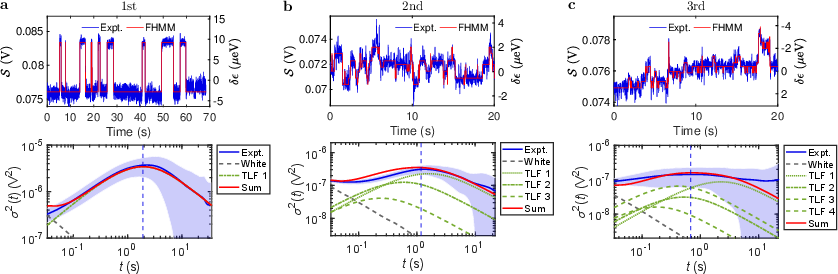
- Blind source separation: A methodology to recover hidden components contributing to an observed signal without detailed knowledge of the mixing process. "This showcases the blind source separation capability of the FHMM technique"
- Bose-Einstein distribution: The statistical distribution describing occupancy of bosonic energy states at thermal equilibrium. "n(ΔE) = (e{ΔE/k_{B}T}-1){-1} is the Bose-Einstein distribution"
- Bistable charge dipole: A localized defect with two stable charge configurations that can switch between states, acting as a fluctuator. "it may be a bistable charge dipole near the plunger gate electrode"
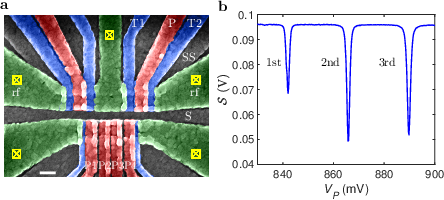
- Coulomb blockade: Suppression of electron transport through a small conductor due to electrostatic charging energy, creating discrete conductance peaks. "We tune the right sensor quantum dot of Device 1 in the Coulomb blockade regime"
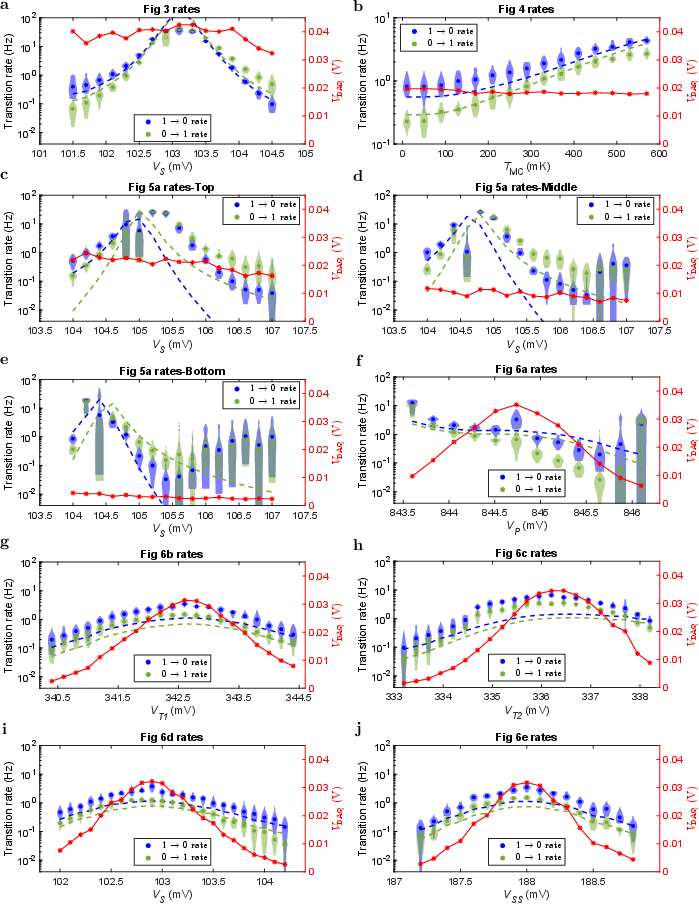
- Detailed balance: The equilibrium condition relating forward and reverse transition rates via energy differences and temperature. "The detailed balance condition enforces Γ{ji}{\mathrm{tunneling} = \Gamma{ij}{\mathrm{tunneling} e{-\Delta E_{ji}/k_{B} T}"
- Dilution refrigerator: A cryogenic system that reaches millikelvin temperatures using a mixture of helium-3 and helium-4. "The device is cooled in a dilution refrigerator with a base temperature around $10~\si{mK}$."
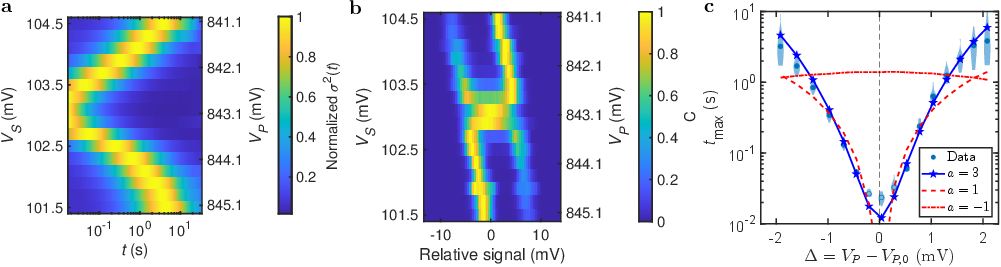
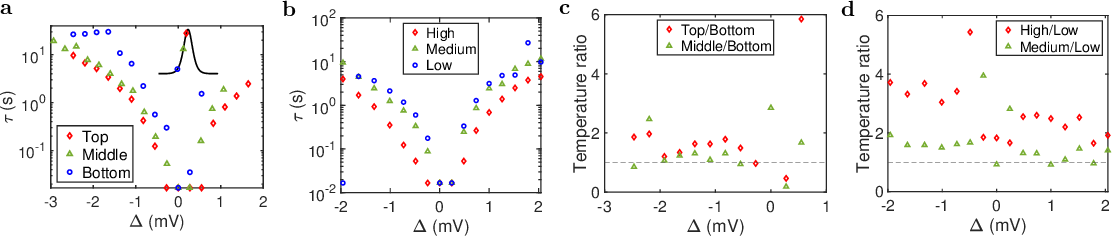
- Electron-assisted tunneling: State transitions in a defect mediated by coupling to electronic excitations rather than phonons. "the qualitative features in our data are consistent with electron-assisted tunneling, which predicts an increased switching time with increasing detuning."
- Electron-phonon coupling: Interaction between electrons and lattice vibrations that can mediate energy relaxation or transitions. "not by direct electron-phonon coupling"
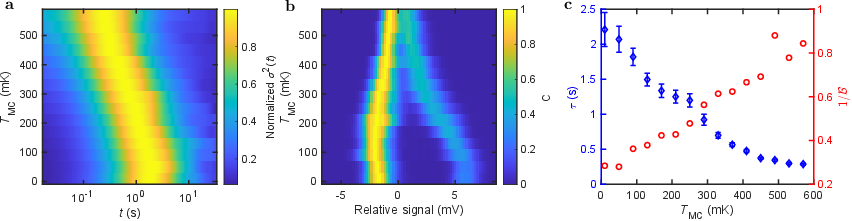
- Environment-assisted tunneling: Transition processes in a two-level system driven by coupling to a surrounding bath or reservoir. "A number of effects could result in this behavior, such as environment-assisted tunneling or poor thermalization of the device to the mixing chamber."
- Factorial Hidden Markov Model (FHMM): A probabilistic model that represents a signal as the superposition of multiple independent hidden Markov chains. "The second method we use to analyze our data is a factorial hidden Markov model (FHMM)"
- Fermi’s Golden Rule: A formula giving transition rates between quantum states due to a weak perturbation, proportional to the density of final states. "is the Fermi's Golden Rule rate of tunneling"
- Gate dielectric: An insulating layer beneath metal gates that controls electric fields in semiconductor devices while preventing leakage. "Both devices have a 15-nm-thick aluminum oxide gate dielectric deposited via atomic layer deposition."
- Gate fidelity: The accuracy of a quantum gate operation relative to its ideal action, often limited by noise. "charge noise in Si quantum dots is a major obstacle limiting gate fidelities"
- Joule heating: Heat generation due to electrical current flowing through a resistive element. "It could be related to Joule heating in the electron reservoirs"
- Lever arm: The proportionality factor converting applied gate voltage into energy shifts in the device. "We find the lever arm by raising the temperature of the mixing chamber to 500 mK and fitting the peak shape to the predicted Coulomb blockade lineshape, assuming pure thermal broadening."
- Mixing chamber: The coldest stage of a dilution refrigerator where samples are thermally anchored. "we sweep the mixing chamber temperature "
- Ohmic contact: A low-resistance electrical contact that provides linear current–voltage behavior, used to access the quantum well. "through ohmic contacts labeled by yellow boxes to the quantum well for rf reflectometry."
- Overlapping gate architecture: A device layout in which multiple metal gates overlap to precisely define and control quantum dots. "fabricated with an overlapping gate architecture (Figure~\ref{fig:setup}a)"
- Pauli matrices: A set of 2×2 matrices used to describe spin-1/2 systems and two-level Hamiltonians. "where denotes the tunnel coupling, the energy bias, and are Pauli matrices."
- Plunger gate: A gate electrode that primarily tunes the electrochemical potential (energy) of a quantum dot. "we set the plunger gate voltage on the flank of the transport peak"
- Power spectral density: A frequency-domain measure of signal power per unit frequency, used to characterize noise. "most previous experiments on charge noise in Si quantum dots have reported power spectral densities"
- Quantum well: A thin semiconductor layer that confines electrons in one dimension, creating a two-dimensional electron system. "an 8-nm-thick natural Si quantum well approximately $50~\si{nm}$ beneath the surface."
- Random telegraph noise (RTN): A two-level noise process where a signal switches stochastically between two values. "The data from the first transport peak show random telegraph noise with a constant step height"
- Reflectometry (rf reflectometry): A measurement technique using radio-frequency signals to infer impedance changes, enabling fast charge sensing. "We measure the sensor conductance via rf reflectometry"
- Screening gate: A gate used to shape or screen electric fields, improving dot definition and reducing crosstalk. "Plunger gates, tunneling gates, screening gates, and accumulation gates are color-coded as red, blue, gray, and green, respectively."
- Source-drain bias: The voltage applied between the source and drain contacts to drive current through a device. "We also measure the TLF while varying the source-drain bias voltage by adjusting the sensor rf excitation"
- Spin-boson model: A theoretical model describing a two-level system coupled to a bosonic bath. "is consistent with both a spin-boson model and a generalization of a model for electron-assisted tunneling"
- Spin qubits: Qubits encoded in the spin state of electrons, offering long coherence in silicon. "Although high gate fidelities can be achieved with spin qubits, charge noise in the semiconductor environment still hinders further improvements."
- Thermal activation: State transitions driven by thermal energy overcoming an energy barrier. "we exclude scenarios involving pure phonon-assisted tunneling or pure thermal activation."
- Thermal broadening: The smearing of energy-dependent features (like conductance peaks) due to finite temperature. "assuming pure thermal broadening."
- Thermally activated rate: A transition rate that increases with temperature according to an activation energy barrier. "We allow for the presence of an additional thermally activated rate taking the Arrhenius form"
- Tunnel coupling: The quantum mechanical coupling between two localized states that enables tunneling transitions. "where denotes the tunnel coupling"
- Tunneling gate: A gate electrode that primarily controls the tunneling barrier between quantum dots or between a dot and a reservoir. "Plunger gates, tunneling gates, screening gates, and accumulation gates are color-coded as red, blue, gray, and green, respectively."
- Two-dimensional electron gas (2DEG): A confined electron system with motion restricted to two dimensions, typically in a quantum well. "such as coupling to electrons in the two-dimensional electron gas."
- Two-level fluctuator (TLF): A defect or system with two metastable states that randomly switches, causing charge noise. "Here, we probe individual two-level fluctuators (TLFs) in Si/SiGe quantum dots"
- Two-level system (TLS): A general term for a system with two energy states, often used to model defects causing noise. "TLFs and two-level systems have been studied intensely in other physical systems such as glasses"
- Two-level tunneling state: A TLS where transitions occur via quantum tunneling, often coupled to reservoirs. "two-level tunneling states coupled to phonon or electron reservoirs."
- Viterbi algorithm: A dynamic programming algorithm that computes the most likely sequence of hidden states in an HMM. "as estimated from the FHMM using the Viterbi algorithm (red)."
- White noise: A noise process with flat power spectral density across frequencies. "the most likely fluctuator noise trajectory without a white noise component"
- Si/SiGe heterostructure: A layered silicon/silicon–germanium semiconductor structure engineered for high-quality quantum devices. "on an undoped Si/SiGe heterostructure with an 8-nm-thick natural Si quantum well"
- RF-equipped charge sensors: Quantum-dot-based sensors integrated with radio-frequency circuitry for fast, sensitive charge readout. "The primary device we use (``Device 1'') is a quadruple-quantum-dot device with two rf-equipped charge sensors"
Collections
Sign up for free to add this paper to one or more collections.