Artificial Intelligence in the Knowledge Economy
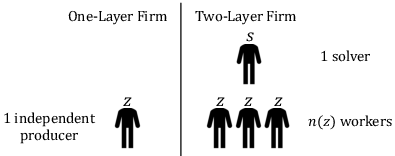
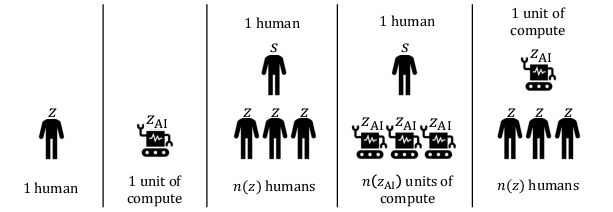
Abstract: AI can transform the knowledge economy by automating non-codifiable work. To analyze this transformation, we incorporate AI into an economy where humans form hierarchical organizations: Less knowledgeable individuals become "workers" doing routine work, while others become "solvers" handling exceptions. We model AI as a technology that converts computational resources into "AI agents" that operate autonomously (as co-workers and solvers/co-pilots) or non-autonomously (solely as co-pilots). Autonomous AI primarily benefits the most knowledgeable individuals; non-autonomous AI benefits the least knowledgeable. However, output is higher with autonomous AI. These findings reconcile contradictory empirical evidence and reveal tradeoffs when regulating AI autonomy.
- Acemoglu, D. and D. Autor (2011): “Chapter 12 - Skills, Tasks and Technologies: Implications for Employment and Earnings,” Elsevier, vol. 4 of Handbook of Labor Economics, 1043–1171.
- Acemoglu, D. and J. Loebbing (2024): “Automation and Polarization,” National Bureau of Economic Research.
- Acemoglu, D. and P. Restrepo (2018): “The Race Between Man and Machine: Implications of Technology for Growth, Factor Shares, and Employment,” American Economic Review, 108, 1488–1542.
- Aghion, P., B. F. Jones, and C. I. Jones (2017): “Artificial Intelligence and Economic Growth,” Working Paper 23928, National Bureau of Economic Research.
- Alfred Sloan (1924): “The Most Important Thing I Ever Learned about Management,” System: The Magazine of Business, 194, 140–141.
- Antràs, P., L. Garicano, and E. Rossi-Hansberg (2006): “Offshoring in a Knowledge Economy,” The Quarterly Journal of Economics, 121, 31–77.
- Autor, D. (2024): “Applying AI to Rebuild Middle Class Jobs,” National Bureau of Economic Research.
- Azar, J., M. Chugunova, K. Keller, and S. Samila (2023): “Monopsony and Automation,” Max Planck Institute for Innovation & Competition Research Paper No. 23-21.
- Brynjolfsson, E. (2022): “The Turing Trap: The Promise & Peril of Human-Like Artificial Intelligence,” Daedalus, 151, 272–287.
- Brynjolfsson, E., D. Li, and L. R. Raymond (2023): “Generative AI at work,” Tech. rep., National Bureau of Economic Research.
- Caicedo, S., J. Lucas, Robert E., and E. Rossi-Hansberg (2019): “Learning, Career Paths, and the Distribution of Wages,” American Economic Journal: Macroeconomics, 11, 49–88.
- Caliendo, L., G. Mion, L. D. Opromolla, and E. Rossi-Hansberg (2020): “Productivity and Organization in Portuguese Firms,” Journal of Political Economy, 128, 4211–4257.
- Caliendo, L., F. Monte, and E. Rossi-Hansberg (2015): “The Anatomy of French Production Hierarchies,” Journal of Political Economy, 123, 809–852.
- Caliendo, L. and E. Rossi-Hansberg (2012): “The Impact of Trade on Organization and Productivity,” The Quarterly Journal of Economics, 127, 1393–1467.
- Carmona, G. and K. Laohakunakorn (Forthcoming): “Improving the Organization of Knowledge in Production by Screening Problems,” Journal of Political Economy.
- Eeckhout, J. and P. Kircher (2018): “Assortative Matching with Large Firms,” Econometrica, 86, 85–132.
- Eloundou, T., S. Manning, P. Mishkin, and D. Rock (2023): “Gpts are gpts: An early look at the labor market impact potential of large language models,” arXiv preprint arXiv:2303.10130.
- Fuchs, W., L. Garicano, and L. Rayo (2015): “Optimal Contracting and the Organization of Knowledge,” The Review of Economic Studies, 82, 632–658.
- Garicano, L. (2000): “Hierarchies and the Organization of Knowledge in Production,” Journal of Political Economy, 108, 874–904.
- Garicano, L. and T. Hubbard (2007): “Managerial Leverage Is Limited by the Extent of the Market: Hierarchies, Specialization, and the Utilization of Lawyers’ Human Capital,” The Journal of Law & Economics, 50, 1–43.
- Garicano, L. and E. Rossi-Hansberg (2004): “Inequality and the Organization of Knowledge,” American Economic Review Papers and Proceedings, 94, 197–202.
- ——— (2006): “Organization and Inequality in a Knowledge Economy,” The Quarterly Journal of Economics, 121, 1383–1435.
- ——— (2012): “Organizing growth,” Journal of Economic Theory, 147, 623–656.
- ——— (2015): “Knowledge-Based Hierarchies: Using Organizations to Understand the Economy,” Annual Review of Economics, 7, 1–30.
- Hayek, F. A. (1945): “The Use of Knowledge in Society,” The American Economic Review, 35, 519–530.
- Meserole, C. O. (2018): “What is Machine Learning?” Tech. rep., Brookings Institution.
- Muro, M., J. Whiton, and R. Maxim (2019): “What Jobs are Affected by AI?” Tech. rep., Brookings Institution.
- Thomson Reuters (2021): “The Business Case for AI-Enabled Legal Technology,” .
- Webb, M. (2020): “The Impact of Artificial Intelligence on the Labor Market,” Working Paper.
- Zeira, J. (1998): “Workers, Machines, and Economic Growth,” The Quarterly Journal of Economics, 113, 1091–1117.
Paper Prompts
Sign up for free to create and run prompts on this paper using GPT-5.
Top Community Prompts
Collections
Sign up for free to add this paper to one or more collections.