- The paper introduces a chiral extension of the Lennard-Jones model by incorporating transverse forces to mimic colloidal spinners.
- It employs large-scale simulations to map phase coexistence and quantify the influence of chirality on surface tension and edge currents.
- The study measures rotational viscosity through edge current analysis, linking chirality to altered non-equilibrium fluid dynamics.
Overview of "Phase Coexistence and Edge Currents in the Chiral Lennard-Jones Fluid"
This paper by Claudio B. Caporusso, Giuseppe Gonnella, and Demian Levis investigates the phase behavior and dynamics of a 2D chiral fluid composed of Brownian disks interacting via a Lennard-Jones potential and a non-conservative transverse force. The research explores how chirality affects phase separation, interface tension, and edge currents, contributing to our understanding of non-equilibrium systems with broken parity and time-reversal symmetry.
Chiral Lennard-Jones Fluid Model
The study develops a chiral extension of the Lennard-Jones model, introducing transverse forces to mimic the behavior of colloidal spinners. The model consists of N=5122 particles in a periodic box, interacting through a Lennard-Jones potential and experiencing a transverse force proportional to their angular velocity ω. This deviation from equilibrium is central to the system's behavior, leading to unique phase characteristics and current formations at the fluid's interface.
Phase Behavior and Coexistence
The authors utilize simulations to establish a phase diagram, identifying distinct gas, chiral liquid, and chiral solid phases.
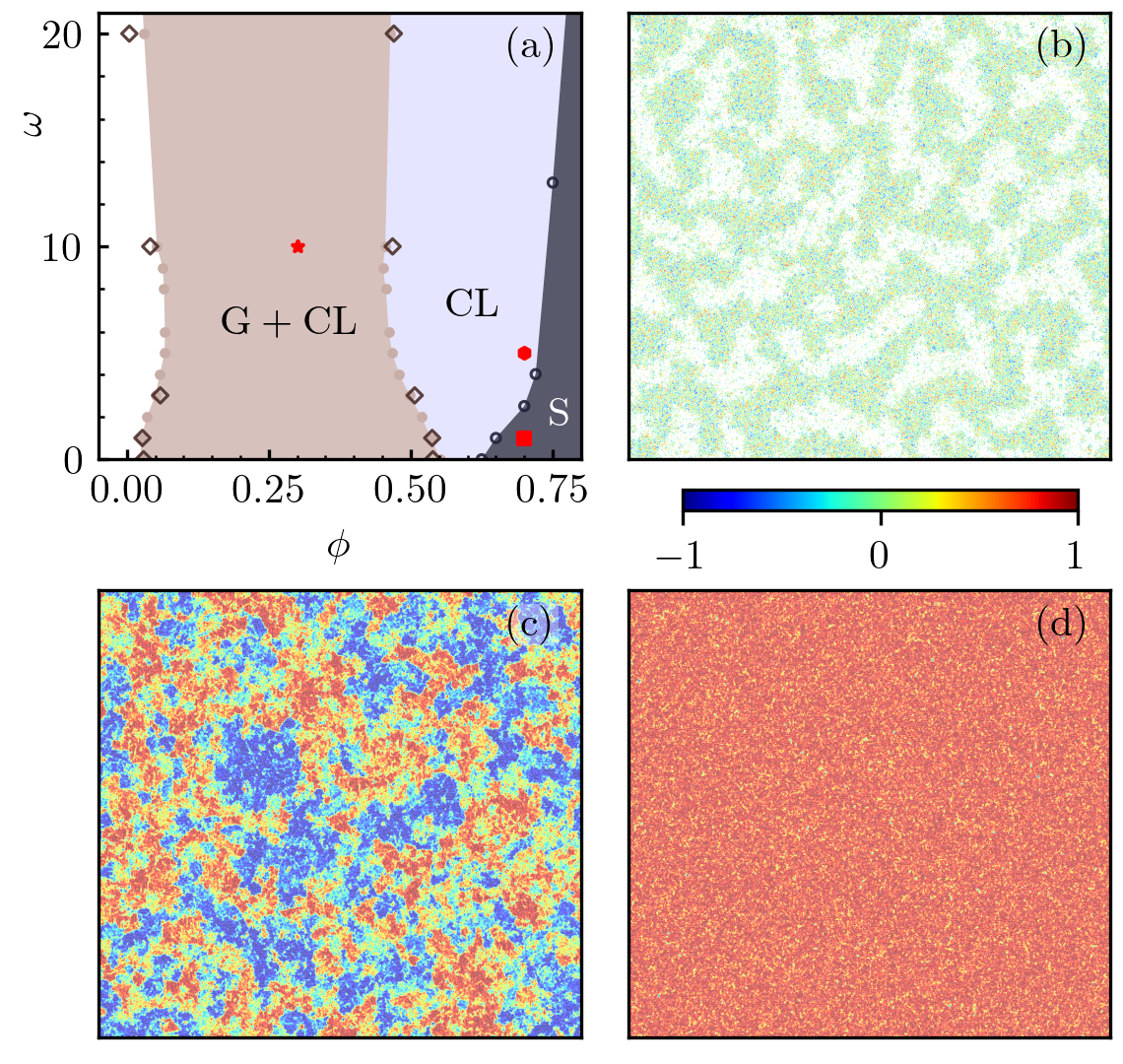
Figure 1: The phase diagram at T=0.47, showing the gas, chiral liquid, and solid phases, including a coexistence region.
The study successfully characterizes phase separation using equilibrium concepts despite the system's non-equilibrium nature. It identifies a coexistence region where dense liquid droplets form in a gas background, elucidating the phase transitions influenced by chirality.
Equations of State and Surface Tension
The research derives the equations of state for different chirality levels and explores interface properties.
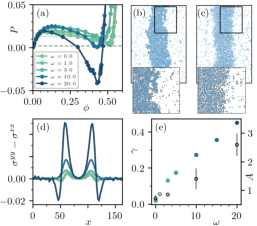
Figure 2: Pressure loops indicating phase coexistence and the differences in pressure profiles for ω=0 and ω=20.
As chirality increases, the system exhibits larger Mayer-Wood loops in its pressure-density curve, suggesting increased surface tension. The study employs stress tensor analysis to quantify this tension, showing that chirality enhances the surface smoothness and stability, confirming the thermodynamic description's applicability.
Edge Currents and Rotational Viscosity
Chirality induces the formation of edge currents at the liquid-gas interface, characterized using hydrodynamic models. The authors analyze these currents to estimate rotational viscosity, a pivotal parameter in chiral hydrodynamics.
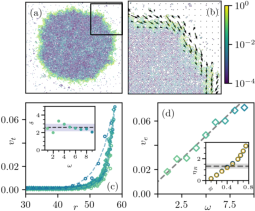
Figure 3: Characterization of edge currents with extracted values of penetration length δ and edge velocity ve.
The systematic analysis reveals that edge velocities increase linearly with chirality, while the penetration depth remains constant, allowing the computation of rotational viscosity consistent with experimental observations.
Impact of Chirality on Solid Phases
Further investigation shows that increased chirality destabilizes the solid phase, creating rotating hexatic patches that resemble observations in experimental systems.
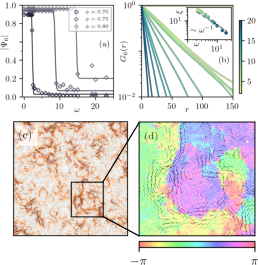
Figure 4: Hexatic order and displacement fields showing the formation of rotating patches in the chiral liquid phase at high chirality.
The study measures the hexatic order parameter and correlation functions, demonstrating the formation of disordered domains due to chirality. This provides insight into how transverse forces lead to fluidization and complex flow patterns.
Conclusion
"Phase Coexistence and Edge Currents in the Chiral Lennard-Jones Fluid" advances the understanding of non-equilibrium chiral fluids. The research integrates theoretical and computational techniques to reveal the effects of chirality on phase behavior, surface tension, and edge currents. It provides a framework for exploring chiral systems within statistical mechanics, addressing both theoretical and practical implications. This work lays the groundwork for future studies on the role of chirality in materials science and soft condensed matter physics.

