- The paper introduces Scallop, a novel language that combines deep learning with logical reasoning for neurosymbolic programming.
- It extends traditional Datalog with recursion, aggregation, and flexible symbolic representations to handle multimodal data efficiently.
- Scallop achieves high data efficiency and interpretability, outperforming state-of-the-art models in diverse neurosymbolic tasks.
Scallop: A Language for Neurosymbolic Programming
The paper introduces Scallop, a language designed for combining deep learning with logical reasoning, facilitating neurosymbolic programming. It outlines the key features of Scallop, its implementation, and the evaluation of its capabilities against various neurosymbolic applications.
Key Features
- Symbolic Representation:
- Utilizes a relational data model offering flexibility to handle diverse data types such as images, videos, and text.
- Capable of integrating structured output from neural networks into logical reasoning processes.
- Declarative Logic Programming:
- Extends traditional Datalog to support recursion, aggregation, and negation.
- Facilitates complex logical reasoning, supporting the integration of domain knowledge.
- Differentiable Reasoning Framework:
- Based on the theory of provenance semirings to support automatic, efficient differentiation, essential for learning tasks.
- Offers customizable learning processes tailored to specific applications through different provenance structures.
Implementation Details
Scallop is implemented in Rust, focusing on efficiency and integration with existing machine learning frameworks such as PyTorch. It includes:
- A compiler and interpreter for executing Scallop programs.
- Bindings to integrate with Python environments, enabling seamless use in machine learning pipelines.
- A comprehensive set of built-in provenances that support both probabilistic and differentiable reasoning.
The system allows neural networks to extract features from data, which are then processed by Scallop to perform logical reasoning and return actionable insights or decisions. The scalable and flexible design accommodates a wide range of neurosymbolic applications.
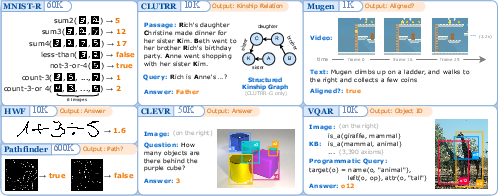
The evaluation covers eight diverse neurosymbolic tasks, each designed to test different aspects of Scallop, such as perception and logical reasoning. Highlights from the evaluation include:
The framework's ability to handle mutual exclusivity and its application in tasks demanding intricate reasoning (e.g., kinship inference from natural language) further demonstrates its utility and versatility.
Conclusion
Scallop represents a significant advance in neurosymbolic programming, offering a unified language and framework capable of seamlessly integrating neural and symbolic paradigms. Its scalable, efficient implementation and successful application to a range of complex tasks underscore its potential for addressing real-world AI challenges. Future work aims to enhance Scallop's functionality, expanding its support for additional machine learning paradigms and applying it to real-world domains such as autonomous driving and medical diagnostics.