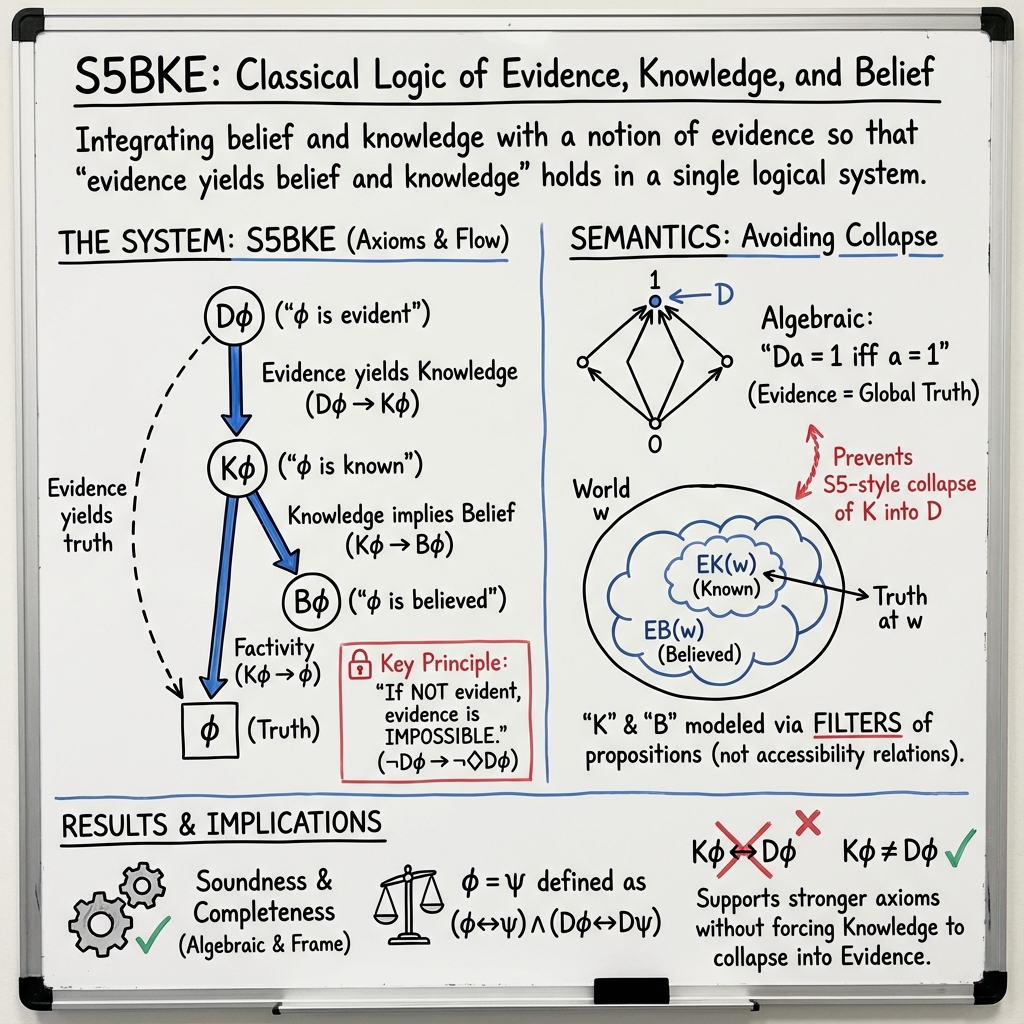
- The paper introduces a novel logical system that integrates a classical notion of evidence with epistemic operators for belief and knowledge.
- It employs a hybrid modal framework combining S5-style axioms with intuitionistic elements to model epistemic reasoning robustly.
- The framework directly models belief and knowledge as sets of propositions, offering new implications for AI logic and epistemic analysis.
Belief, Knowledge, and Evidence in Modal Logic
Introduction
The paper "Belief, knowledge and evidence" (2304.01283) introduces a novel logical system that synthesizes classical epistemic concepts of belief and knowledge with a refined construct of evidence. This logical framework is constructed to uphold the intuitive principle that evidence supports both belief and knowledge. The system is built upon a modal framework inspired by intuitionistic truth in previous works, particularly those by Lewitzka, which were in turn inspired by modal systems such as S5-style principles. Within this framework, the authors replace intuitionistic proof with a classical notion of evidence, distinguishing this concept from classical proof and intuitionistic logic. Unlike typical possible worlds semantics, belief and knowledge are modeled directly as sets of propositions, thus providing a more nuanced approach to epistemic reasoning.
Epistemic Concepts and Axioms
The paper articulates its logical framework by weaving together established elements of modal epistemic logic with evidence as a core component. A key focus is the interplay between the constructive concept of proof and its classical counterpart, evidence. Evidence is positioned as a robust form of justification for knowledge and belief, distinguished from either knowledge or classical truth. The implication structure addressed is evidence implying knowledge, belief, and truth, though evidence is distinguished from knowledge itself. Notably, the paper outlines modal system L5's axioms, combining classical and intuitionistic logic, to exhibit the transition from proof to a classical evidence-based interpretation.
The modal logical principles incorporated include:
- Disjunction Property
- Distribution of various epistemic operators
- Co-reflection principles
These axioms aim to capture the epistemic nuances that govern belief, knowledge, and evidence from both intuitionistic and classical perspectives. S5-style axioms are deemed adequate in this hybrid system for logical reasoning about intuitionistic truth—suggesting a blend of actual and possible proofs within epistemic contexts.
Semantic and Logical Structure
The construction of the logical system encompasses a distinct semantics to model epistemic concepts. Rather than employing accessibility relations typical in modal logic, a relational frame-based semantics is proposed where epistemic operators are interpreted directly as sets of propositions linked to frames within the logic. This approach combats collapsing epistemic operators into single, indistinguishable forms, as seen in some strong forms of introspective knowledge.
The frame-based semantics operates by assigning Boolean algebra-based models over ultrafilters for evidence, belief, and knowledge. In this setting, propositions determine model satisfaction, with filters forming the basis for the epistemic reasoning about truth and derivation. The epistemic operators are interpreted consistently over these frames to ensure adherence to logical principles.
Implications and Future Directions
This logical system introduces significant potential for exploring epistemic reasoning realms beyond classical approaches, integrating intuitionistic and constructive aspects rigorously. The combination of modal system S5 attributes with epistemic considerations predicts further investigations into how evidence can influence logical systems traditionally dominated by belief and knowledge alone. The focus on evidence extending capabilities of classical modal principles suggests promising expansions in AI logic implementations, where certainty must be considered alongside belief and knowledge.
Conclusion
The paper "Belief, knowledge and evidence" presents an ample logical framework accommodating evidence within classical epistemic constructs, thereby enhancing the logical interplay between belief and knowledge paradigms. The logical and semantic intricacies propose a refined manner of reasoning about epistemic states, offering future implications for expanding AI-related epistemic logic and strengthening reasoning systems across computational domains.