- The paper introduces a universal guidance algorithm that eliminates retraining, significantly reducing computational overhead across modalities.
- It applies guidance on denoised images to bridge the domain gap, allowing off-the-shelf networks to effectively control the diffusion process.
- Experimental results validate robust performance in tasks like text-guided, segmentation, and identity-preserving image generation.
Universal Guidance for Diffusion Models
Introduction
The paper "Universal Guidance for Diffusion Models" (2302.07121) introduces an innovative approach to enhance the versatility of diffusion models in generating conditioned outputs across multiple modalities. Typically, diffusion models are restrained by the necessity to train specifically for one conditioning modality, such as text or segmentation maps, leading to inefficiencies when new modalities are required. The authors propose a universal guidance algorithm allowing diffusion models to be controlled by arbitrary guidance modalities without necessitating retraining.
Diffusion models, recognized for their prowess in generating high-quality digital content, conventionally leverage conditioning inputs to modulate their generative process. Conditioning limits the adaptability of diffusion models to new tasks without substantial retraining costs. In contrast, the proposed universal guidance methodology relies on providing flexibility by utilizing guidance functions, enhancing the model's adaptability across diverse generative tasks, thus broadening their applicability and significantly reducing computational overhead.
Core Contributions
The authors make several crucial contributions to the field of conditional image generation using diffusion models.
- Universal Guidance: They introduce a universal guidance algorithm where arbitrary guidance modalities can be integrated into the diffusion process. Importantly, this approach allows existing diffusion models to remain fixed, eliminating the need for retraining and thereby reducing computational cost significantly.
- Samplers on Denoised Images: By evaluating guidance models solely on denoised images rather than noisy latent states, they bridge the domain gap encountered in standard guidance methods. This approach facilitates effective control of diffusion models using off-the-shelf networks without the need for adjustments or retraining on noisy data.
- Demonstrating Versatility:
The authors showcase the efficacy of their method through several constraints, demonstrating support for classifier labels, human identities, segmentation maps, object detectors, and resolving inverse linear problems. Their results prove the method's robustness and generalizability across varied guiding functions, reinforcing its potential for wide adoption in image generation tasks.
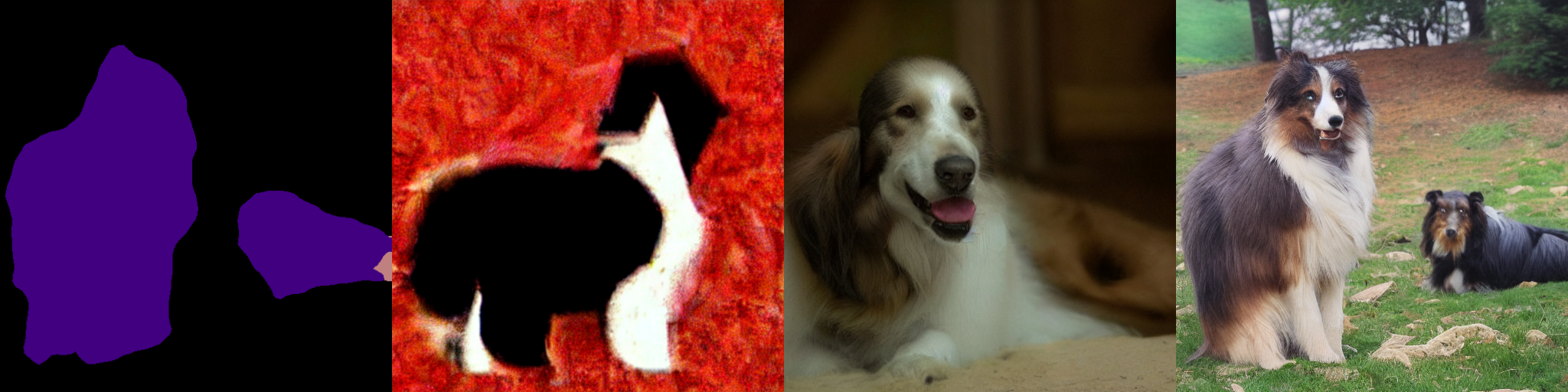
Figure 1: An example of how self-recurrence helps segmentation-guided generation. The left-most figure is the given segmentation map, and the images generated with recurrence steps of 1, 4, and 10 follow in order.
Theoretical Foundations
The theoretical foundation of the paper revolves around a nuanced understanding of diffusion models. Diffusion models are characterized by a forward process that gradually adds Gaussian noise to data and a reverse process that incrementally denoises the data. Traditionally reliant on training custom models for each task, the universal guidance algorithm empowers a diffusion model to adapt to essentially any guidance function by evaluating guidance strategies on denoised outputs such as those estimated from noise-free iterations.
The transition from model-specific training to a universally guided approach is augmented by treating the diffusion model as a generic image generator. This transition is bolstered by mathematical formulations that align the guidance objectives with image denoising in a way that keeps noise present but controlled during segmentation, object recognition, etc., without deviation from the foundational generative task.
Experimental Results
Through extensive experiments displayed across multiple figures and tables, the authors validate their universal guidance approach by extending diffusion models to new tasks without retraining. Experimentation included generating images from text prompts using CLIP guidance, aligning image outputs with pre-defined segmentation maps, and maintaining identity features using facial recognition guidance. Each case underscored the method's ability to produce high-quality, conditioned image outputs efficiently.
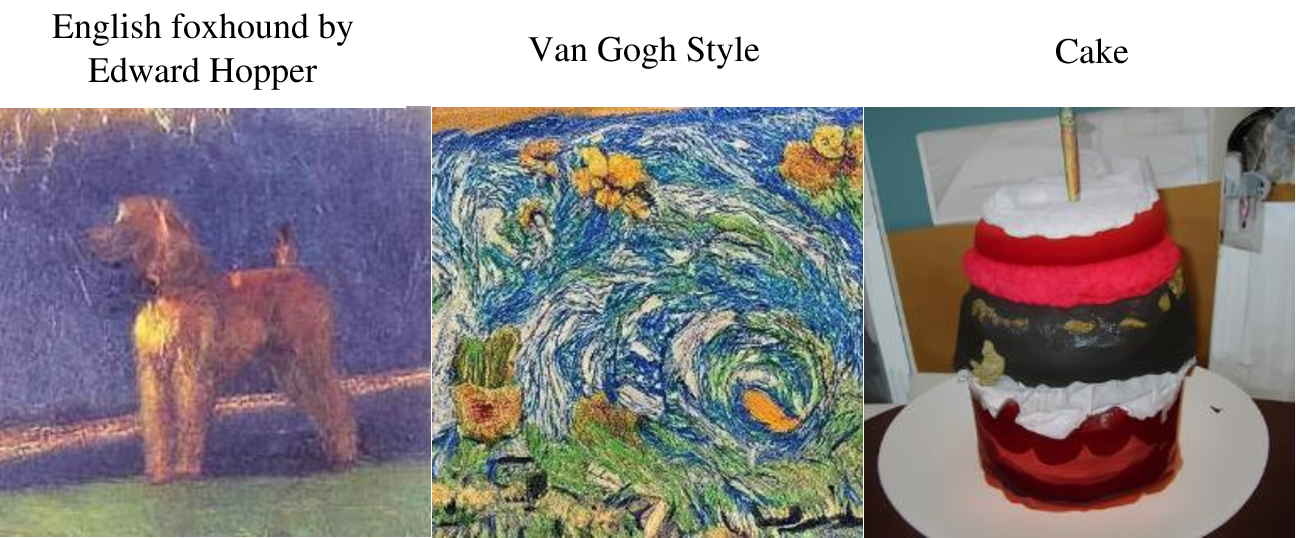
Figure 2: We show that unconditional diffusion models trained on ImageNet can be guided with CLIP to generate high-quality images that match the text prompts, even if these generated images should be out of distribution.
Their empirical results exhibit substantive matches between output images and conditioning prompts, affirming broad applicability. Lower computational demands and streamlined training processes were observed, owing to the method's elimination of noise-induced train/test discrepancies and effective alignment with denoising tasks.
Conclusion
The proposed universal guidance algorithm represents a significant enhancement in the functionality and efficiency of diffusion models used for generating conditioned images. By obviating the need for model retraining while supporting a multitude of modalities, this approach broadens the capabilities of existing diffusion models significantly. The method's applicability to scalable tasks such as segmentation and object detection sets a new standard in extending diffusion models' ingenuity, marking a promising advancement for further research in scalable image generation and adaptive diffusion processes.

