- The paper introduces MCHAMR, a hierarchical framework that recursively composes low-level generators to create complex video game levels.
- The methodology leverages evolutionary algorithms like NEAT and novelty search to optimize structure fitness against predefined designer criteria.
- Practical implications include improved scalability and modularity, enabling flexible, large-scale procedural content generation for modern games.
Hierarchically Composing Level Generators for the Creation of Complex Structures
Introduction
The paper "Hierarchically Composing Level Generators for the Creation of Complex Structures" (2302.01561) addresses a crucial limitation in Procedural Content Generation (PCG) for video games—specifically, the challenge of optimizing objective functions in complex settings. While PCG is valuable for generating game content at reduced costs and increased volume compared to manual creation, its applications are often restricted to simpler games due to difficulties in generating large and complex levels. This paper introduces a compositional approach to PCG that vertically integrates simple, low-level generators into a hierarchical framework that can construct complex structures like towns in video games.
Methodology
The proposed approach, Multi-level Composition of Hierarchical and Adaptive Models via Recursion (MCHAMR), employs a hierarchical system in which generators are recursively composed to generate larger structures. Initially, a top-level generator produces an abstract mapping of the target environment (e.g., a town composed of tiles representing houses, roads, and gardens). Each tile becomes a directive for another generator to create the associated subcomponents. This recursive process results in a fully detailed level that aligns with specified objectives.
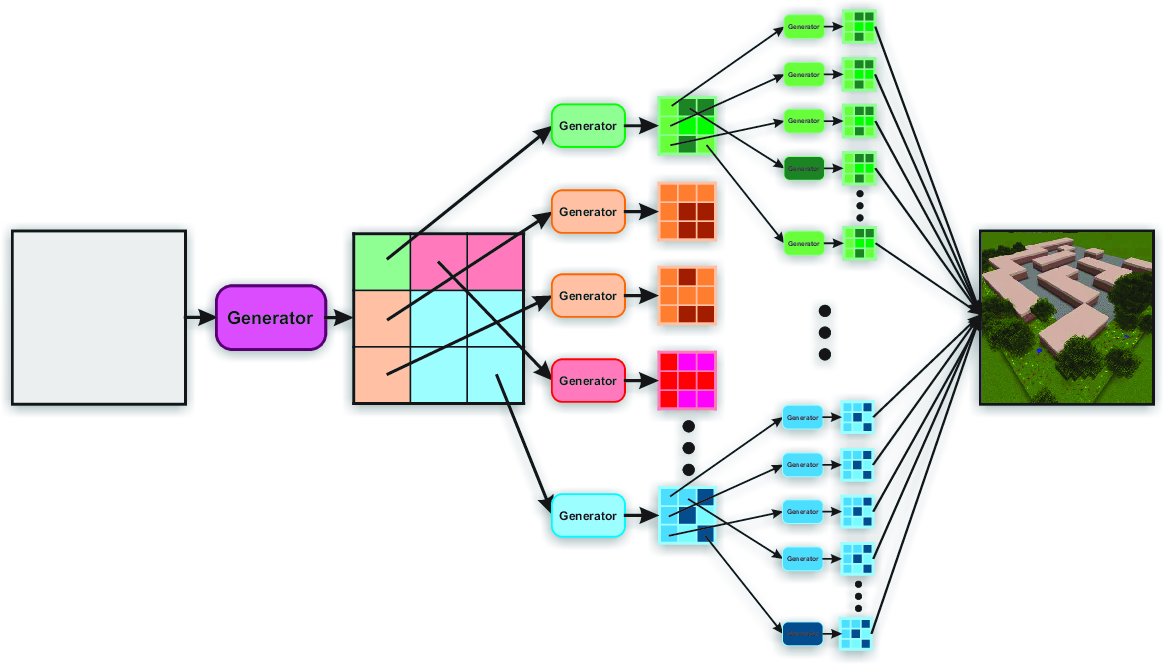
Figure 1: A high-level illustration of MCHAMR. We begin with a top-level generator, which generates an abstract tilemap. Each tile in this map is an instruction to use a lower-level generator and to place its output at that location. Each of these generators can be further composed of other generators. In the end, we obtain a fully-fledged level.
This hierarchical system draws inspiration from hierarchical reinforcement learning, decomposing a complex task into manageable subtasks handled autonomously. It leverages evolutionary algorithms like NEAT and novelty search to evolve level generators, focusing on speed and diversity to efficiently produce complex structures. Additionally, coalescing contiguous tiles improves structural cohesiveness.
Experimental Evaluation
Hierarchical Generation: The paper evaluates the benefits of hierarchical generation versus non-compositional ones by using varied window sizes as a proxy for complexity in subcomponent formation. Window sizes correspond to the complexity: a window size of 1×1 represents the simplest, composed form, requiring less coordinated actions than larger window sizes, such as 5×5.
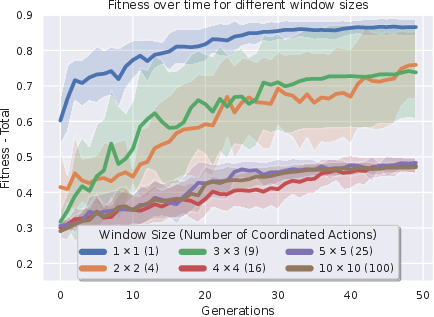
Figure 2: A plot showing the maximum fitness value in the population (i.e., how ``correct'' the generated levels are) over time for different window sizes (#1{i.e., how many coordinated actions are required to build the lower-level structures}).
Results demonstrated that simplifying top-level generator tasks significantly enhances final fitness scores due to better satisfaction of designer requirements, underscoring the efficiency and adaptability of hierarchical composition in PCG.
Composition vs Flat Generation: Compared against flat generation methods with fixed random layouts, the hierarchical approach outperformed at generating levels that more accurately adhered to predefined layouts.
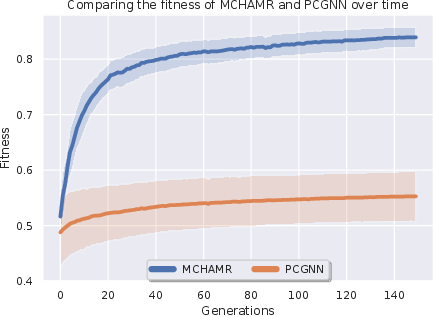
Figure 3: Illustrating the fitness over time on 20 random town layouts for MCHAMR (consisting of the composed town and house generators) compared to the flat, non-compositional method, corresponding to vanilla PCGNN. We first compute the average fitness across 10 seeds and plot the mean and standard deviation over the 20 layouts.
Practical Implications and Future Directions
The paper’s implications for the gaming industry are significant. The modular nature of MCHAMR allows designers to modify components individually without impacting overall structure—a vital capability in open-world game design. Moreover, the approach's versatility promises substantial improvements in the capability of PCG tools to automate large-scale content generation for complex environments, potentially revolutionizing the flexibility and scale of procedural game design.
Future research could further explore the integration of diverse PCG methods, utilizing data-driven approaches alongside fitness-based systems to optimize various aspects of level generation. Additionally, enhancing verticality in level designs and incorporating emergent structures from low-level interactions could provide richer and more dynamic gaming experiences, offering new perspectives on collaboration between automated systems and human designers in game development.
Conclusion
This paper introduces a hierarchical composition framework, MCHAMR, for procedural generation, demonstrating its efficacy in generating large and complex game structures. By leveraging modular low-level generators within a hierarchical system, MCHAMR provides a scalable and adaptable solution for complex procedural generation challenges, paving the way for broader PCG adoption in modern gaming.