- The paper introduces a novel framework that extends synthetic controls to model dynamic treatment effects through low-rank latent factor models.
- It details two primary models—LTV and LTI—that capture evolving and time-invariant treatment effects in observational panel data.
- The SBE-PCR algorithm is empirically validated by assessing financial interventions on Korean firms' export performance.
Synthetic Blips: Generalizing Synthetic Controls for Dynamic Treatment Effects
Introduction
The paper, "Synthetic Blips: Generalizing Synthetic Controls for Dynamic Treatment Effects" (2210.11003), proposes a novel methodological framework to address dynamic treatment effects in observational panel data. It extends the widely used synthetic control method to handle scenarios where units receive treatments in a sequential, adaptive manner. The core innovation lies in the estimation of unit-specific treatment effects under dynamic interventions by leveraging a low-rank latent factor model, effectively capturing both time-varying and invariant dynamical systems.
Latent Factor Models for Dynamic Treatments
The research introduces two primary models: the Linear Time-Varying (LTV) factor model and the Linear Time-Invariant (LTI) factor model. These models assume that outcomes can be expressed as linear combinations of latent unit-specific factors and treatment-specific blip effects.
- Linear Time-Varying Model (LTV): This model captures dynamic effects where the influence of each treatment is expressed as an additive term that varies with time. It is particularly suitable for contexts where treatment effects evolve over time due to the progression of the system state.
- Linear Time-Invariant Model (LTI): This model assumes that the effects of treatments depend solely on the lag from the action, not the specific time, thus providing a simpler yet compelling framework when time-invariant dynamics are plausible.
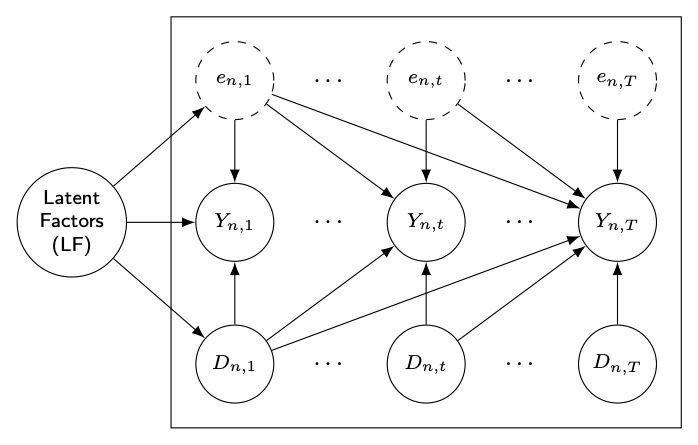
Figure 1: DAG that is consistent with the exogeneity conditions implied by the definition of $\Ic^{\bar{d}}$.
Identification Strategy and Assumptions
The paper provides a detailed identification strategy employing synthetic blip effects to estimate treatment impacts. The critical identification assumption is the low-rank structure of the latent factors, which allows for the expression of mean potential outcomes under hypothetical intervention sequences as linear combinations of observed outcomes from a donor pool of other units.
- Donor Units: These are crucial for identifying counterfactual outcomes. The choice of donor units depends on the sequence of treatments received and an assumption of conditional mean independence of unobserved factors.
- Sequential Exogeneity: The model assumes a sequential exogeneity condition, relaxed compared to standard causality frameworks, which allows unobserved confounding to vary dynamically with time.
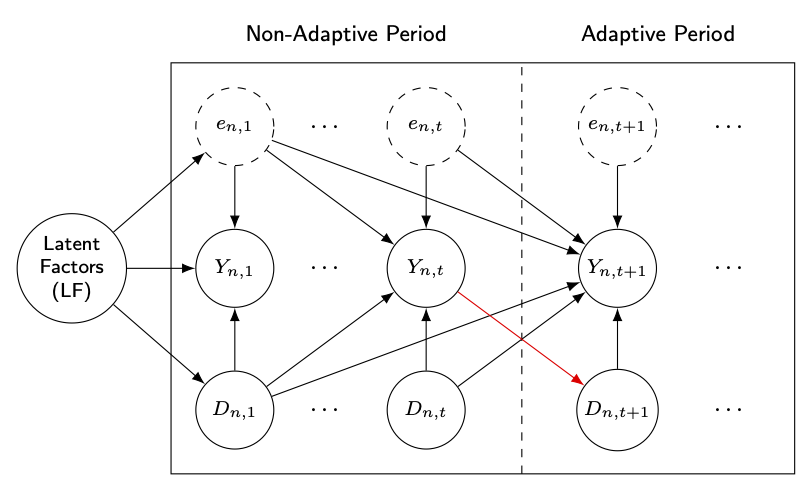
Figure 2: DAG that is consistent with the exogeneity conditions implied by the definition of Icd_t. From time step t + 1, the action sequence (Dn,t+1) can adapt based on outcomes.
Implementation and Algorithm
The estimation process employs a Principal Component Regression (PCR) technique on augmented covariates derived from observed outcomes and external features. The method iteratively estimates the baseline outcomes and subsequent blip effects through recursive synthetic control constructions. The proposed Synthetic Blip Effects Principal Component Regression (SBE-PCR) algorithm demonstrates consistency under standard high-dimensional statistical assumptions.
Empirical Application
The authors apply their framework to a real-world dataset assessing the impact of financial support on the export performance of Korean firms. They explore various dynamic allocation rules, revealing insights into how different sequences and timings of interventions influence export outcomes. This empirical validation demonstrates the model's practical utility in optimizing dynamic treatment strategies for policy implementation.
Conclusion
The research provides a robust framework for extending synthetic controls to dynamic treatment scenarios, accommodating adaptive policies with unobserved, time-varying confounding. The models not only exhibit potential in theoretical causal inference under the panel data setup but also offer practical insights for policy optimization in dynamic environments. Future research might explore integrating more complex dynamic systems and further relaxing the exogeneity assumptions to broaden the applicability of the synthetic blip framework.
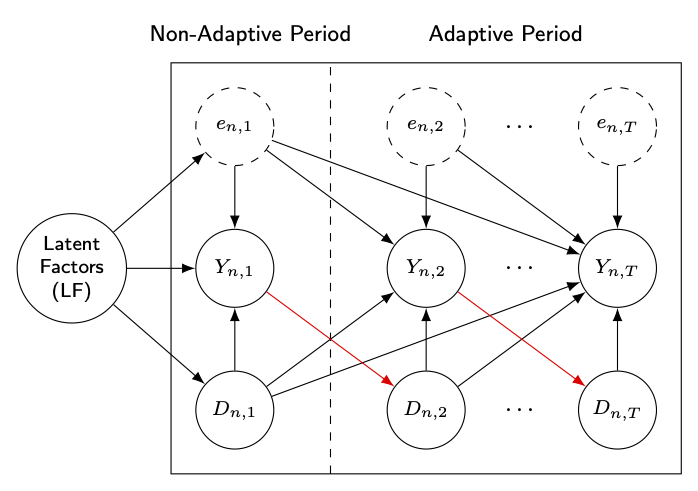
Figure 3: DAG that is consistent with the exogeneity conditions implied by the definition of $\tilde{\Ic}$. The adaptive policy can commence from any time step.