- The paper introduces an elastic sense of self as a framework for enabling ethical and autonomous decisions in AI systems.
- It integrates classical philosophical debates with modern machine ethics, challenging traditional rational choice models.
- Early studies in reinforcement learning and multi-agent interactions suggest the framework can balance self-interest with broader social welfare.
AI and the Sense of Self
Introduction
The paper "AI and the Sense of Self" (2201.05576) revisits philosophical questions that are pertinent to the development of artificial intelligence, especially focusing on concepts of intelligence and ethical decision-making. The authors argue for a renewed interest in developing AI systems imbued with a cognitive sense of self, which is critical for autonomous decision-making and responsible behavior. This approach is particularly relevant given the increased deployment of AI in complex and ethically sensitive applications.
Philosophical Foundations in AI
Artificial intelligence, despite its recent technological advancements largely driven by improvements in hardware such as GPUs, continues to face longstanding philosophical questions related to ethics and commonsense reasoning. These discussions, which were highly debated during the initial waves of AI, have resurfaced due to ethical concerns in today's large-scale AI applications. The authors emphasize the importance of revisiting philosophical debates about intelligence that emerged in the latter half of the 20th century, positing that many of these foundational issues remain unresolved despite the technical progress.
Machine Ethics and Cognitive Agency
Machine ethics typically involves ensuring that AI systems act ethically within constrained environments, using normative constructs modeled as constraint satisfaction or optimization problems. Different paradigms, such as deontics, consequentialism, and virtuous agents, are employed to guide ethical reasoning in AI systems. However, the paper argues that these approaches are incomplete and that a fundamental conceptual framework is needed—one that incorporates a cognitive sense of self to facilitate the seamless integration of ethical reasoning and intelligence.
Elastic Sense of Self
The authors propose an "elastic sense of self" as a critical ingredient for modeling ethical and responsible behavior in AI agents. This model suggests that an AI’s sense of identity should extend beyond the boundaries of its immediate self to include other entities or concepts. Such an identity set allows for considerations of broader social and ethical responsibilities, much like how humans identify with community, family, or causes, leading to empathy and cooperative behavior.

Figure 1: Contrasting derived utility between classical model and prospect theory, showing the influence of saturation and risk aversion in utility management.
This concept challenges the classical model of rational choice, described by von Neumann and Morgenstern, asserting that these models inadequately capture the complexities of human agency. The elastic sense of self expands an agent’s valuation of outcomes beyond immediate payoffs to encompass systemic impacts and broader welfare considerations.
Implications and Future Directions
Future research should involve applying the elastic sense of self to practical agent-based applications, particularly in scenarios involving reinforcement learning and multi-agent interaction. Early implementations suggest that agents can pursue their own interests while remaining cognizant of the potential for collateral damage. The authors suggest that a comprehensive computational model of self, incorporating elements of trust, homeostasis, and epistemic novelty, could form the basis for more robust ethical AI systems.
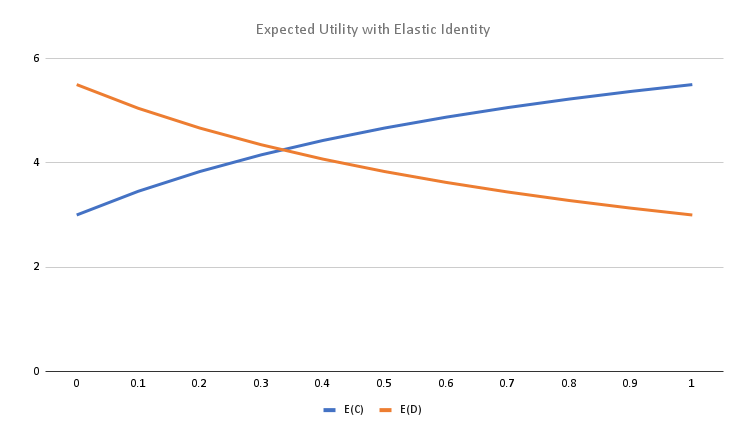
Figure 2: Change in expected utility with increased elasticity of sense of self, illustrating how empathy influences decision-making in one-shot interactions.
Challenges remain in accurately modeling the components of the elastic self-framework—particularly in defining identity sets, semantic distances, and attenuation parameters. Additionally, the theoretical model's evolutionary stability in ecosystems with non-empathetic agents presents an area ripe for exploration.
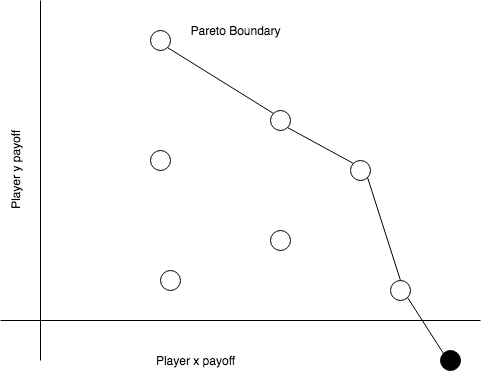
Figure 3: Pareto boundary and fairness, demonstrating how equitable outcomes can emerge from agents with an elastic sense of identity.
Conclusions
The paper "AI and the Sense of Self" advocates for enriching AI with a cognitive sense of self to better navigate ethical dilemmas and act responsibly in complex environments. By encouraging further exploration into computational models rooted in psychological and philosophical understandings of identity, the authors aim to advance ethical and autonomous AI. Future work will emphasize implementing these concepts in reinforcement learning contexts and address open questions surrounding the manipulation of identity-related parameters.
This line of inquiry holds promise for bridging gaps between robust AI deployments and meaningful ethical engagements, potentially leading to systems that exhibit both technical sophistication and moral sophistication.