- The paper introduces a finite-difference scheme that accurately simulates reactive settling in sequencing batch reactors with moving boundaries.
- It employs a splitting method to decouple convection, diffusion, and reaction processes while ensuring mass conservation and nonnegative concentrations.
- Simulation results confirm the model captures essential dynamics such as oxygen consumption and substrate conversion during SBR cycles.
Numerical Scheme for Reactive Settling in Wastewater Treatment
Introduction
The paper presents a numerical scheme developed to simulate reactive settling processes in sequencing batch reactors (SBRs) within wastewater treatment plants. This process involves sedimentation of flocculated particles (biomass, or activated sludge) consisting of multiple components reacting with dissolved substrates in the fluid. An SBR operates in cycles involving fill, react, settle, draw, and idle stages, characterized by varying tank volumes and moving mixture surfaces. The process is modeled using a system of spatially one-dimensional, nonlinear, strongly degenerate parabolic convection-diffusion-reaction equations. These equations are coupled via mass conservation conditions to transport equations on a half-line representing the effluent pipe, with its origin at a moving boundary. The finite-difference scheme introduced maintains an invariant-region property, ensuring nonnegative concentrations and obeying mass invariance when executed using a simple splitting method.
The SBR model involves a sequence of stages: fill, react, settle, draw, and idle, each depicted in Figure 1. The mixture includes flocculated particles of biomass and several dissolved substrates. The removal of substrates, achieved during these stages, defines the primary purpose of the SBR. The system of nonlinear PDEs in the model is spatially one-dimensional, representing the vertical dynamics of settling. The complexity arises from the moving boundary condition, necessitating advanced schemes to maintain mass balance and positivity of concentration.
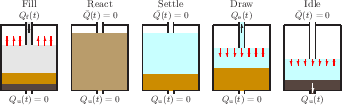
Figure 1: The five stages of a cycle of an SBR, showcasing the process dynamics and interactions involved.
Numerical Scheme
The unique challenge in this modeling lies in adequately representing the moving boundary, characterized by suction, filling, and extraction during various phases. The numerical scheme is specifically designed to manage this dynamically evolving boundary. A splitting scheme is employed, which divides the system into convection, diffusion, and reaction processes, permitting each to be solved sequentially while maintaining stability and accuracy.
The finite difference method is applied on a discretized grid, and the governing equations are advanced in time using an explicit time-stepping scheme, subject to a Courant-Friedrichs-Lewy (CFL) condition ensuring stability:
τmax{β1,β2,MC(1+M3),MS,M~/ε}≤1
Where β1, β2, MC, MS are defined in terms of the system's material properties and geometry.
Simulation and Results
Simulations depict the behavior of each component through various stages of the SBR cycle. The numerical output confirms that the scheme adheres to the invariant-region property, ensuring positivity and realistic concentration boundaries, crucial for reliable predictions.
Figures 4 and 5 visualize the particulate and dissolved concentrations over time, demonstrating the accurate capture of dynamics such as oxygen consumption and substrate conversion.
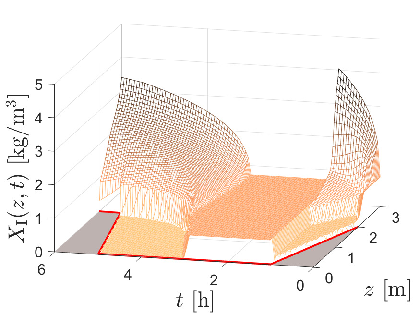
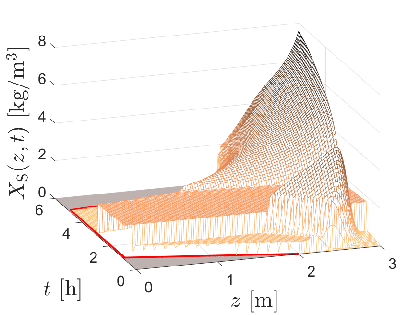
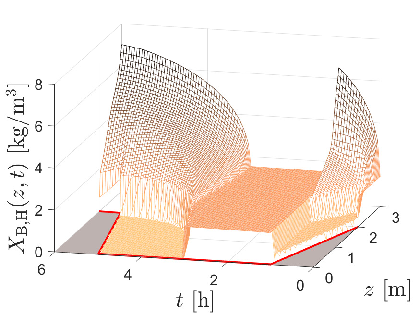
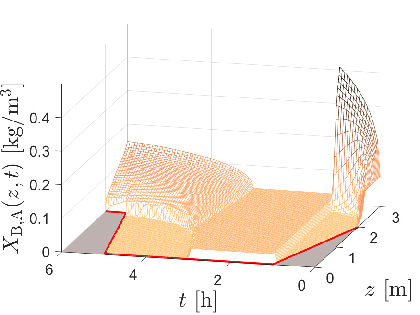
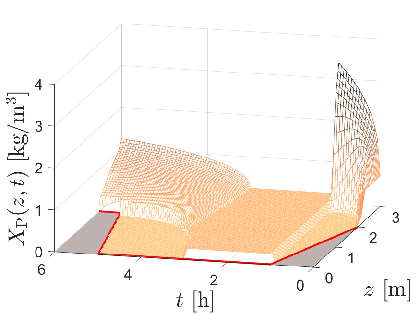
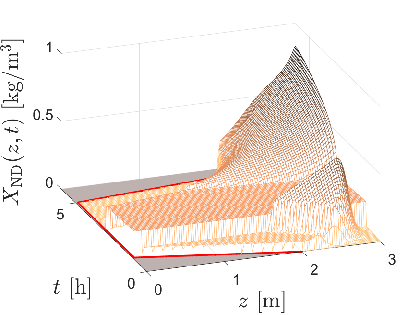
Figure 2: Concentrations of the six solid components during numerical simulation, highlighting the evolution in relation to the SBR cycle.
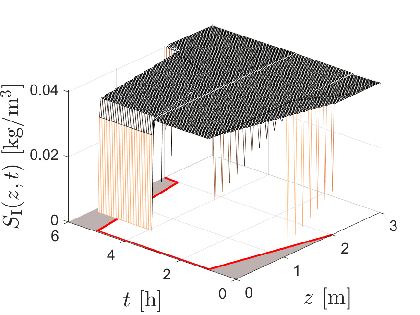
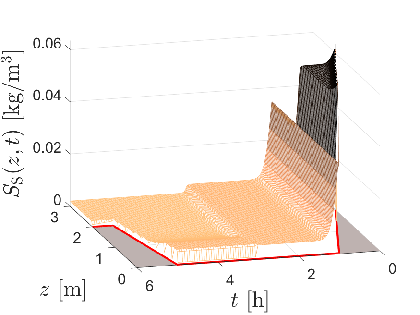
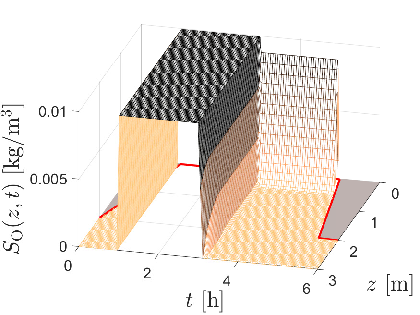
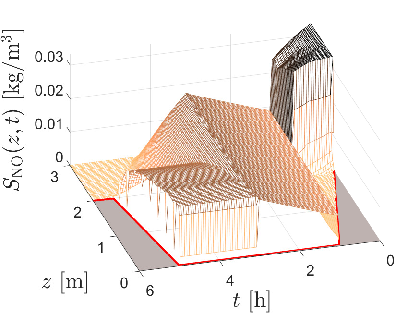
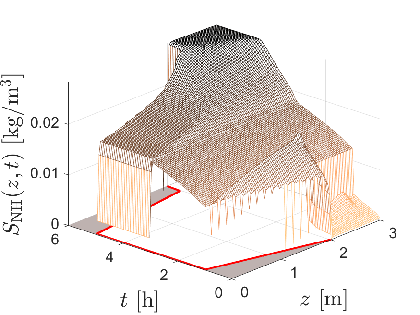
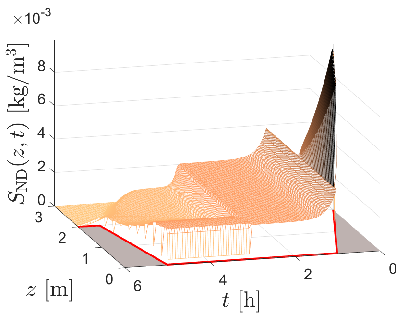
Figure 3: Concentrations of the six dissolved components demonstrating the interplay and chemical reactions occurring within the system.
Conclusions
The paper successfully presents a numerical scheme capable of simulating complex reactive settling phenomena in SBRs with strong reliability and computational accuracy. The scheme respects mass conservation principles and maintains concentration positivity, which is critical for valid modeling of wastewater treatment processes. Though initially constrained by a stringent CFL condition, the approach offers a compelling foundation for future advancements in modeling moving boundary systems with reactive components.
The splitting method enhancement implies significant potential for computational efficiency, especially when coupled with high-performance computing systems or when implementing implicit improvements in future iterations, offering ample opportunity for further refinement and potential real-time application in industry settings.