- The paper demonstrates that higher-order interactions significantly modify magnetic properties in transition-metal trilayers using DFT.
- It shows how variations in band filling and stacking sequences alter conventional Heisenberg interactions and enhance HOI terms.
- Results indicate tuning HOIs can stabilize skyrmions, offering promising strategies for spintronic device design.
Introduction
The paper investigates higher-order exchange interactions (HOIs) in transition-metal trilayers containing central Fe or Co layers, sandwiched between $4d$ and $5d$ transition-metal layers. The study employs density functional theory (DFT) to elucidate the role of these interactions, specifically the biquadratic and the three- and four-site four spin interactions, in altering the magnetic properties of these systems. The results are contextualized by exploring both symmetric and asymmetric trilayer systems, considering variations in band filling and stacking sequences.
Methodology
The study utilizes an extended classical Heisenberg model, which incorporates HOIs to describe the magnetic properties of transition metal trilayers. The model employs DFT calculations using both the full-potential linearized augmented plane-wave (FLAPW) method implemented in the {\tt FLEUR} code and the projector augmented wave (PAW) method incorporated in the {\tt VASP} code. The systems studied include symmetric $4d$/Fe/$4d$, and asymmetric $4d$/Fe/Ir, $5d$/Fe/Rh trilayers, with Rh/Fe/Ir serving as a reference for the analysis.
Results and Discussion
Fe-Based Trilayers
For symmetric $4d$/Fe/$4d$ trilayers, the study illustrates that pair-wise Heisenberg interactions and HOIs exhibit distinct dependencies on $4d$ band filling. The nearest-neighbor (NN) interaction, J1, increases linearly from Tc to Pd, driven by changes in 3d-4d hybridization and magnetic moments in the Fe layer. Notably, in Rh/Fe/Rh trilayers, HOI terms reach magnitudes comparable to conventional exchange interactions, with the three-site four-spin term contributing significantly to observed energy dispersions.
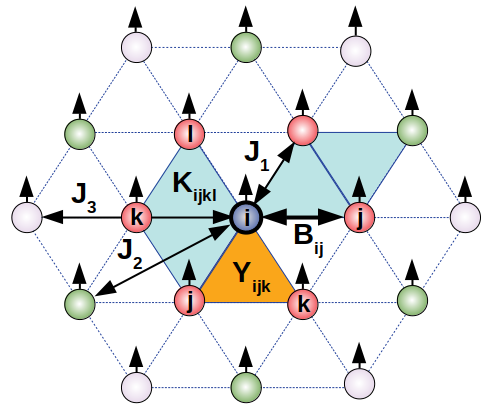
Figure 1: Schematic representation of magnetic exchange interactions on a hexagonal lattice relevant in transition-metal trilayers.
For asymmetric $4d$/Fe/Ir trilayers, the presence of deep spin spiral minima indicates strong band-dependent hybridization, significantly altering magnetic ground states. A comparative analysis shows that for trilayers like Pd/Fe/Ir, the four-site four-spin interaction, K1, is notably large, enhancing skyrmion stability — a key finding corroborated by corresponding film systems.
Co-Based Trilayers
The $4d$/Co/Ir trilayers reveal predominant ferromagnetic interactions, with substantial NN coupling. However, significant frustration emerges from competing interactions, producing flat energy dispersions near their magnetic ground state. The negative K1 in these trilayers is detrimental to the stability of skyrmions compared to Fe-based counterparts. The observed trends align well with film system results like Rh/Co/Ir(111).
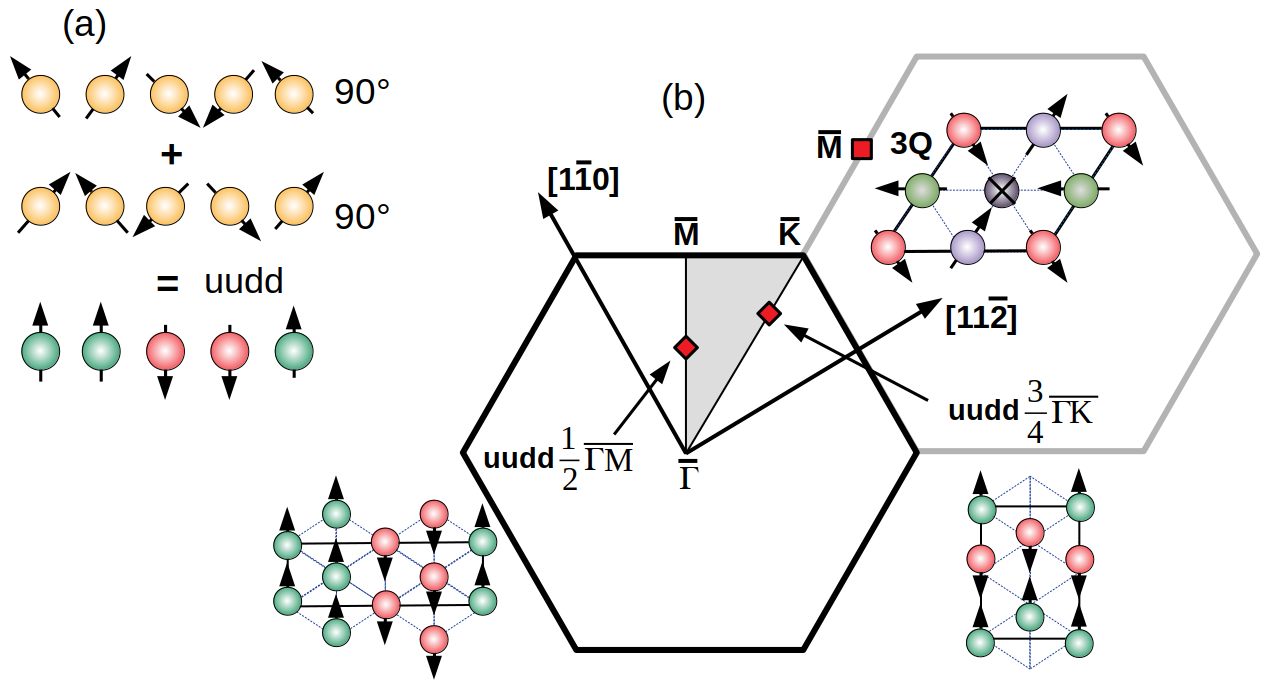
Figure 2: Energy dispersion of flat spin spirals for symmetric fcc-$4d$/Fe/$4d$ trilayers, illustrating fitting to the Heisenberg model.
Computational Strategies and Implications
The research highlights substantial stacking-sequence effects, with fcc to hcp transitions revealing stability shifts in the magnetic ground state, notably in Rh/Fe/Ir trilayers. This observation emphasizes the critical impact of precise interlayer hybridizations and geometric arrangement on HOIs and magnetic textures in these sandwich systems, shedding light on potential engineered stabilization of non-collinear spin structures like skyrmions.
Conclusion
The analysis demonstrates that HOIs, particularly in Fe-based trilayers, can achieve magnitudes influencing the ground state magnetization substantially. The study's findings guide understanding magnetic interactions in engineered thin-film systems with practical implications in device design for spintronics, particularly the role of four-site four-spin interactions in stabilizing skyrmionic textures across differing material interfaces.
Through systematic DFT-based examination, this paper successfully delineates the dependency of magnetic interaction trends on electronic structure alterations and provides foundational insights into tailoring magnetic properties via multilayer stacking and composition strategies.
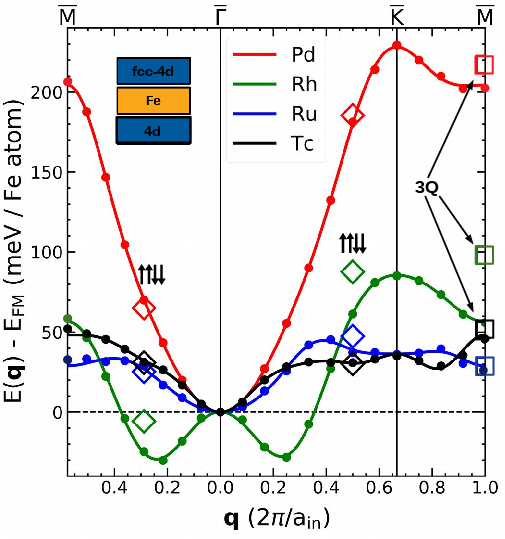
Figure 3: Trend of Heisenberg and HOI parameters for fcc and hcp $4d$/Fe/Ir trilayers, showing the influence of stacking on magnetic interactions.