- The paper demonstrates that GaAs metasurfaces enable efficient infrared-to-visible up-conversion via nonlinear wave-mixing, bypassing cryogenic cooling.
- The study employs numerical modeling and experimental validation to optimize resonant conditions for enhanced sum-frequency generation efficiency.
- The findings pave the way for compact, room-temperature IR imaging devices with applications in night-vision, biomedical imaging, and telecommunications.
Introduction
The paper "Infrared up-conversion imaging in nonlinear metasurfaces" (2101.01824) explores the potential of nonlinear metasurfaces for infrared (IR) imaging applications. Traditional IR imaging relies on narrow-band gap semiconductors, which can be cumbersome due to their susceptibility to thermal noise and the requirement for cryogenic cooling. This study suggests an alternative approach employing GaAs semiconductor metasurfaces, which utilize a nonlinear wave-mixing process for up-conversion of IR to visible wavelengths, aiming to alleviate the challenges inherent in conventional methodologies.
Metasurfaces, composed of nanoantennas with engineered optical properties, enable light manipulation at the nanoscale. The specific focus is on (110) GaAs metasurfaces, chosen for their strong quadratic nonlinear response and compatibility with the sum-frequency generation (SFG) process. Significantly, the research demonstrates that these metasurfaces can effectively mix infrared and near-infrared wavelengths to produce a visible output, utilizing the spatial information of the IR input image in the nonlinear process.
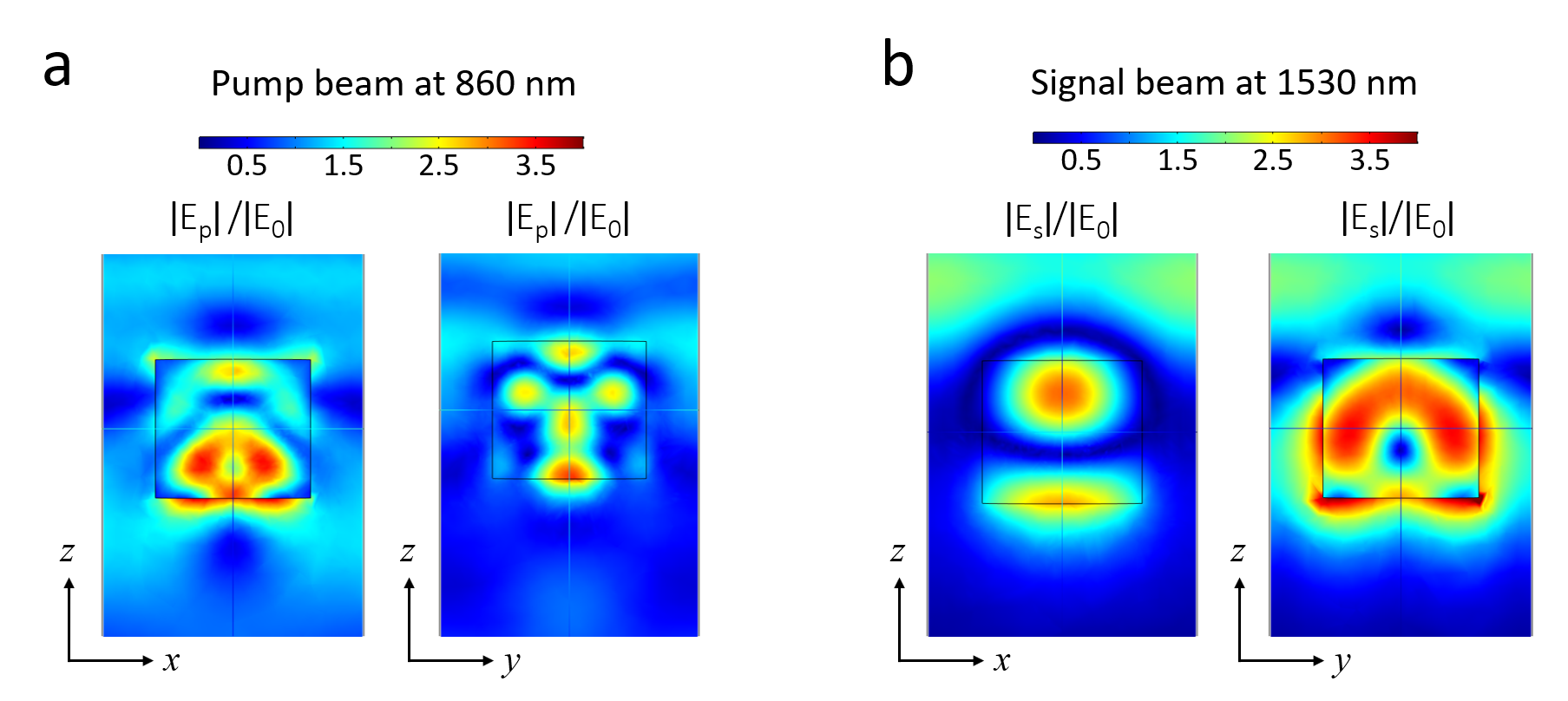
Figure 1: Calculated modulus of electric field distribution through the center of GaAs metasurface unitary cell (r=225~nm, h=400~nm) at an incident wavelength of (a) 860 and (b) 1530~nm.
The metasurfaces described leverage the favorable nonlinear optical characteristics of GaAs, integrating the benefits of semiconductors and metamaterials to facilitate efficient frequency conversion. This approach demonstrates a promising miniaturization and integration path for IR imaging technologies, offering a room-temperature solution dependent on standard CMOS detectors instead of specialized cryogenics.
Numerical and Experimental Analysis
The study includes extensive numerical modeling to optimize the design of the GaAs metasurfaces. The calculated transmission spectra reveal resonances aligned with the pump and signal beam wavelengths, ensuring efficient nonlinear interaction and up-conversion of the image from IR to the visible spectrum.
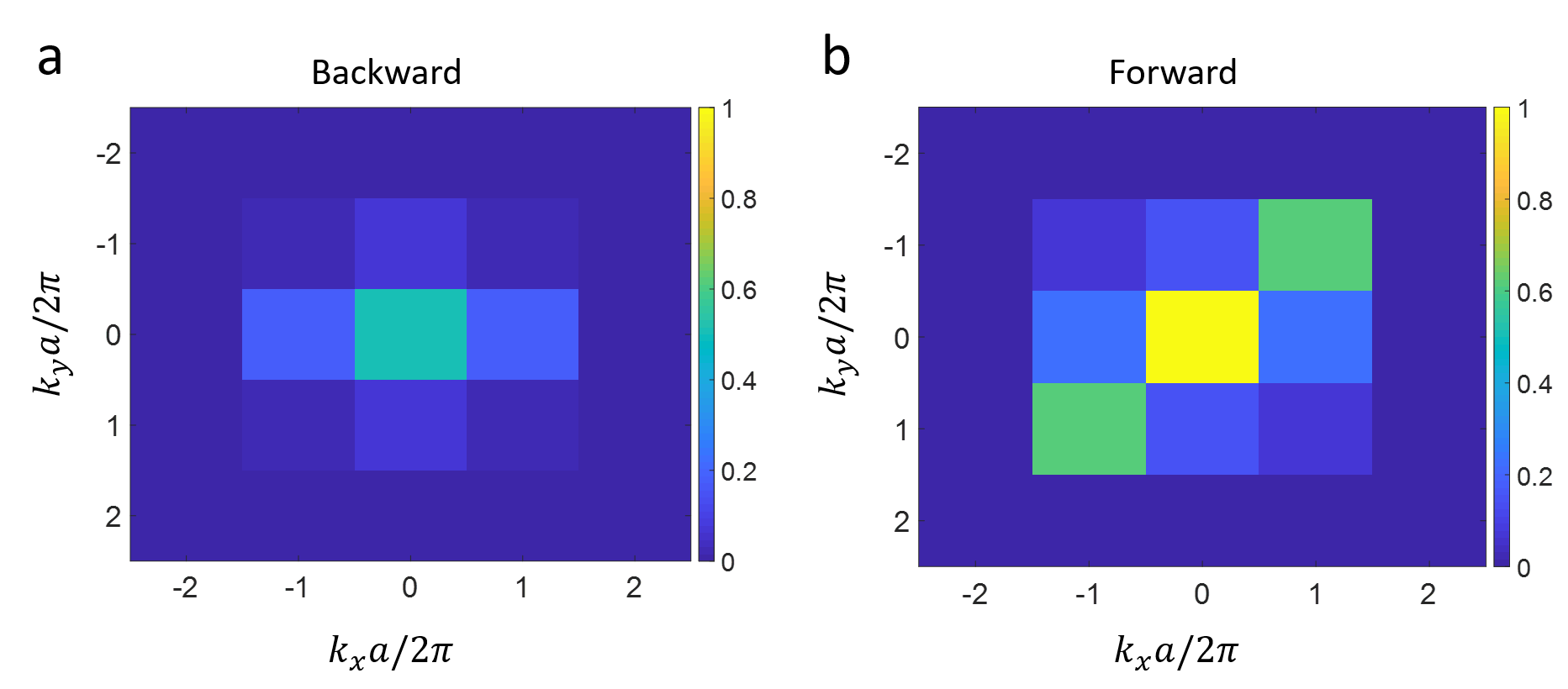
Figure 2: Far-field diffraction distribution of SFG calculated in the (a) backward and (b) forward direction to the GaAs metasurface, illustrating the propagation dynamics when excited by the pump and signal beams.
Experimentally, the metasurfaces show robust nonlinear emission characteristics, with carefully engineered resonant behaviors enabling efficient SFG processes. Through tuning the geometrical parameters of the metasurfaces, the authors achieved simultaneous double resonant conditions that maximize the SFG efficiency, validated by the measured conversion efficiencies.
Implications and Future Developments
The work opens pathways for developing compact, room-temperature IR imaging devices with a broad range of applications, from night-vision systems to biomedical imaging. The ability to convert an IR image to visible light using a single metasurface without post-processing suggests significant advantages in system simplicity and cost.
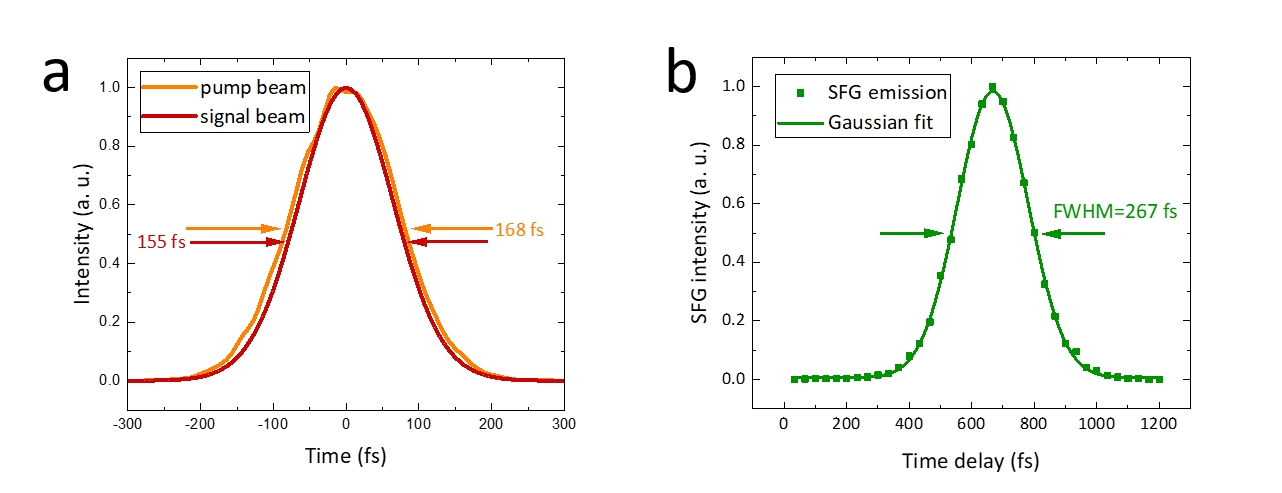
Figure 3: Cross correlation of the pump pulsed laser beam with the signal pulsed laser beam demonstrates synchronization necessary for efficient SFG.
Future research could explore enhancing SFG conversion efficiency via quality factor improvements and exploring multi-wavelength and multi-mode configurations. The adaptability of metasurfaces for various designs can also foster innovative applications beyond traditional imaging, including spectroscopic and telecommunication technologies.
Conclusion
The study successfully demonstrates that GaAs nonlinear metasurfaces offer a promising alternative to traditional IR imaging devices, with significant benefits in size, integration, and operational simplicity. This research sets the groundwork for the furthering of compact and efficient IR imaging technologies that leverage the unique properties of metasurfaces to expand the capabilities of optical systems.

