- The paper presents a rigorous application of the Pontryagin Maximum Principle to derive optimal control protocols in quantum systems.
- It utilizes advanced mathematical tools, including Lie algebra and differential geometric methods, to analyze control trajectories and solution stability.
- The study integrates gradient-based optimization algorithms with practical examples to improve quantum control design and robustness.
Introduction to the Pontryagin Maximum Principle for Quantum Optimal Control
This paper presents a detailed elucidation of the Pontryagin Maximum Principle (PMP) contextualized for quantum optimal control systems. The core analysis aims to make advanced aspects of optimal control theory more accessible to researchers and practitioners working in quantum technologies, offering essential methodologies for designing effective quantum control protocols without experimental feedback.
Core Concepts in Quantum Optimal Control
The Pontryagin Maximum Principle, originally developed for classical systems, is a pivotal tool for deriving optimal control laws in quantum dynamics. This principle allows practitioners to formulate and solve control problems by minimizing a cost function subject to dynamic constraints. The paper expertly demonstrates the application of the PMP in the context of quantum systems, particularly focusing on low- and high-dimensional systems where differential geometric and analytical techniques can be particularly advantageous.
In the quantum setting, control systems are often described by Schrödinger or Lindblad equations, where the state evolves on complex or real manifolds, such as spheres in the Bloch representation. The PMP is adapted here to quantum systems, where states are typically manipulated using electromagnetic fields. The core recursive relation of the PMP is maintained in its formulation, guiding the derivation of optimal control policies.
A central part of the paper is devoted to the formal mathematical statement and the proof of the existence of an optimal solution under certain conditions. The authors employ a variety of sophisticated mathematical tools, such as Lie algebra structures, to tackle the controllability and observability of quantum systems.
For instance, to elucidate these concepts, the authors explore the geometric properties of quantum control problems, such as reachability sets and extremal trajectories. Control trajectories are often confined to specific submanifolds of a larger state space, necessitating an analysis of the tangent and cotangent spaces, and engaging with the Hamiltonian dynamics to explore solution robustness and stability.
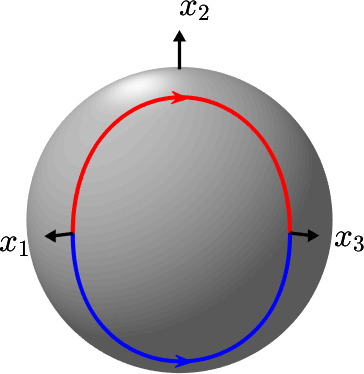
Figure 1: (Color online) Picture of the sphere with the spherical coordinates θ and φ.
Examples of Quantum Control Processes
The paper provides detailed examples to illustrate the practical application of the PMP, such as driving a two-level quantum system from one quantum state to another, showing the analytical paths and control functions necessary to achieve this with minimal energy expenditure and maximal efficiency.
Another example involves controlling a spin-1/2 particle's state within a Bloch sphere using external magnetic fields. Here, the strategy is to manipulate the control variable to minimize the time taken to transition to a desired target state, employing the PMP to derivationally solve equations that govern such motion under bounded controls.
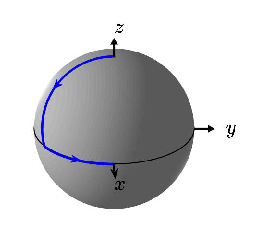
Figure 2: (Color online) Optimal trajectories (in blue) going from the north pole to the south pole of the Bloch sphere. The solid black line indicates the position of the equator. The parameter Δ is set to -0.5.
Gradient-based Optimization Algorithms
Importantly, the paper bridges theoretical developments with computational techniques by discussing gradient-based optimization algorithms derived from the PMP. These iterative algorithms enhance the application of PMP principles in high-dimensional systems where analytical solutions are infeasible. The algorithms leverage linearizing transformations to approximate solutions, allowing quantum engineers to design control sequences that are robust to parameter variations and uncertainties.
Conclusion
The presented tutorial consolidates our understanding of the Pontryagin Maximum Principle as it applies to complex quantum dynamical systems. This understanding is pivotal for advancing quantum technologies, particularly in applications where precise control over quantum states is required, such as quantum computation and quantum simulations.
The mathematical depth and breadth of the discussions pave the way for future research to explore even more complex quantum control landscapes and to harness quantum optimal control techniques for broader applications in physics and technology. The inclusion of assumptions and necessary conditions for the existence of solutions provides a robust framework for tackling diverse problems within the quantum domain.