- The paper introduces NJ-ODE, a framework that integrates jump mechanisms with neural ODEs to yield L2-optimal continuous-time predictions.
- It employs a novel jump neural network for hidden state updates, providing theoretical convergence and reduced complexity.
- Empirical results on financial and real-world datasets confirm NJ-ODE's superior accuracy in modeling irregular stochastic processes.
Neural Jump Ordinary Differential Equations: Consistent Continuous-Time Prediction and Filtering
The paper "Neural Jump Ordinary Differential Equations: Consistent Continuous-Time Prediction and Filtering" introduces the Neural Jump Ordinary Differential Equation (NJ-ODE) framework. This framework extends neural ODEs by incorporating jump mechanisms to model the conditional expectation of stochastic processes with irregular observations. The paper demonstrates the NJ-ODE's theoretical convergence and shows its superior empirical performance compared to existing models like GRU-ODE-Bayes and ODE-RNN.
Model Overview
NJ-ODE combines the strengths of RNNs and neural ODEs to continuously model stochastic processes while accommodating jumps at observation times. Unlike ODE-RNNs, which rely on RNN cells to update hidden states, NJ-ODE employs a simpler approach using a neural network jump mechanism. This choice reduces complexity and allows for theoretical convergence guarantees, emphasizing that NJ-ODE outputs converge to the L2-optimal prediction or conditional expectation.
Implementation Details
Architecture
NJ-ODE consists of several components:
- Neural ODE: Captures continuous latent dynamics between observations.
- Jump Mechanism: Updates hidden states at observation times without relying on prior hidden states, using a standalone neural network.
- Output Mapping: Translates the hidden states to predictions via an output neural network.
1
2
3
4
5
6
7
8
9
|
def NJ_ODE(x, timesteps, model_params):
    h_t = initialize_hidden_state(x[0])
    predictions = []
    for i in range(1, len(timesteps)):
        h_t = ODESolve(h_t, timesteps[i-1], timesteps[i], model_params)
        if timesteps[i] in observation_times:
            h_t = jumpNN(x[timesteps[i]], model_params)
        predictions.append(outputNN(h_t, model_params))
return predictions |
Training
Training involves minimizing a novel loss function that balances fitting observed values and maintaining continuity between observations. The convergence guarantees provided by the NJ-ODE's framework are largely due to the precise mathematical formulations and loss function design.
Experimental Results
NJ-ODE was tested on synthetic datasets (Black-Scholes, Ornstein-Uhlenbeck, and Heston models) and real-world datasets (such as climate data and physiological recordings). The empirical results show that NJ-ODE consistently outperforms GRU-ODE-Bayes, especially in more complex scenarios like the Heston model.
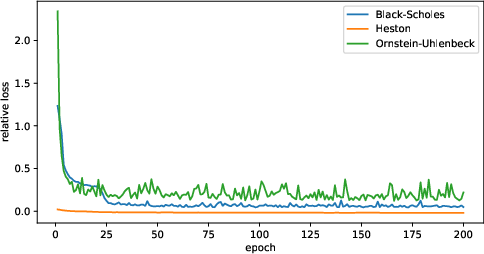
Figure 1: Predicted and true conditional expectation on a test sample of the Heston dataset.
The NJ-ODE's superior performance is largely attributed to its robust handling of irregular time-series data and its ability to model complex non-linearities present in stochastic processes.
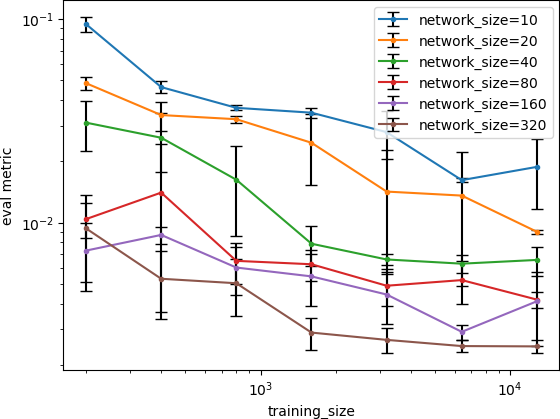
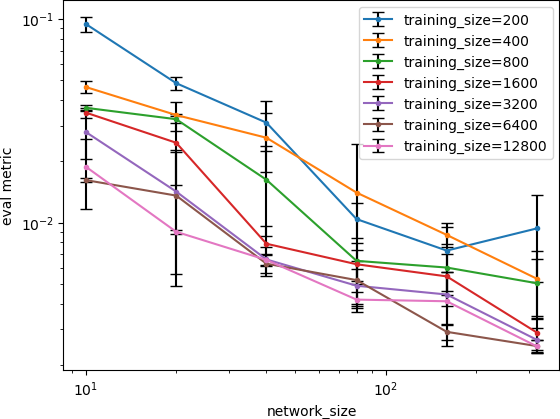
Figure 2: Black-Scholes dataset. Mean ± standard deviation (black bars) of the evaluation metric for varying training samples N1 and network size M.
Implications and Future Work
NJ-ODE offers a robust framework for modeling stochastic processes in finance, healthcare, and climate science. By eschewing the need for continuous information between observations, NJ-ODE makes online updates feasible, which is crucial for real-time applications. Future research could extend NJ-ODEs to capture dependencies across multiple stochastic processes or enhance scalability for large datasets.
Conclusion
The NJ-ODE model represents a significant advancement in continuous-time prediction for irregularly sampled stochastic processes. Its theoretical rigor and empirical success suggest potential for widespread application across fields that rely on time-series data. The integration of jumps into the neural ODE framework addresses a critical gap in continuous-time modeling, facilitating both theoretical developments and practical implementations.