- The paper presents a federated graph learning platform enabling collaborative detection of financial crimes across institutions.
- It reduces false positives by 20-30% through integrating local and global features with advanced graph analytics.
- The approach ensures regulatory compliance via privacy-preserving federated training and scalable detection improvements.
Towards Federated Graph Learning for Collaborative Financial Crimes Detection
Introduction
The paper "Towards Federated Graph Learning for Collaborative Financial Crimes Detection" (1909.12946) discusses a novel approach for improving the detection of financial crimes such as money laundering, fraud, and various forms of theft. The central theme revolves around augmenting traditional AML systems within financial institutions using a federated graph learning framework. This framework allows the sharing of insights and patterns without exchanging sensitive raw data, adhering to stringent privacy and regulatory requirements.
Financial Crimes and Current Detection Challenges
Financial crimes present expansive challenges due to their complexity and the significant resources required for effective detection and mitigation. Traditional systems are hindered by over-reporting false positives, necessitating costly manual reviews. The paper identifies a critical limitation: financial institutions operate in isolation without insights from other firms, limiting the detection of sophisticated techniques perpetrated by criminals across multiple geographies and institutions.
Machine Learning and Graph Learning Integration
The integration of machine learning, specifically graph-based approaches, is a promising method that current detection strategies can utilize. By constructing party-to-party relationships and leveraging graph-based features, machine learning models improve the efficiency of transaction monitoring systems. This methodology effectively reduces false positives by 20-30% through improved anomaly detection, leveraging network embeddings, and traditional graph algorithms.
The core contribution of the paper lies in its development of a federated graph learning platform. This platform allows institutions to share essential features extracted from their local data, such as customer demographics and transaction metrics, and also global graph features that are computed using a joint representation of interactions across institutions. The federated learning paradigm ensures privacy-preserving model training and enhances the detection capabilities beyond isolated models.
Local and Global Feature Computation
Local features derived from customer data and transaction behaviors form the initial input for models. Global features, providing contextual data across institutions, enhance detection capabilities. The paper details graph analytics to derive global features, including metrics from community detection algorithms and multi-hop egonets, emphasizing the crucial insights gained from these enriched data structures.
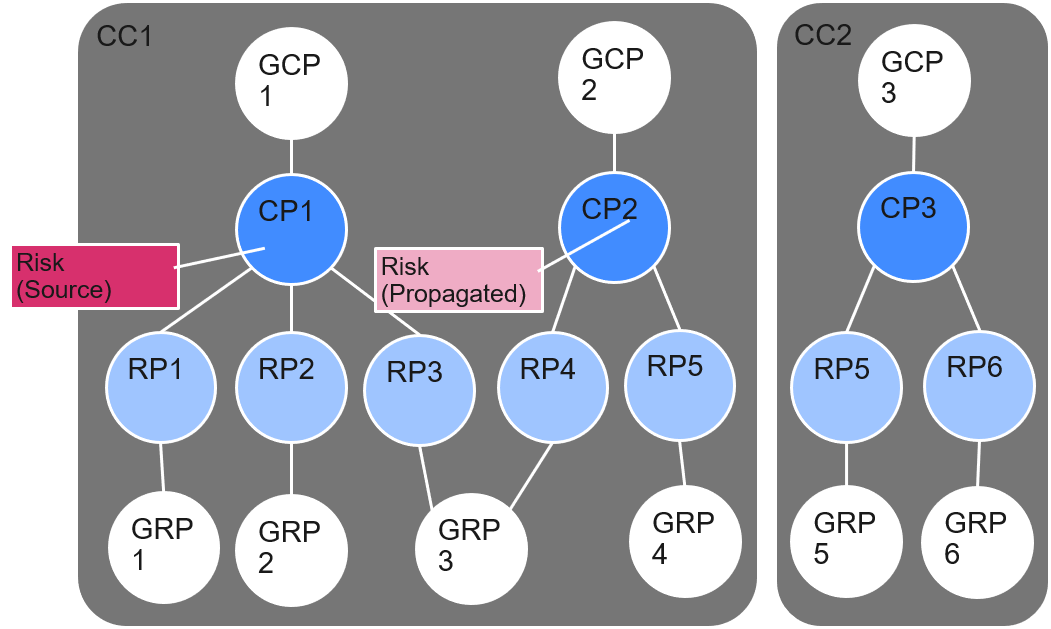
Figure 1: Relation between customers and related parties.
Experimental Evaluation
The framework was evaluated using data from the UK FCA TechSprint event dataset, comprising profiles and transactions from multiple UK-based institutions. The novel use of federated graph learning led to a 20% improvement over local models. Significantly, the approach maintained data privacy, adhering to financial regulations and competitive neutrality.
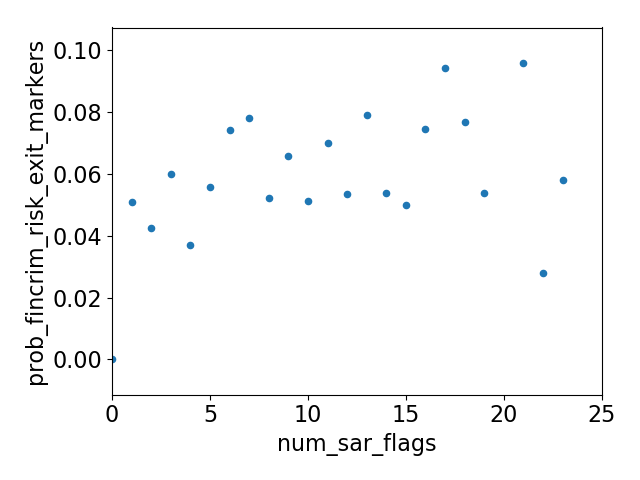
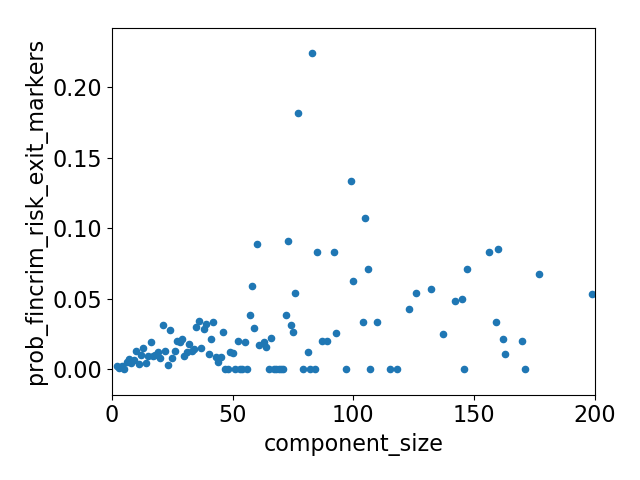
Figure 2: Conditional probability of a customer's fincrime exit marker being flagged as a function of a feature. Left: the feature is the number of SAR-flagged customers in the same connected component. Right: the feature is the number of nodes in the connected component.
Implementation Considerations
Implementing such a federated graph learning system requires addressing several technical considerations, including the secure computation necessary to protect sensitive information. Furthermore, ensuring system scalability to work with vast amounts of data from real-world applications is crucial. The system should enable decentralized training with secure communication protocols to reconcile global model parameters without compromising institutional data privacy.
Conclusions and Future Directions
The federated graph learning platform presents significant potential for enhancing global financial crime detection mechanisms. Future work involves real-world piloting, exploring roles for different industry stakeholders in deploying these techniques effectively, and integrating advanced secure computation frameworks for entity resolution processes. This work substantiates a foundation for collaborative, privacy-preserving financial crime detection across multiple financial institutions globally.