- The paper introduces UAGA, a framework that uses adversarial training to align graph embeddings without relying on node attributes.
- It employs a three-step process—embedding, adversarial mapping, and refinement with pseudo anchor links—to achieve effective node correspondence.
- Experimental results on datasets like Last.fm and Flickr demonstrate that UAGA improves alignment accuracy, achieving high Precision@N metrics.
Unsupervised Adversarial Graph Alignment with Graph Embedding
Introduction
The paper "Unsupervised Adversarial Graph Alignment with Graph Embedding" presents a novel approach for unsupervised graph alignment, a critical task in social network analysis. This task involves finding node correspondence across different social graphs without using any anchor links or node attribute information. The paper introduces the Unsupervised Adversarial Graph Alignment (UAGA) framework, which leverages adversarial training to align embedding spaces of different graphs, aiming to match node representations between these spaces effectively.
Framework Overview
UAGA Approach
The UAGA method consists of three primary steps: embedding, matching, and refining. The process begins with learning graph embeddings using an unsupervised method, such as DeepWalk. These embeddings capture the local graph structure in a continuous feature space. The next step uses adversarial training to learn a linear mapping between the source and target embedding spaces, making them indistinguishable and creating a shared space where alignment can occur. A refinement process follows, using pseudo anchor links to fine-tune the mapping with a closed-form Procrustes solution. This solution helps derive pseudo node correspondences, further refining alignment.
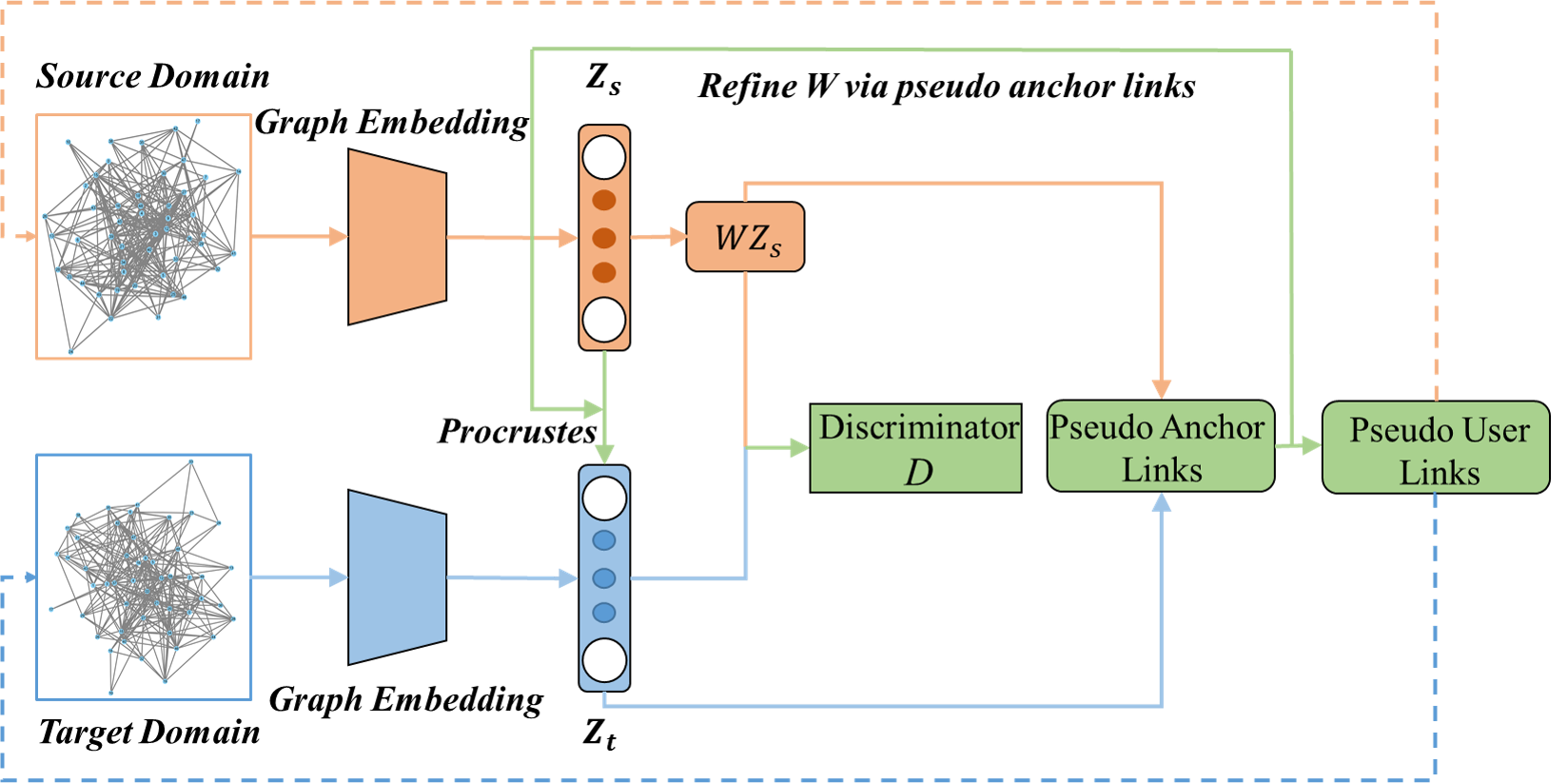
Figure 1: The architectures of the proposed UAGA and iUAGA models. Z_s and Z_t denote the source and target embeddings, respectively. In UAGA, the mapping W is refined by Procrustes with pseudo anchor links. In iUAGA, we utilize the derived pseudo anchor links to generate pseudo user links, in order to extend the source and target graphs (the dash lines). And then we iteratively use the extended source and target graphs to improve both the graph embedding and the mapping quality.
Incremental UAGA
Introduction of iUAGA
The paper extends UAGA to incremental UAGA (iUAGA), which iteratively uses revealed unobserved user links based on pseudo anchor links to enhance embedding quality and alignment performance. The approach incrementally constructs pseudo user links, facilitating graph extension and improved alignment over successive iterations. Each iteration incorporates newly discovered structural information, boosting both embedding spaces and the corresponding mapping's accuracy. This iterative extension captures additional graph attributes, leading to richer feature representations.
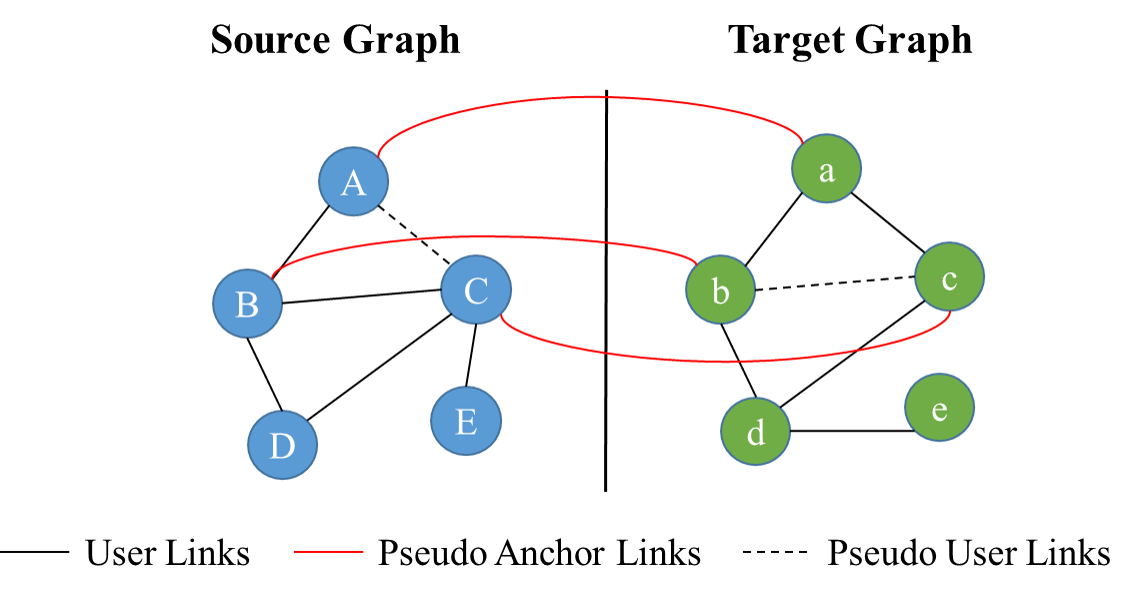
Figure 2: The illustration of graph extension by constructing pseudo user links (black dash) with pseudo anchor links (red solid). For simplicity, we utilize the synthetic data for illustration. The user pair (b,c) is not linked in the target graph, but the counterpart user pair (B,C) is linked in the source graph. In addition, we have the pseudo anchor links (B,b) and (C,c). Thus, it is reasonable to add the pseudo user link (b,c) in the target graph. Likewise the user link (A,C) can be added.
Experimental Evaluation
Performance Metrics
The UAGA and iUAGA models were evaluated on real-world datasets such as Last.fm and Flickr. The experiments demonstrated their superior performance over traditional unsupervised centrality-based methods and competitive results comparable to supervised approaches. Key evaluation metrics included Precision@N, indicating the model's accuracy in identifying correct node correspondences in the top N predictions.
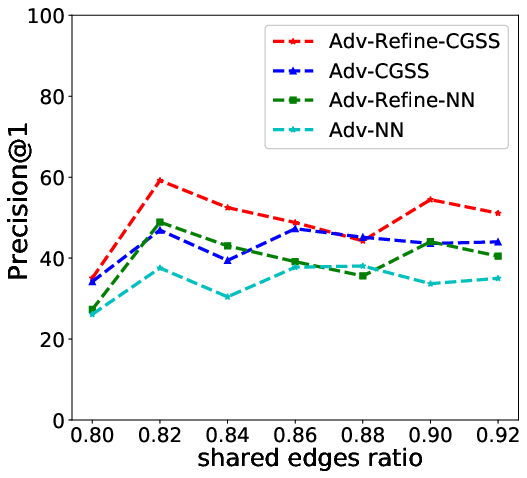
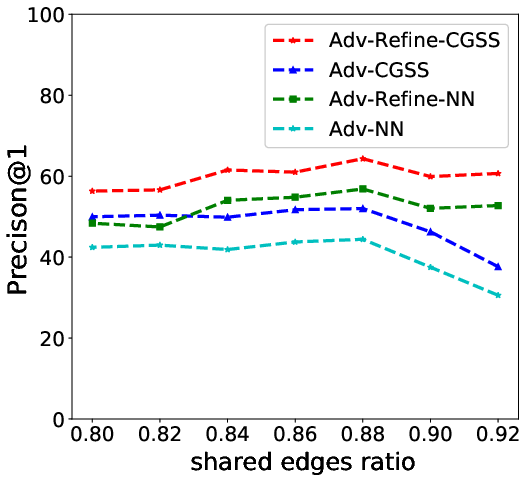
Figure 3: The Precision@1 result for (a) Last.fm-Last.fm graphs, (b) Flickr-Flickr graphs, and lambda_e ranges from 0.8 to 0.92.
Visualization of Embedding Alignment
t-SNE visualization for source and target graph embeddings before and after applying UAGA showcased significant domain-invariance post-alignment, demonstrating effective embedding space convergence.

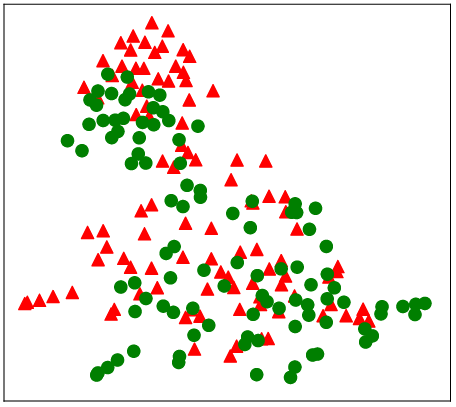
Figure 4: The t-SNE visualization of the source and target graph embedding learned by DeepWalk (before alignment) and UAGA (after alignment), respectively.
Conclusion
The proposed UAGA framework, particularly its extension to iUAGA, effectively addresses unsupervised graph alignment challenges. By leveraging adversarial training and iterative pseudo link construction, the methods achieve efficient alignment without relying on node attributes or anchor links. This holds promise for applications like cross-domain recommendations and link predictions within diverse, real-world network graphs, highlighting the model's contribution to the field. Future research could explore optimizing computational costs associated with iterative graph extensions and refining adversarial training dynamics further.